
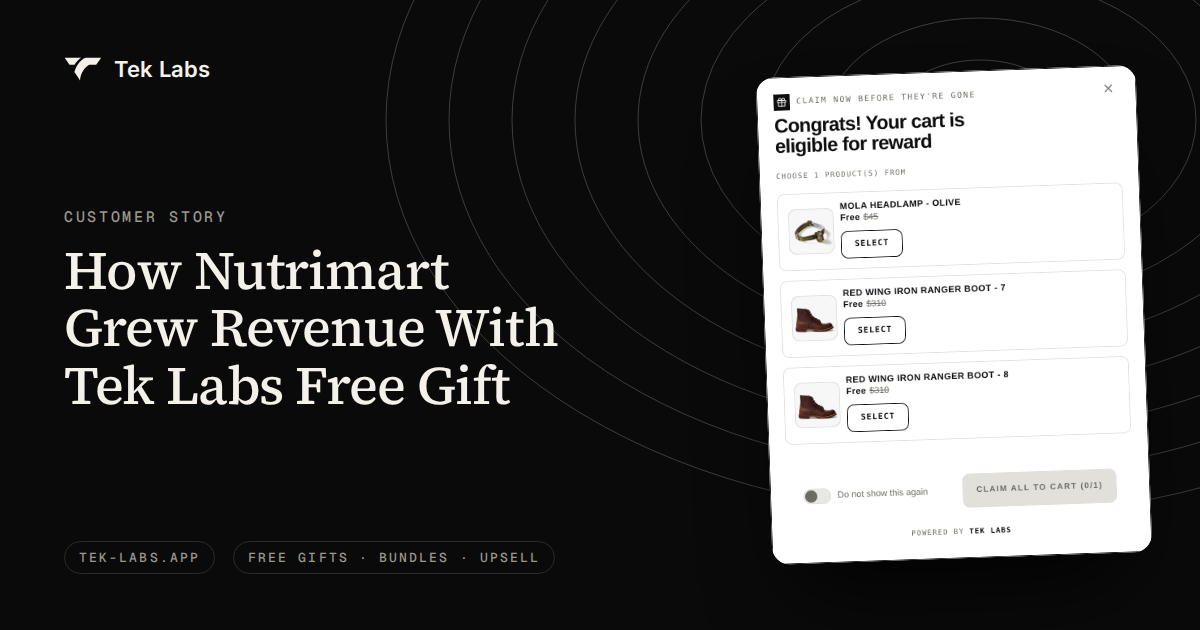
Nutrimart, a nutrition and wellness store on Shopify, added Tek Labs Free Gift so that shoppers were rewarded for buying instead of for waiting for a lower price. The gift was layered on top of the promotions the store already ran, and the original case study reports measurable revenue influenced by gifting.
This story has three parts. First, what the original Tek Labs case study reported in early 2026. Second, what Nutrimart’s public store shows today, because we looked again in October 2026 and the gift offer is still there, in a new form. Third, a practical plan for copying the approach on your own store, with the arithmetic that decides whether a gift offer makes or loses money. If you want to see more stories like this one, browse the Tek Labs customers page.
Everything below about Nutrimart comes from one of three places: the original Tek Labs case study, the screenshots published with it, or Nutrimart’s own public website. Where those sources are vague, this article stays vague. We have no interview, no customer quote and no private data, so none appear here. The rest is verified context on health shoppers and Shopify discounts, plus the steps to copy.
Key takeaways
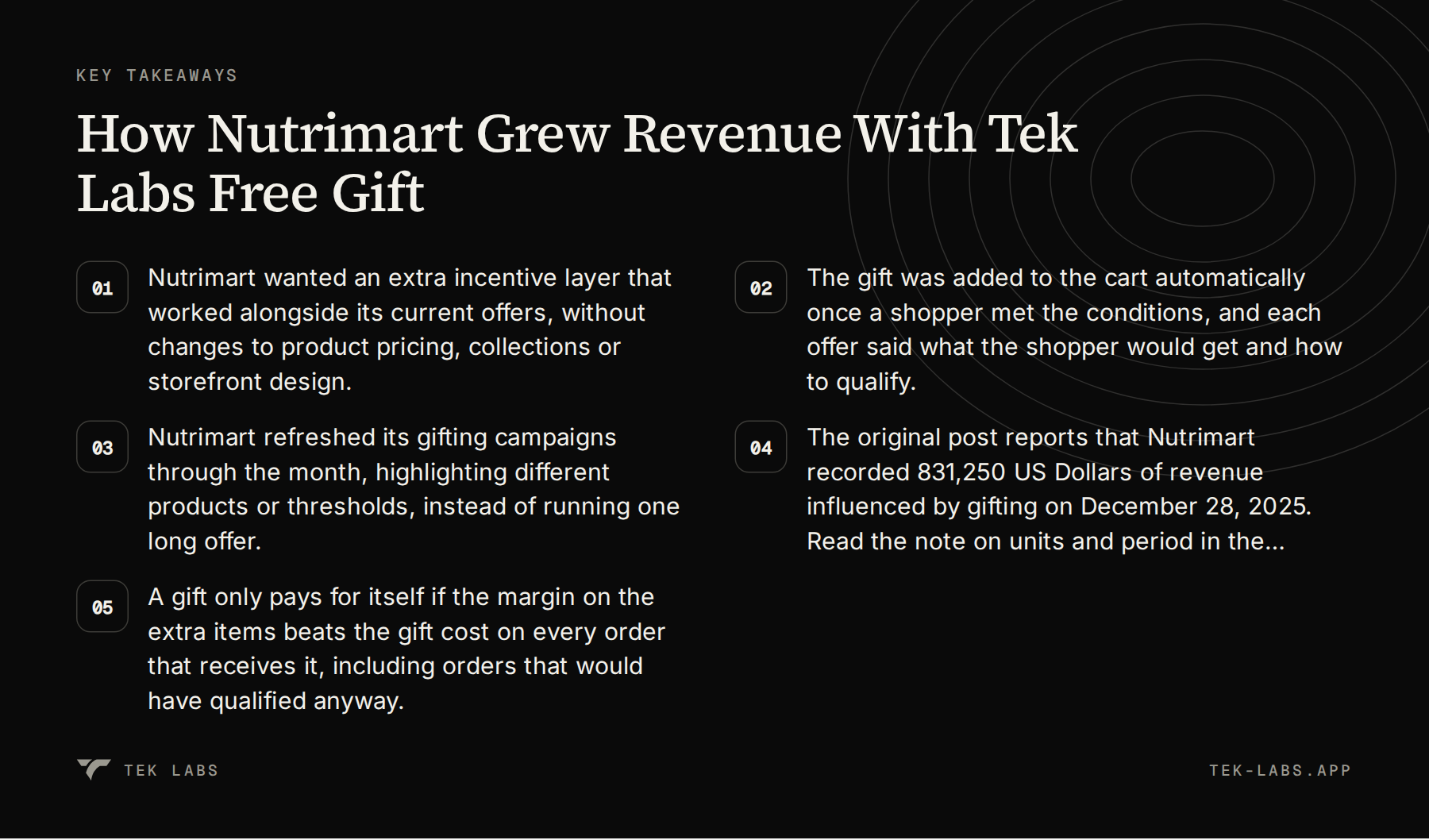
- Nutrimart wanted an extra incentive layer that worked alongside its current offers, without changes to product pricing, collections or storefront design.
- The gift was added to the cart automatically once a shopper met the conditions, and each offer said what the shopper would get and how to qualify.
- Nutrimart refreshed its gifting campaigns through the month, highlighting different products or thresholds, instead of running one long offer.
- The original post reports that Nutrimart recorded 831,250 US Dollars of revenue influenced by gifting on December 28, 2025. Read the note on units and period in the results section before quoting it.
- On October 4, 2026, the store still showed gift-led promotion: a product page widget with a Rp 700,000 spend condition and a homepage banner offering a free gift of the shopper’s choice.
- A gift only pays for itself if the margin on the extra items beats the gift cost on every order that receives it, including orders that would have qualified anyway.
At a glance
| Item | Detail |
|---|---|
| Store | Nutrimart (nutrimart.co.id), a Shopify store |
| Country | Indonesia. The storefront is in Indonesian and priced in rupiah (Rp) |
| Category | Nutrition, wellness and healthy grocery products |
| Brands sold | The store describes itself as the official store of L-Men, Tropicana Slim, HiLo, NutriSari and Lokalate |
| Tek Labs app used | Tek Labs Free Gifts BOGO and Upsell, Free Gift offers |
| Offer types seen | Spend-threshold gift with automatic add to cart (original case study and October 2026 product page); gift of the shopper’s choice with a minimum purchase on selected milk products (October 2026 homepage banner) |
| Original results snapshot | December 28, 2025, as published in the original case study |
| Latest public pages observed | October 4, 2026 |
The store and its shoppers
According to the original case study, Nutrimart is a nutrition and wellness brand on Shopify that specializes in health-focused products designed for everyday use. Its store attracts a mix of first-time visitors and returning customers looking for trusted wellness solutions.
Nutrimart’s public store at nutrimart.co.id describes itself as the official store of L-Men, Tropicana Slim, HiLo, NutriSari and Lokalate. The storefront is written in Indonesian and prices are shown in rupiah. When we opened it on October 1, 2026, the menu grouped products into categories that included sweeteners, milk, yogurt and whey protein, and collagen drinks. The homepage also highlighted W’Dank among its featured brands.
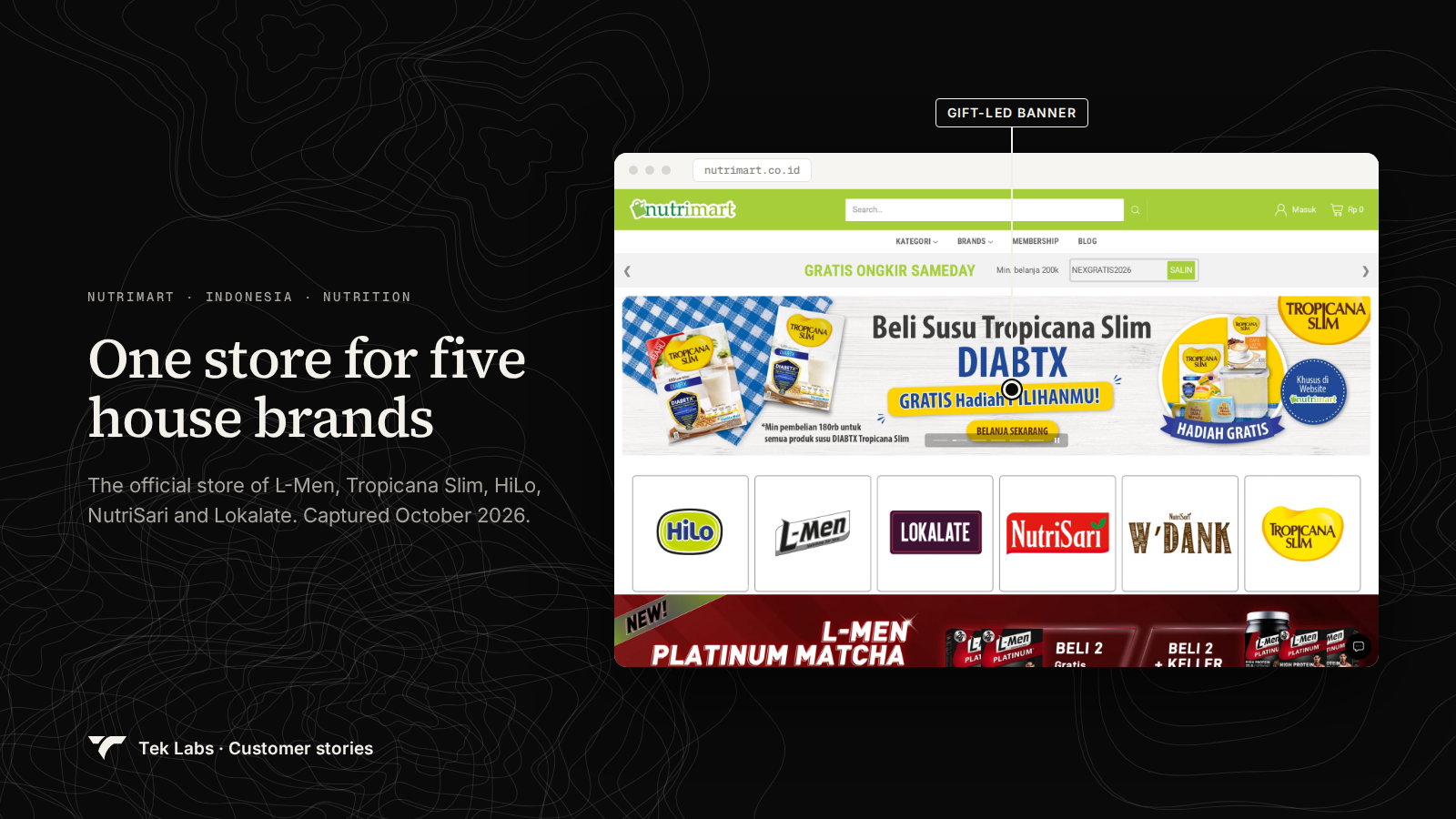
The homepage banner is worth a close read. It promises “GRATIS Hadiah PILIHANMU”, which means a free gift of your choice, and the fine print says “*Min pembelian 180rb untuk semua produk susu DIABTX Tropicana Slim”, a minimum purchase of 180rb (Rp 180,000) across all DIABTX milk products from Tropicana Slim. Another line reads “Khusus di Website nutrimart”, meaning the offer is exclusive to the Nutrimart website. In other words, a gift is now a headline message on the first screen of the store, not only a widget deep in a product page.
The original post describes the starting point simply. Traffic was increasing, but Nutrimart recognized that higher engagement alone was not enough. The brand needed a way to convert interest into completed purchases while encouraging customers to explore more products per order.
A useful way to read Nutrimart’s story is as three layers that were added in sequence. The first layer is price: the markdowns on the product grid and the coupons on the homepage, which the store already ran. The second layer is shipping: free same-day delivery above a minimum spend, which nudges cart value in the same range as the gift thresholds. The third layer is the gift, which is the only one of the three that rewards a specific purchase decision instead of lowering a price or a delivery cost. Seeing the layers separately helps you decide where a gift belongs in your own offer stack and which existing offer it should sit beside.
It also helps to be clear about what a case study like this can and cannot show. It can show the shape of a working setup, the wording of a widget, and the way a gift appears in a cart. It cannot show that a gift beat a discount on profit, because the original post publishes no test and no costs. We keep that boundary visible throughout so you can borrow the structure without borrowing a claim the evidence does not support.
What health and nutrition shoppers weigh
Nutrimart sells into a market where online retail is large and growing. The Google, Temasek and Bain e-Conomy SEA 2025 report, summarized in Google’s Indonesian announcement, projects Indonesian e-commerce to grow more than 14% to US$71 billion in 2025. That is a projection for the whole sector, not for Nutrimart, but it explains why a store in this space competes on more than catalog.
Health shoppers are also cautious. In its 2025 survey of Indonesian consumers, NIQ found that consumers cite difficulty accessing healthy alternatives (48%), high costs (43%) and doubts about the effectiveness of products and services (43%) as major barriers to living healthier lifestyles. The same release reports that 69% rank access to detailed product information as a top influence on wellness-related purchases, behind medical specialist recommendations at 77%.
Two practical readings follow, and both are our assessment rather than NIQ’s conclusion. Cost matters to this audience, which is why discounts are tempting. Clear information matters too, which is why a gift offer that is explained plainly has a better chance than one that shoppers have to decode.
The challenge: discount fatigue and hidden products
Promotion fatigue from discounts
The original case study says discount-based campaigns delivered short bursts of sales but gradually lost effectiveness, and that repeated price reductions raised concerns about long-term brand perception. It gives no numbers for that decline, so we do not either.
The concern is consistent with published research. A review in the Small Business Institute Journal (Gardner, 2022) quotes earlier work saying that repeated monetary promotions are especially susceptible to less favorable brand attitudes by lowering consumers’ reference price, and that non-monetary promotions may actually strengthen brand equity. It is a literature review, so treat it as direction, not proof for any single store.
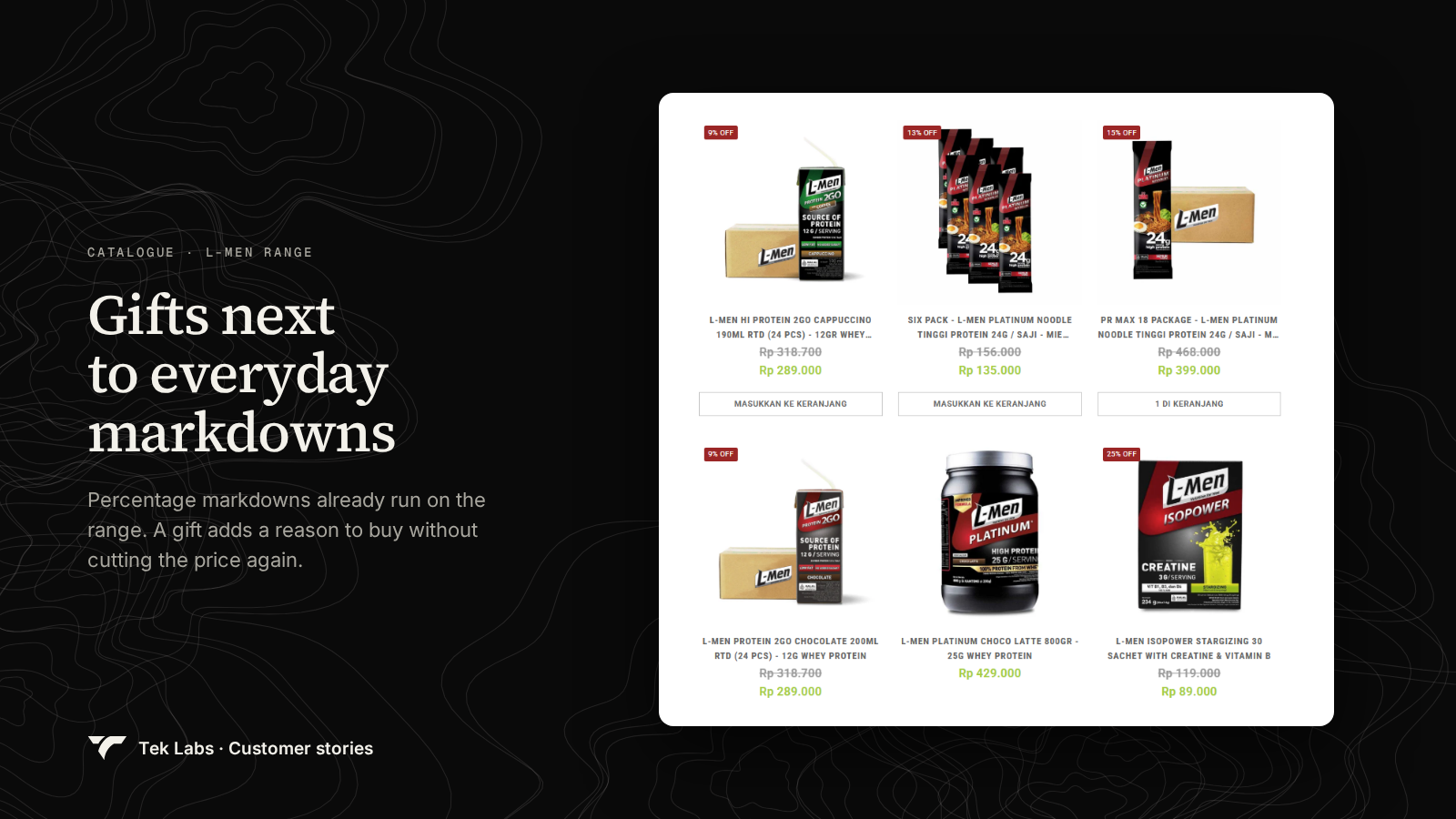
The product grid shows what a price-led catalog looks like: badges with markdowns of 9%, 13%, 15% and 25% off, with the original price struck through. A shopper who sees this on every product learns that the price is negotiable by waiting, which is the habit the original post wanted to avoid feeding.
Giving selected products more attention
The second problem was visibility. Nutrimart wanted to give more attention to specific products already included in its offers. Those products fit the catalog, but they were not always the items customers focused on during their shopping journey. By adding an incentive through gifting, the brand aimed to gently guide customers toward those products and raise overall basket value.
Adding options without disturbing what already worked
Nutrimart was already running promotions that matched its pricing and catalog strategy. Rather than change what worked, it wanted an extra incentive layer that could sit next to current offers, with no changes to product pricing, collections or storefront design. Free gifting fit that brief because it adds value to an order while leaving the rest of the store as it is.
That last point is still visible today. When we opened Nutrimart’s homepage, it showed coupon offers: free same-day shipping with a minimum spend of Rp 200,000, a 10% discount on certain dates each month with the same minimum, and a Rp 15,000 discount for new customers with a minimum spend of Rp 100,000. We cannot say what ran during the campaign, but the store plainly continues to run price-based offers beside gift offers.
The approach: reward the purchase, not the wait
The original post frames the shift in one line: reward customers for purchasing, not for waiting for a lower price. Instead of another discount campaign, Nutrimart adopted Tek Labs Free Gift to offer value-driven incentives.
There is academic support for the idea that a gift frame and a discount frame are perceived differently. In a 2025 online experiment with 342 participants published in Behavioral Sciences, Li and Han compared a free gift frame with a price discount frame for product bundles that did not naturally belong together. The free gift frame attenuated the drop in purchase intention that appeared under the discount frame. That is one experiment about bundles, not a rule for every store, and it does not measure margin.
In practice, the approach has three working parts. A condition the shopper can meet by choosing to buy more or to buy a featured product. A gift that has real perceived value and a known cost to the store. And messaging that states the rule before the shopper has to ask. The next section walks through how those parts met the shopper on Nutrimart’s store.
How the setup works on the store: the shopper’s path
The sequence below combines the published screenshots with the public pages. It describes what a shopper can see, not the app’s internal configuration, which the original post does not publish.
- The shopper lands on a page that mentions a gift. On the homepage today, a banner leads with a free gift of the shopper’s choice tied to a minimum purchase on selected milk products.
- The shopper opens a product page. A widget above the add to cart button states the spend needed to earn rewards, for example “Spend at least Rp 500,000 to get rewards” in the original case study.
- The shopper adds products to the cart. Nothing special is required from the shopper beyond reaching the stated condition.
- The gift appears in the cart. Once the conditions are met, the gift is added as its own cart line, its price reduced to Rp 0 by a labeled promotion, so the shopper sees the value of the gift and that it costs nothing.
- The shopper checks out. Because the gift was added automatically, there is no code to enter and no extra product to find, which is the friction the original post says Nutrimart wanted to remove.
The original case study describes four design choices behind that path. We list them in order and add what the published screenshots show.
Popups tied to shopper behavior
Rather than showing popups immediately, Nutrimart configured Free Gift to activate based on shopper behavior, so the offer appeared when customers were already engaged and felt relevant and timely. The post does not say which behavior triggered the popup, and we will not guess.
Automatic gift addition
Once customers met the purchase conditions, the free gift was added to their cart automatically. The original post says this removed friction and confusion and kept checkout smooth. Shopify’s own Buy X get Y discount works differently: its help center states that the free or discounted “get” item is never automatically added to the cart, so shoppers must add it themselves.
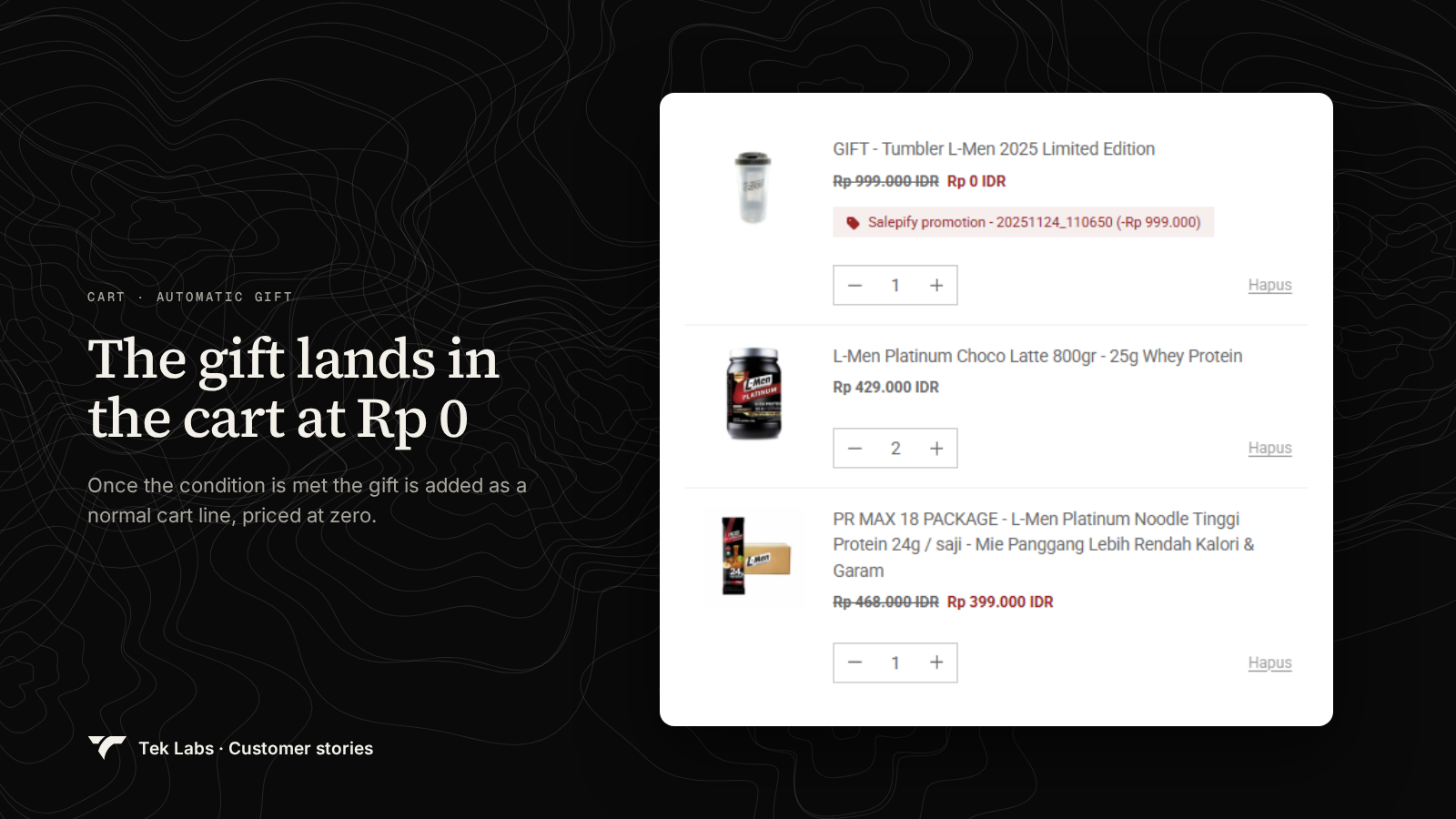
In the screenshot, the gift line is a tumbler whose original price of Rp 999.000 is reduced to Rp 0 by a line labeled as a Salepify promotion, shown beside two paid products. The gift appears as a normal cart line with the discount stated, which keeps the value visible to the shopper. Salepify is the app’s internal name, which is why it appears in the label.
Clear and transparent messaging
Each offer clearly explained what the customer would receive and how to qualify. The original post says this clarity reduced hesitation and increased trust in the offer. The product page screenshot shows the widget in practice.
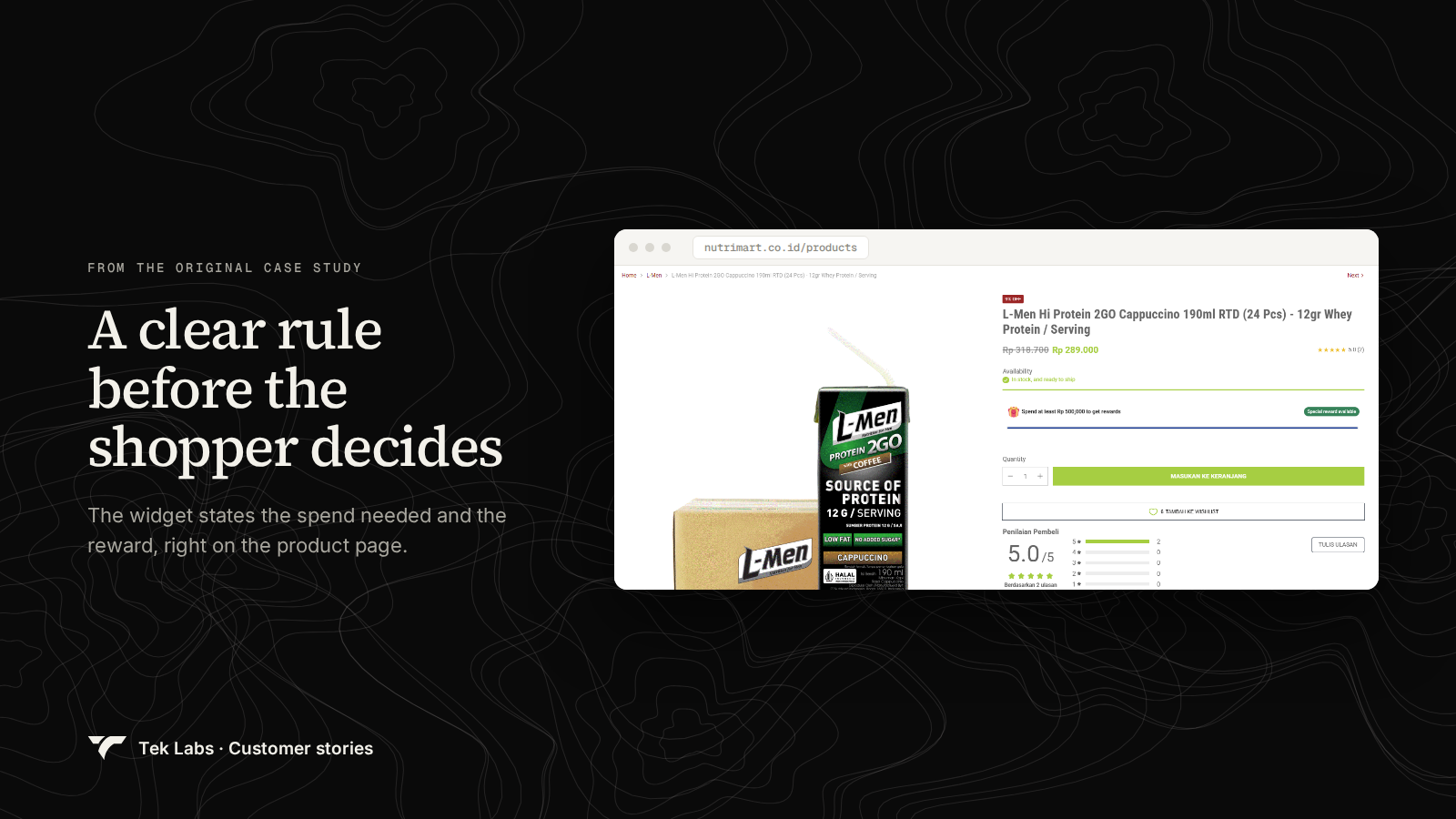
The widget on that product page reads “Spend at least Rp 500,000 to get rewards” and carries a “Special reward available” tag. The qualifying rule sits where the shopper decides, before the add to cart button.
Campaigns that change through the month
One of Nutrimart’s priorities was avoiding static promotions that customers quickly learn to ignore. Instead of one long-term offer, the brand used Free Gift to launch new gifting campaigns throughout the month. Each campaign highlighted different products or thresholds, giving customers a reason to return and see what was new. By refreshing offers regularly, the original post says, Nutrimart kept excitement up without overwhelming shoppers.
What the original case study reported
The original post says the impact of gifting showed up in performance data and gives one dated snapshot. On December 28, 2025, Nutrimart recorded a total sales value of 2,906,998 and total revenue influenced by gifting of 831,250 US Dollars.
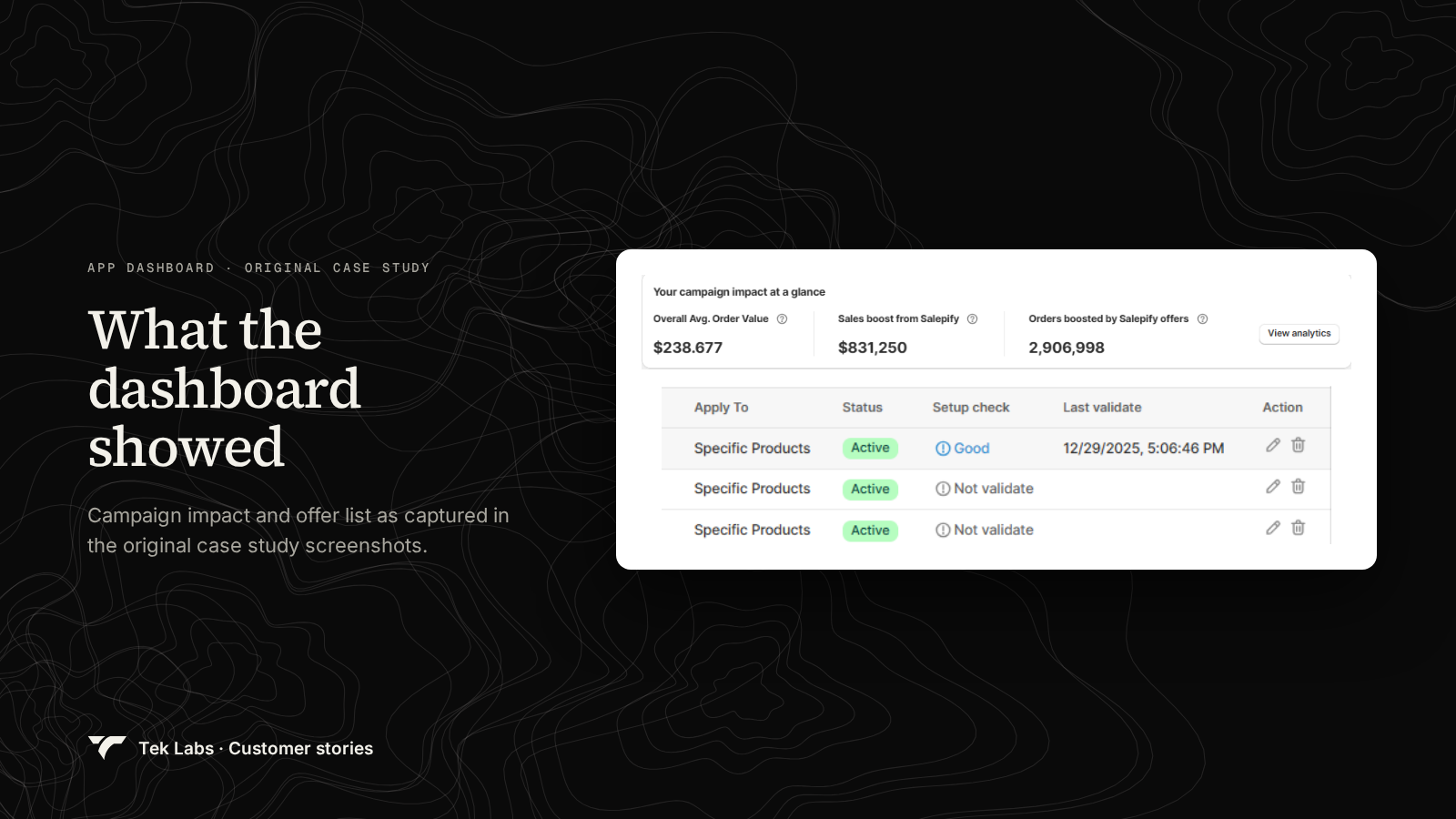
The dashboard panel is titled “Your campaign impact at a glance”. It shows three figures exactly as displayed: Overall Avg. Order Value $238.677, Sales boost from Salepify $831,250, and Orders boosted by Salepify offers 2,906,998. Below it, the offer list shows Free Gift offers applied to specific products, each with a “Setup check” value of “Good” or “Not validate”. The “Setup check” column is the result of the app’s Validate offer button, which, per the Tek Labs user guide, checks the widget block, auto-add behavior, offer visibility and popup position before you go live.
| Figure | Value as published | Where it appears |
|---|---|---|
| Date of the snapshot | December 28, 2025 | Post text |
| Total sales value (post wording) | 2,906,998 | Post text. The dashboard tile labels the same number “Orders boosted by Salepify offers”. |
| Revenue influenced by gifting (post wording) | 831,250 US Dollars | Post text. The tile reads “Sales boost from Salepify $831,250”. |
| Overall Avg. Order Value | $238.677 | Dashboard tile only |
A note on reading these figures. The post text and the dashboard tile label the 2,906,998 figure differently, and neither states a currency for it. The storefront itself is priced in rupiah, while the dashboard shows a dollar sign. We publish the numbers exactly as they appeared and do not convert, round or extend them.
The post gives no before-and-after comparison, no conversion rate, no change in average order value and no gift cost. That means no lift percentage can be calculated from it, and we do not claim one. The post also does not say whether the figures cover that single date or a longer period. What it does establish is that the dashboard attributed a measurable amount of revenue to gifting, which is the claim the original makes.
What the store runs today
We looked at Nutrimart’s public pages again on October 4, 2026, about nine months after the original snapshot. We saw only what any visitor sees: no admin data, no sales figures, and no way to tell how the offers perform. What we can report is the shape of the offers.
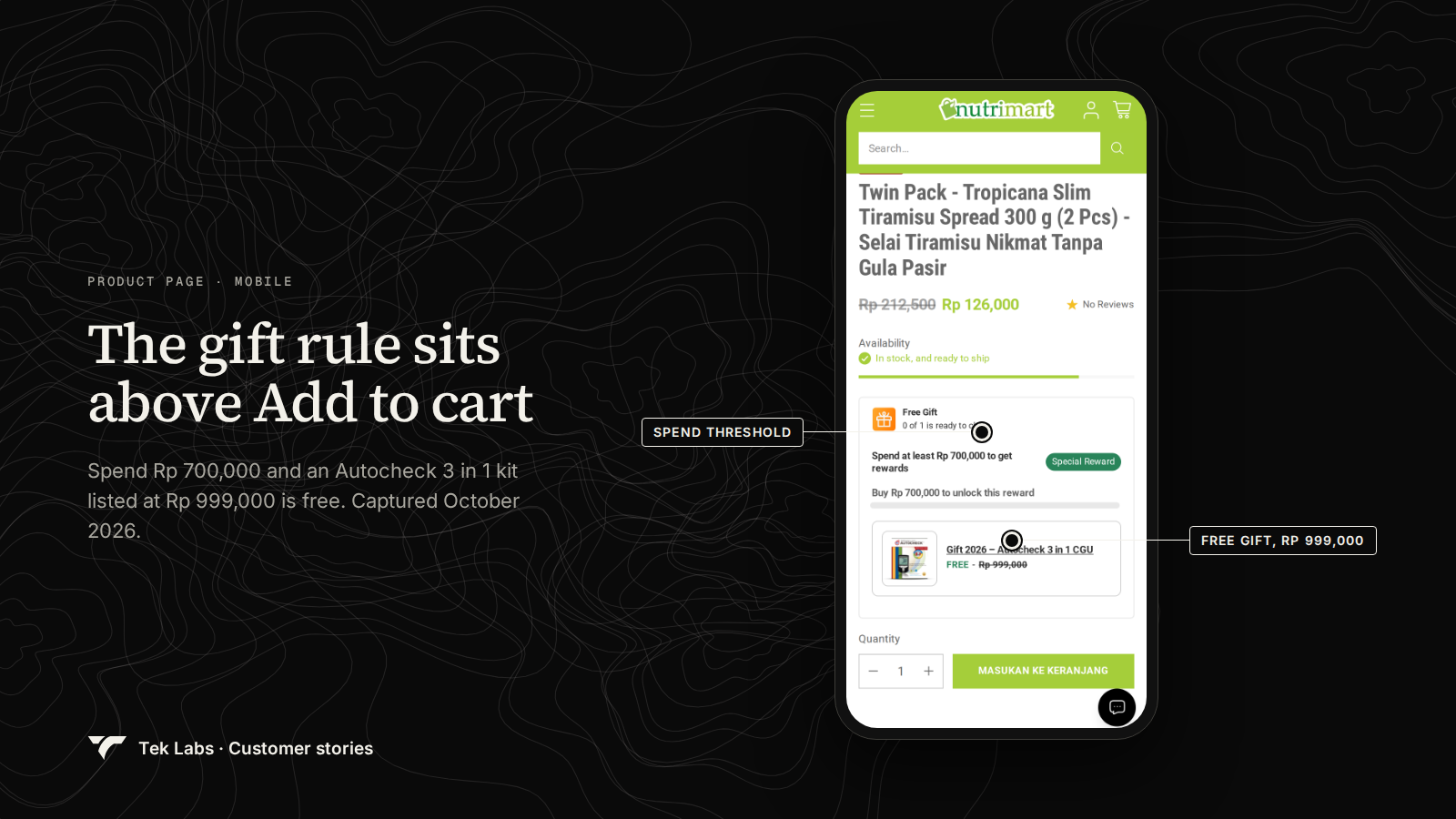
The product page widget now reads “Spend at least Rp 700,000 to get rewards”. The gift is “Gift 2026 – Autocheck 3 in 1 CGU”, listed at Rp 999,000 and shown as FREE. The widget sits above the add to cart button, labeled “MASUKAN KE KERANJANG”. It is the same placement as in the original case study, with a different threshold and a different gift.
| Element | Original case study | Observed October 4, 2026 |
|---|---|---|
| Product page widget text | Spend at least Rp 500,000 to get rewards | Spend at least Rp 700,000 to get rewards |
| Gift shown | A limited edition tumbler, listed Rp 999.000 in the cart, reduced to Rp 0 | Gift 2026 – Autocheck 3 in 1 CGU, listed Rp 999,000, shown FREE |
| Widget position | Above the add to cart button | Above the add to cart button |
| Homepage gift message | Not shown in the case study | Tropicana Slim DIABTX banner: free gift of the shopper’s choice, minimum purchase 180rb on DIABTX milk |
| Other offers | Percentage markdowns on products | Free same-day shipping from Rp 200,000 (code NEXGRATIS2026), 10% discount on certain dates, Rp 15,000 for new customers |
Three observations, each labeled as our reading of public pages and not as something Nutrimart told us. First, the gift offer has not disappeared: it is still on the product page. Second, the threshold and the gift are different, which fits the “refresh the campaign” approach the original post describes, although we cannot say why Nutrimart changed them. Third, gifts now appear in two places, a threshold widget on product pages and a headline banner for a specific product line, so the store is using more than one gift mechanic at once.
The top bar also advertises “GRATIS ONGKIR SAMEDAY Min. belanja 200k” with the code NEXGRATIS2026, free same-day shipping from Rp 200,000. Shipping thresholds and gift thresholds sit in the same range of cart values, so a store running both needs to decide which one it wants to lead with. That is an observation about the layout of offers, not about how shoppers respond.
Why the strategy works
The original post credits four principles. The table pairs each one with how to apply it on your own store.
| Principle from the post | What it looked like at Nutrimart | How to apply it |
|---|---|---|
| Value felt earned, not forced | The gift was tied to purchase conditions, not handed out for waiting | Set a spend or quantity condition, and say it plainly |
| Incentives appeared at the right moment | Popups activated on shopper behavior, not immediately | Show the offer after the shopper has shown intent, such as on a product or cart page |
| Customers understood the offer instantly | Each offer stated what the customer gets and how to qualify | Put the rule in one sentence next to the add to cart button |
| The experience stayed frictionless | The gift was added to the cart automatically | Choose auto-add unless you want customers to pick |
The original post also lists four learnings for e-commerce brands: gifting can replace discounts without hurting performance, dynamic campaigns encourage repeat visits, targeted incentives outperform blanket promotions, and customer experience matters as much as the offer itself. Those are the post’s own conclusions from one store, and the post presents no comparison test behind them. Test them on your own numbers before you treat them as rules.
The research cited earlier gives a second layer of support. The Gardner review points to non-monetary promotions as less likely to erode a brand’s reference price, and the Li and Han experiment found that a gift frame softened the drop in purchase intention seen under a discount frame for mismatched bundles. Neither study is about Nutrimart, and neither measures profit. They explain why gifting is worth testing, not why it will win on your store.
One more reason is structural. A percentage discount lowers the price of what the shopper was already going to buy. A threshold gift asks the shopper to add something to reach the threshold, so the store gets more items per order in exchange for the gift cost. Whether that trade is good depends entirely on margin, which is why the worked example below matters more than any headline number.
How to copy this setup, step by step
The steps below follow the Free Gift settings documented in the Tek Labs user guide. They are a general method, not a description of Nutrimart’s exact configuration, which the original post does not publish. For the feature overview, see the free gift with purchase feature page.
- Pull a baseline. Record average order value, orders per month, gross margin on your main products, and how many orders already clear the threshold you are considering.
- Choose what to spotlight. Nutrimart wanted attention on selected products already in its offers. Pick the products or collections you want customers to notice, and decide which gift fits them.
- Set the condition. The guide offers cart value and cart quantity conditions, applied to specific products, collections, variants, tags or all products.
- Set the reward. Choose whether gifts are added automatically or chosen by the customer, and whether the gift is free, a percentage off or a fixed amount off. Set limits per order and in total if stock is limited.
- Pick the widgets. The guide describes a notification banner, a popup and an embedded widget. Write the qualifying rule so a shopper understands it at a glance, and place it before the add to cart button.
- Check discount combinations. Decide whether the gift may combine with product, order and shipping discounts, then test a cart that uses your real codes.
- Validate, then schedule. Run Validate offer, test on desktop and mobile with a real cart, then set the start date and, if you plan to rotate offers, an end date.
- Rotate and review. Change the featured products or the threshold on a regular schedule, and compare each campaign to your baseline.
Before you launch your own version, write down the answers to four questions on one page. Which products do you want shoppers to notice, and why those. What gift will you offer, and what does it cost you landed. What spend or quantity condition will you set, and what share of your orders already clears it. And how will you know after two weeks whether the offer earned its cost. If you cannot answer the last question before launch, you are not ready to launch, because you will have no way to tell a good result from a bad one afterward.
Two smaller points from Nutrimart’s pages are easy to copy. First, name the gift on the page. The October 2026 widget names the gift product and shows its listed price beside the word FREE, which makes the value concrete. Second, check the language of every message a shopper will read. Nutrimart’s homepage banner is in Indonesian for Indonesian shoppers, while the widget text we captured is in English, so confirm that each message matches the language your store speaks, and edit it if it does not.
Default Shopify discounts versus a gift app
You can run a gift promotion with Shopify’s built-in Buy X get Y discount, and for some stores that is enough. The table compares the two on the points that mattered in Nutrimart’s story. For a longer comparison, see our post on Shopify default Buy X Get Y versus third-party providers.
| Point | Shopify Buy X get Y | Tek Labs Free Gift |
|---|---|---|
| Gift added to the cart | Never automatic, the shopper adds it (Shopify help center) | Automatic or customer-chosen (App Store listing and user guide) |
| Where shoppers see the offer | Discount code entered at checkout, or applied automatically for an automatic discount (Shopify help center) | Notification, popup and embedded widgets on product and cart pages (user guide) |
| Stacking with other discounts | On plans other than Plus, Buy X get Y products are ineligible for further product discounts (Shopify help center) | Combination toggles for product, order and shipping discounts (user guide) |
Whichever route you take, Shopify’s limits apply to the whole store. The discount combinations page states a maximum of 25 active automatic discounts, including app-based discounts, and a maximum of 5 product or order discount codes plus 1 shipping discount code on the same order. Count your active offers before you add another. A store like Nutrimart, which runs shipping codes, date-based percentage coupons, new-customer coupons and gift offers together, is exactly the kind of store that needs to count.
A hypothetical worked example: do the gift math first
This example is hypothetical and does not use Nutrimart’s numbers. It shows why the baseline step matters. A store has 1,000 orders a month, a $40 average order value, a 50% gross margin and a gift with a landed cost of $4. The question is where to set the spend threshold.
| Line | Threshold $50 | Threshold $60 |
|---|---|---|
| Orders already at or above the threshold | 200 | 80 |
| Orders that stretch up to the threshold because of the offer | 150 (from $40, +$10 each) | 120 (from $40, +$20 each) |
| Gift cost, all orders that receive a gift | (200 + 150) x $4 = $1,400 | (80 + 120) x $4 = $800 |
| Added gross margin from stretched orders | 150 x $10 x 50% = $750 | 120 x $20 x 50% = $1,200 |
| Net effect | $750 – $1,400 = -$650 | $1,200 – $800 = +$400 |
At $50, the offer loses money because 200 orders were already large enough and now receive a gift they did not need. At $60, fewer orders qualify for free and the stretch is bigger, so the same gift pays. The figures ignore conversion changes, repeat purchases and shipping, all of which move the result. The point is the method: count gift cost on every order that receives a gift, and count only the margin on the extra spend you actually caused.
To find a starting threshold for your own average order value, use the free gift threshold calculator. If you need a refresher on terms such as AOV and BOGO, see the glossary.
What to measure
The original post reports sales and revenue influenced by gifting. For your store, add the numbers that let you judge profit as well as volume.
| Metric | Why it matters | Where to find it |
|---|---|---|
| Average order value, before and after | Shows whether shoppers are stretching to qualify | Shopify analytics, compared over equal periods |
| Share of orders that include the gift | Shows reach, and how many orders would have qualified anyway | Offer analytics in the app and your order list |
| Gift cost per order | Needed to judge profit, not just revenue | Your own landed cost for the gift |
| Orders by offer name | Separates campaigns when you rotate them | The Sales by discount codes report in Shopify groups sales by discount name |
| Repeat visits during a campaign | Tests the claim that refreshed offers bring people back | Shopify analytics sessions and returning customer rate |
| Offer setup check | Catches a widget or auto-add setting that is not working before shoppers see it | The Setup check column in the offer list, after running Validate offer |
Pick one campaign length, such as two weeks, and compare it with an equal period without the offer. Rotating several variables at once makes it hard to tell which one worked, so change the product, the threshold or the message, not all three. If you run a shipping threshold and a gift threshold together, as Nutrimart’s pages suggest it does, label them as separate offers so the discount report can tell them apart.
Common mistakes
- Setting the threshold below your typical order. Most orders qualify without changing behavior, and you pay for the gift anyway, as the worked example shows.
- Leaving the offer running forever. Nutrimart’s own priority was avoiding static promotions that customers learn to ignore.
- Hiding the rule. If shoppers cannot tell what they get and how to qualify, the offer adds hesitation instead of removing it.
- Skipping the setup check. Validate the offer and test a real cart on mobile before it goes live. The offer list in the original screenshot shows that setup status is visible per offer, so use it.
- Ignoring discount stacking. Test the gift with the codes and automatic discounts you already run, and keep inside Shopify’s limits.
- Quoting a headline number without its definition. “Revenue influenced” is not profit and not a lift. State what it counts.
Where Nutrimart’s approach fits your store
Gifting suits stores that already have healthy traffic and a catalog with a few products they want to feature. It is a weaker fit if your margins are thin enough that a gift on every qualifying order cannot be covered, or if you only have one or two products. If your goal is to clear slow stock, a gift of a slow-moving item can help, and our guide on how to liquidate excess inventory covers the wider options.
Multi-tier rewards are a natural next step once a single offer works. A progress bar can show a gift at one spend level and a larger reward at the next. Nutrimart’s own pages hint at the same direction, since a threshold widget on product pages and a product-line gift banner on the homepage already give shoppers two different reasons to add to the cart.
Final thoughts
Nutrimart’s story is a modest one, and that is its value. It added a gift layer meant to work beside its existing offers, kept the rules clear, added the gift automatically and refreshed the campaigns through the month. The original post reports revenue influenced by gifting as of a given date, and the store’s public pages in October 2026 still show gift-led promotion with a new threshold and a new gift. Your job is to measure the same thing on your own store with margin included.
If you want to try the same approach, you can see the offer types and install the app from the Tek Labs Free Gifts BOGO and Upsell page. The app has a free plan. More stories from stores using Tek Labs apps are on the customers page.
Frequently Asked Questions
Which app did Nutrimart use for its free gift offers?
Nutrimart used Tek Labs Free Gift on its Shopify store. The dashboard in the original case study labels its figures with the app’s internal name, Salepify.
Did Nutrimart stop running discounts?
The original post does not say so. It describes gifting as an extra layer next to existing offers, and Nutrimart’s homepage still showed coupon offers when we checked in October 2026.
Does Nutrimart still run a free gift offer?
On October 4, 2026, a product page showed a widget reading “Spend at least Rp 700,000 to get rewards” with the gift “Gift 2026 – Autocheck 3 in 1 CGU” shown as free, and the homepage carried a banner for a free gift of the shopper’s choice on Tropicana Slim DIABTX milk. We cannot see how these offers perform.
Is a free gift better than a discount?
It depends on your margins and audience. Research such as the 2025 Behavioral Sciences experiment finds the two frames are perceived differently, but only your own test shows which one earns more profit.
Should the gift be added automatically or chosen by the customer?
Tek Labs Free Gift supports both. Nutrimart’s gift in the original case study was added automatically once the conditions were met, which the post says kept checkout smooth. Choose customer selection when the gift list is varied and the choice itself adds appeal. Nutrimart’s current homepage banner promises a gift “of your choice”, which suggests a choice-based offer on that product line, though we cannot see the configuration.
How much should a free gift cost me?
There is no universal figure. Work backward from your margin on the extra spend you expect to cause, and remember the gift also goes to orders that would have qualified anyway. The worked example above shows the arithmetic.
Can a free gift offer work with other Shopify discounts?
Often yes, if the combinations are allowed. Shopify applies discounts only when each one permits the combination, and its limits still apply, so test a real cart with your own codes before you launch.
Can I quote the revenue figure from the case study?
Only with its context. The 831,250 figure is “revenue influenced by gifting” on December 28, 2025, shown on a dashboard with a dollar sign while the store sells in rupiah. It is not profit, not a lift percentage, and the post does not state whether it covers one day or a longer period.