The best way to liquidate excess inventory without destroying margin is to match each tactic to the reason the stock is not selling, start with the lightest discount that works, and compare every offer against what it costs you to keep holding the stock. In the examples below, bundles and free gifts protect margin better than a straight markdown because they move slow units attached to something that sells; flash sales and deep markdowns are the fallback once carrying costs outweigh the discount.
This is a full rewrite of our earlier BFCM guide. We dropped the claims we could not re-verify, replaced them with sources we opened this month, and added what the old version lacked: a carrying cost calculation, margin arithmetic for each tactic, Shopify’s own rules for stacking offers, and IRS notes on donating or writing down stock. Black Friday is November 27, 2026 and Cyber Monday is November 30, so you have time to plan if you start now.
Key takeaways
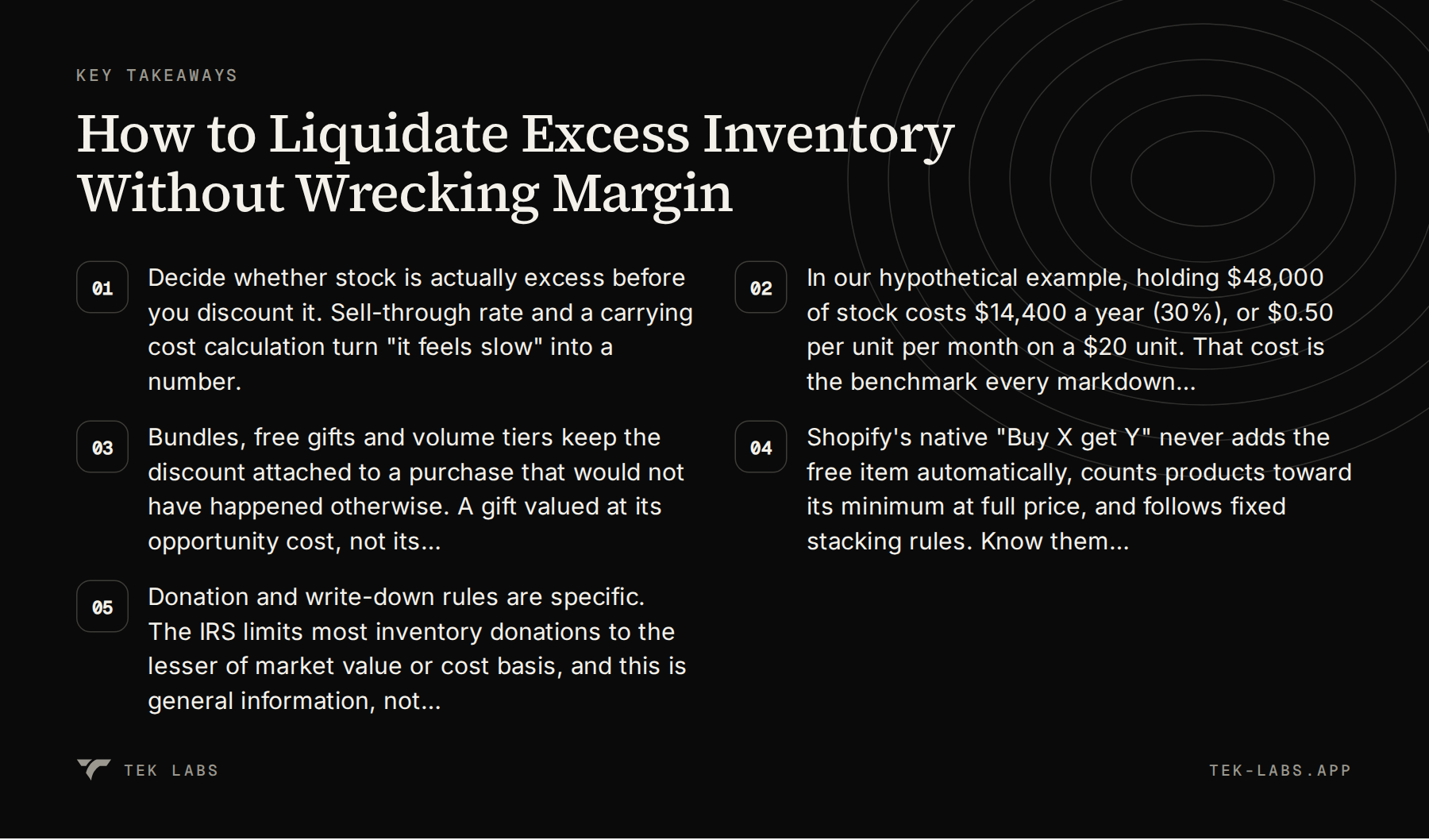
- Decide whether stock is actually excess before you discount it. Sell-through rate and a carrying cost calculation turn “it feels slow” into a number.
- In our hypothetical example, holding $48,000 of stock costs $14,400 a year (30%), or $0.50 per unit per month on a $20 unit. That cost is the benchmark every markdown should beat.
- Bundles, free gifts and volume tiers keep the discount attached to a purchase that would not have happened otherwise. A gift valued at its opportunity cost, not its retail price, can be close to free for you.
- Shopify’s native “Buy X get Y” never adds the free item automatically, counts products toward its minimum at full price, and follows fixed stacking rules. Know them before you stack offers.
- Donation and write-down rules are specific. The IRS limits most inventory donations to the lesser of market value or cost basis, and this is general information, not tax advice.
Is it really excess? Measure before you discount
Overstock is a global problem. IHL Group’s 2023 study, hosted by Blue Yonder, projected that overstocks cost retailers $562 billion worldwide in 2023, alongside $1.2 trillion for out-of-stocks. That is a 2023 projection from a vendor-hosted report, so treat it as context, not a benchmark for a small Shopify store. For your store, two numbers matter.
Sell-through rate is the share of stock you sold in a period. Shopify’s formula is (total sales / stock on hand) x 100. If you received 200 units of a product in September and sold 50 by the end of October, the sell-through is 50 / 200 x 100 = 25%. Compare it across products and against your own goal; Shopify’s example uses 80% as a target for a monthly period, but the right number depends on how long your products stay relevant.
Days of stock on hand is how long the current stock lasts at the current sales pace. If you hold 600 units and sell 20 a month, that is 30 months of stock, long enough for seasonality, fashion or expiry to turn it into a write-off. A quick way to sort a catalog is to pull sell-through and months of stock for every SKU, then label each one:
| Label | Sign | Likely cause | Typical first move |
|---|---|---|---|
| — | — | — | — |
| Slow but healthy | Low sell-through, long shelf life, still relevant | Wrong audience, weak merchandising | Bundle or feature it, no markdown yet |
| Seasonal or dated | Demand tied to an event or trend that has passed | Timing | Time-limited markdown ladder |
| Perishable | Expiry or quality window | Overbuying | Early flash sale, donation if eligible |
| Dead | Low sell-through for 12 months or more | Product-market fit | Liquidate for cash, write down |
What holding stock really costs: a worked example
Shopify defines inventory carrying cost as the total expenses of holding unsold goods, including warehousing, insurance, labor, utilities, taxes, depreciation, spoilage, obsolescence and the opportunity cost of tied-up capital. The formula is the annual holding costs divided by the inventory value, multiplied by 100.
This is a hypothetical store with 2,400 units of slow-moving stock that cost $20 each, so the stock is worth $48,000 at cost. Annual holding costs (all assumed):
| Cost | Annual amount |
|---|---|
| — | — |
| Storage space (3PL or warehouse fees) | $4,800 |
| Handling and cycle counts | $1,200 |
| Insurance and taxes | $600 |
| Depreciation and obsolescence | $2,400 |
| Opportunity cost of the cash tied up | $4,800 |
| Spoilage, damage and shrinkage | $600 |
| Holding sum | $14,400 |
Carrying cost = $14,400 / $48,000 x 100 = 30% a year. Per unit that is $14,400 / 2,400 = $6.00 a year, or $0.50 a month.
Now use that number to make a decision. Suppose each unit sells for $50 and costs $20.
| Discount | Sale price | Gross profit per unit | Units needed to match the gross profit of 100 full-price sales |
|---|---|---|---|
| — | — | — | — |
| 0% | $50 | $30 | 100 |
| 20% | $40 | $20 | 150 |
| 30% | $35 | $15 | 200 |
| 40% | $30 | $10 | 300 |
| 50% | $25 | $5 | 600 |
| 60% | $20 | $0 | never |
Two lessons come from this table. First, discount depth is not linear in its effect: going from 20% to 50% off cuts your profit per unit by 75%, so you need four times the units to earn the same gross profit. Second, you can compare waiting with discounting. Selling now at 40% off earns $10 a unit. Waiting for a 20% sale that earns $20 a unit gains $10, but holding costs $0.50 per unit per month, so waiting only pays if the better sale happens within $10 / $0.50 = 20 months, and only if the unit does not go out of season, expire or get superseded in the meantime. For a durable item with steady demand, a patient markdown ladder can beat a fire sale. For a seasonal or perishable item, it usually cannot.
Shopify’s retail markdown guidance describes the same pattern: an initial markdown off the ticket price, followed by a secondary markdown if the product still misses its sell-through target. Its example is a parka marked down 15% in January, then a further 30% in March when 300 units remained. Treat every step as a test with a review date, not as a permanent price.
Tactic 1: Bundle slow movers with bestsellers
A bundle pairs a slow unit with something that already sells, so the discount buys you a sale of the slow item that would not otherwise happen. Shopify’s liquidation guide, citing a 2025 Salsify report, says 45% of shoppers buy bundles because the deal feels better than buying single items. We did not open the Salsify report, so take that figure as Shopify’s secondhand citation.
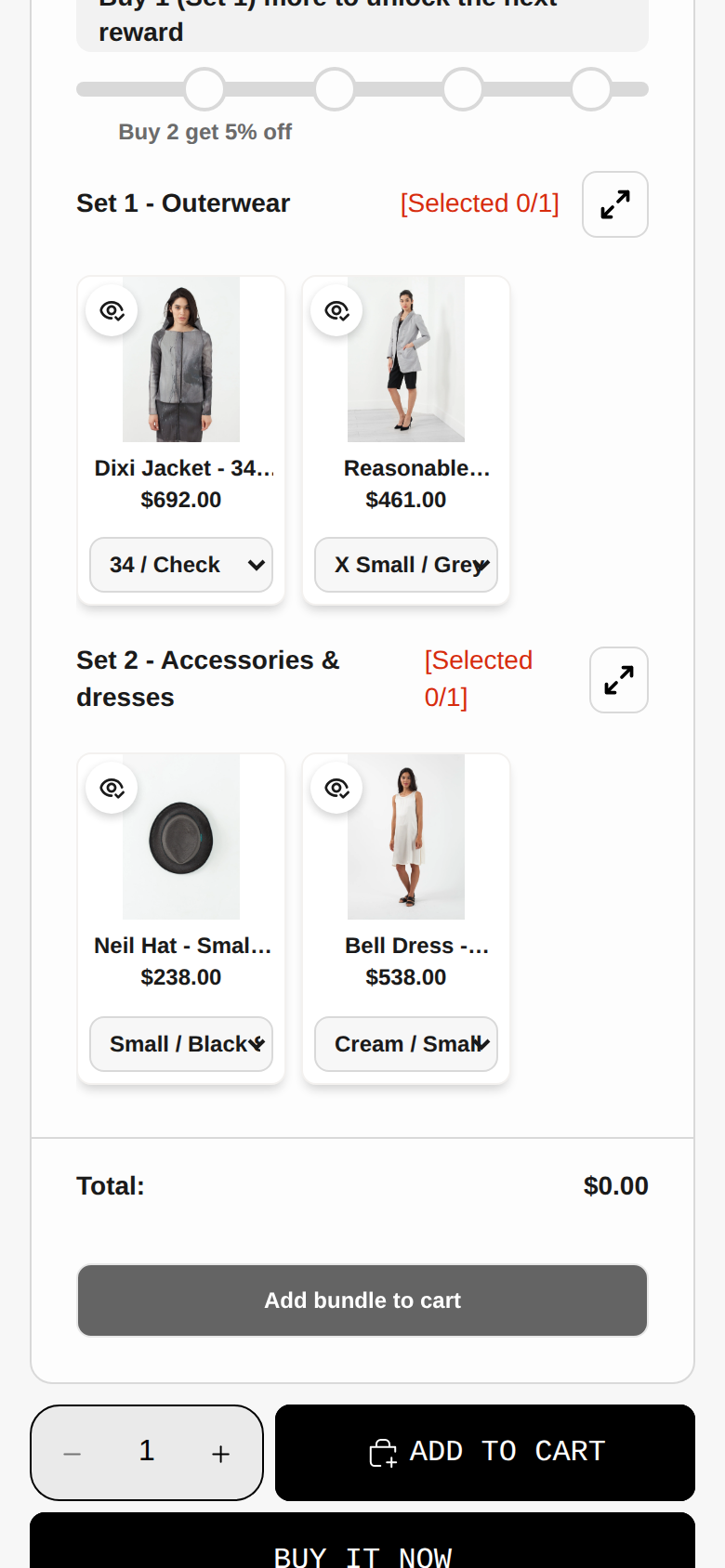
Worked example (hypothetical). A bestseller sells for $40 and costs $14. A slow mover sells for $30 and costs $10. You bundle them for $59 instead of the $70 list total, which is an 11 / 70 = 15.7% discount.
- Gross profit on the bundle: $59 minus $24 total cost = $35.
- Gross profit if the shopper had bought the bestseller alone: $40 minus $14 = $26.
- Incremental gross profit from the bundle, if the shopper was buying the bestseller anyway: $35 minus $26 = $9, and one slow unit cleared.
- Gross profit if you had discounted the slow mover alone by 50% to $15: $15 minus $10 = $5, and only if someone wanted it.
So in this example the bundle earns $9 per slow unit cleared, against $5 for a half-price standalone markdown. If shoppers would have bought the pair at full price, you gave away $11, so keep the bundles to pairs where the slow item adds something, and watch whether bestseller sales per order change.
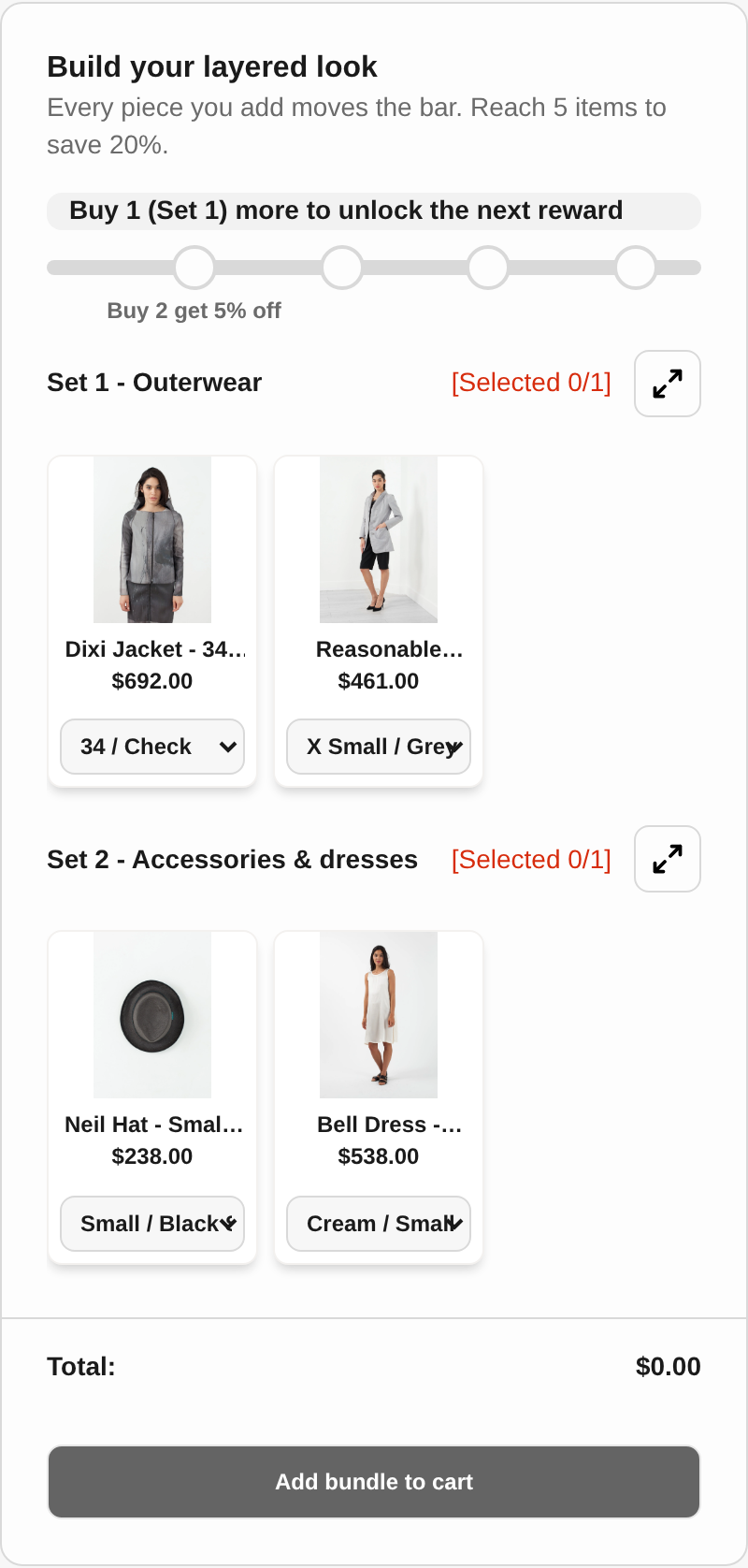
Where to use which bundle type: a fixed bundle for a clear pair, a mix-and-match offer when the slow movers share a collection (for example “any 3 accessories”), and a multipack for consumables. Mix & Match Bundles supports fixed bundles, mix-and-match, multipacks and build-a-box with fixed or tiered pricing, according to its App Store listing.
Tactic 2: Use overstock as a free gift with purchase
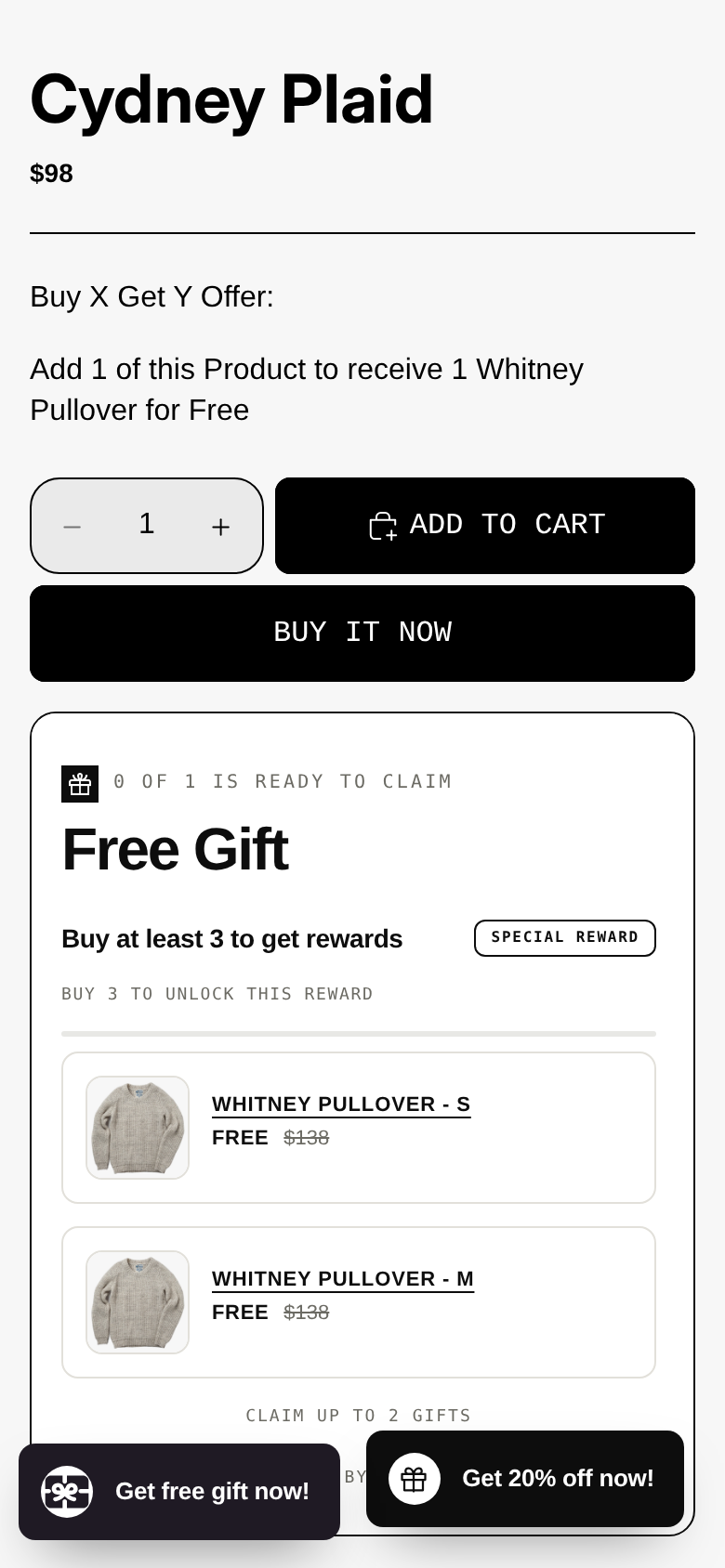
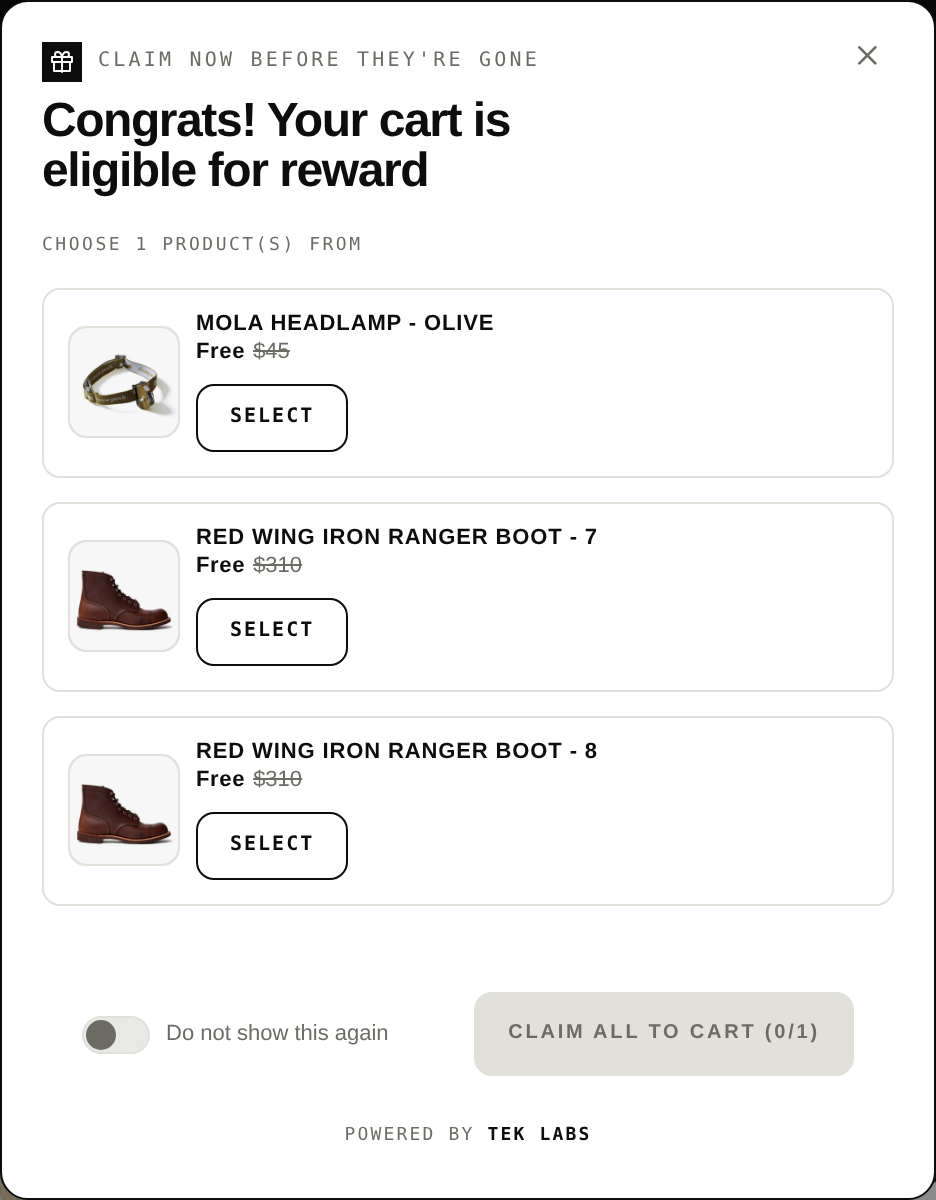
A free gift with purchase offers the slow item at no charge when the cart reaches a minimum, which lifts order value while moving the stock. It works best when the gift is a unit you would otherwise liquidate, not a product you could sell at full price.
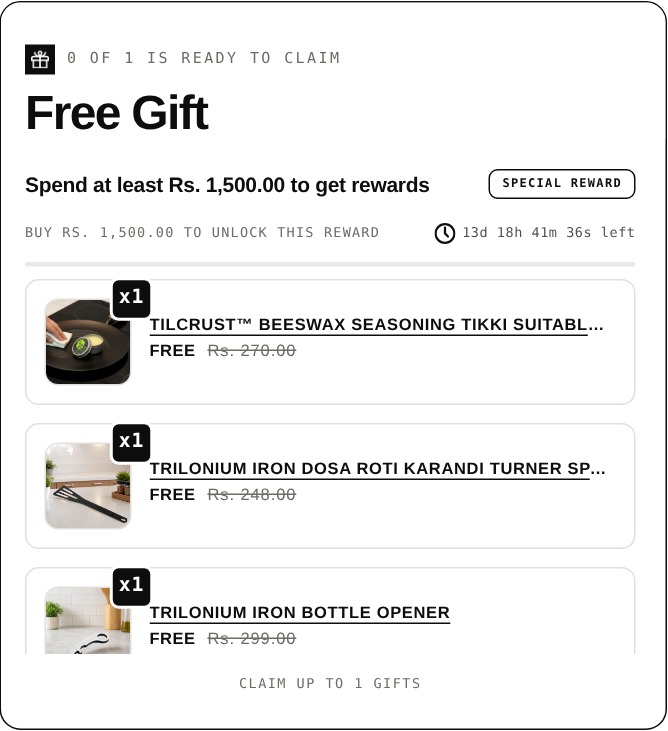
Shopify’s native Buy X get Y discount can create a version of this, but with a catch worth knowing: customers must add all items to the cart manually, and the free “get” item is never automatically added to the cart. If the shopper does not add the gift, the offer silently does nothing. Shopify also counts products toward the minimum at their full price, before any other discount, and excludes items already discounted by another combinable product discount. That detail matters if you are also running a sitewide sale.
Worked example (hypothetical). 1,000 orders a month, average order value $62, gross margin 45%. You offer a free gift at $75. The gift unit cost you $4 (it would list at $16). Assume 200 orders were already above $75 and 150 orders top up by an average of $13 to reach the gift.
- Added gross profit from top-ups: 150 x $13 x 0.45 = $877.50.
- At full cost: you give 350 gifts (200 + 150) at $4 = $1,400. Net: $877.50 minus $1,400 = minus $522.50.
- At opportunity cost: suppose a liquidator would pay $1.50 for the unit, and holding it another year would cost 30% of $4 = $1.20. Giving it away forgoes $1.50 but avoids $1.20, an effective cost of $0.30. 350 x $0.30 = $105. Net: $877.50 minus $105 = plus $772.50.
The two views are both honest. The first treats the gift as a cost of goods, the second treats it as a way to avoid a worse exit. The sensible way to use this is to get a real quote for your alternative (liquidator offer, marketplace price, donation) before you decide how much the gift “costs.” The trap in this example is the same one that catches free shipping thresholds: 200 shoppers got a gift they did not need to be persuaded to claim. Capping the number of uses limits the damage. Shopify lets you set a total-use limit and a maximum number of uses per order on a Buy X get Y discount, so a promotion tied to 300 spare units can stop at 300.
You can model your own gift threshold and cost with our free gift calculator. For a related margin walk-through on the shipping side, see our guide to free shipping strategy for the 2026 holiday season.
Tactic 3: BOGO and Buy X get Y
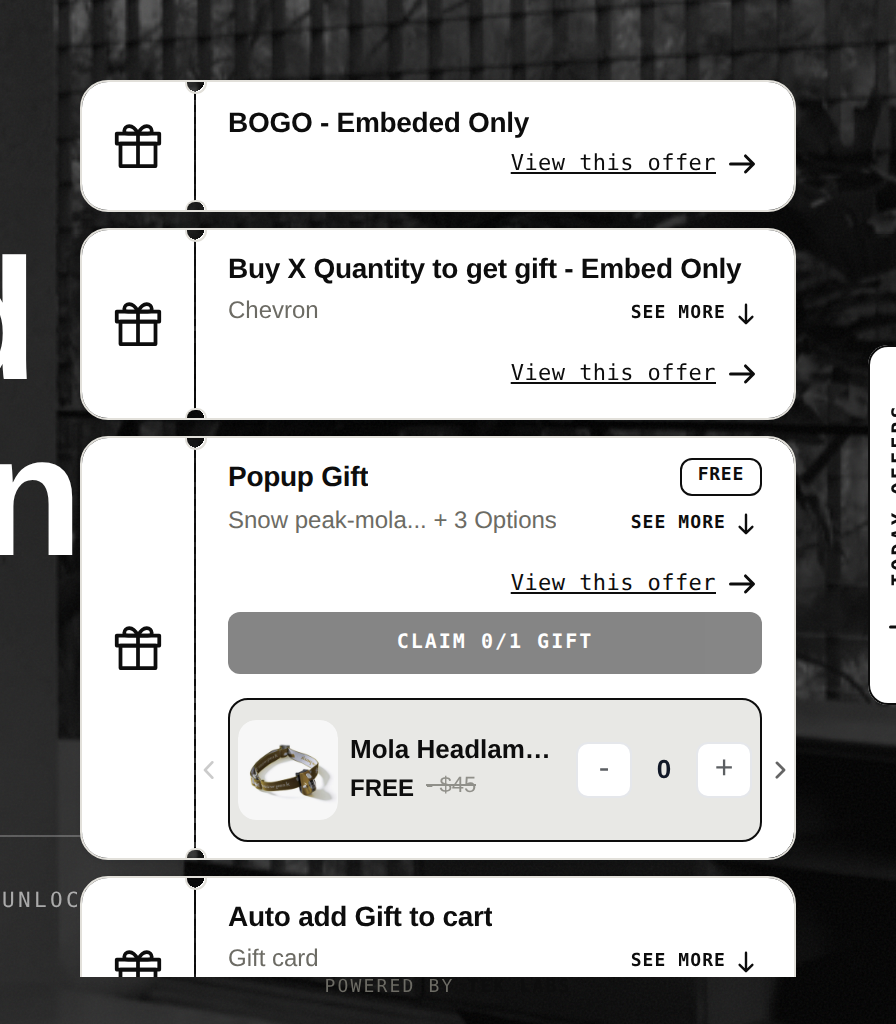
BOGO is the most understood offer and the most expensive per unit, because “free” is a 50% discount across the pair. A table makes the effective discount clear. Each unit sells for $30 and costs $10.
| Offer | Customer pays for the units | Effective discount | Gross profit |
|---|---|---|---|
| — | — | — | — |
| Two at full price | $60 | 0% | $60 minus $20 = $40 |
| Buy one, get the second 50% off | $45 | 25% | $45 minus $20 = $25 |
| Buy one, get one free | $30 | 50% | $30 minus $20 = $10 |
| Buy three, get one free (four units) | $90 | 25% | $90 minus $40 = $50 |
The pattern: BOGO free gives away half your revenue on the pair, while “buy three, get one free” gives away 25% and sells four units. When the goal is clearing units, a 25% effective discount on four units often beats a 50% discount on two. BOGO also suits stock where the second unit is the slow one: set the discount on the cheaper item so you protect the bestseller’s price.
Tactic 4: Volume discounts
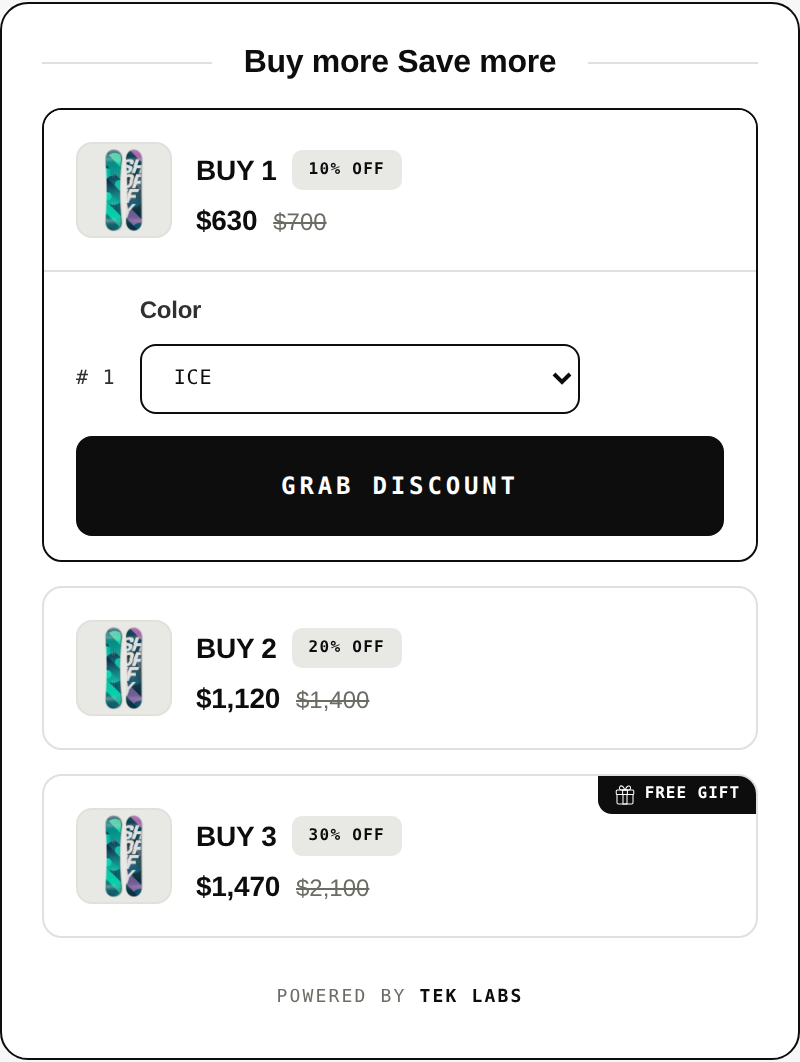
Volume tiers (“Buy 2 save 10%, buy 3 save 15%”) raise units per order, which is the real objective with slow, low-cost items that people buy in multiples: paper goods, consumables, accessories. The advantage over a flat markdown is that the customer who wants one unit pays full price.
Worked example (hypothetical). A $20 item costs $8. Tiers: 1 unit at $20, 2 units at 10% off ($36), 3 units at 15% off ($51).
- One unit: $20 minus $8 = $12 profit.
- Two units: $36 minus $16 = $20 profit ($10 each).
- Three units: $51 minus $24 = $27 profit ($9 each).
The shopper who moves from one unit to three increases profit by $15 and clears two extra slow units, while your per-unit margin falls from $12 to $9. A tier can also carry a free gift on the top step, so the third unit unlocks a surplus accessory.
Tactic 5: Flash sales and markdown ladders
Flash sales concentrate demand. Shopify’s liquidation guide, citing Salsify’s 2025 Q2 report, says 62% of consumers say flash sales and other limited-time discounts are a top driver for completing online purchases. As with the bundle figure, we did not open Salsify’s report, so use it as directional only.
How deep should a flash sale go? Adobe’s analysis of the 2025 holiday season gives a market reference. Its listed-price discounts peaked at 30.9% in electronics, 29.6% in toys and 25.1% in apparel. If your category average discount during Black Friday week is 25%, a 40% flash sale on a single clearance line is a deliberate choice that needs to clear stock, not a default.
Rules that protect margin:
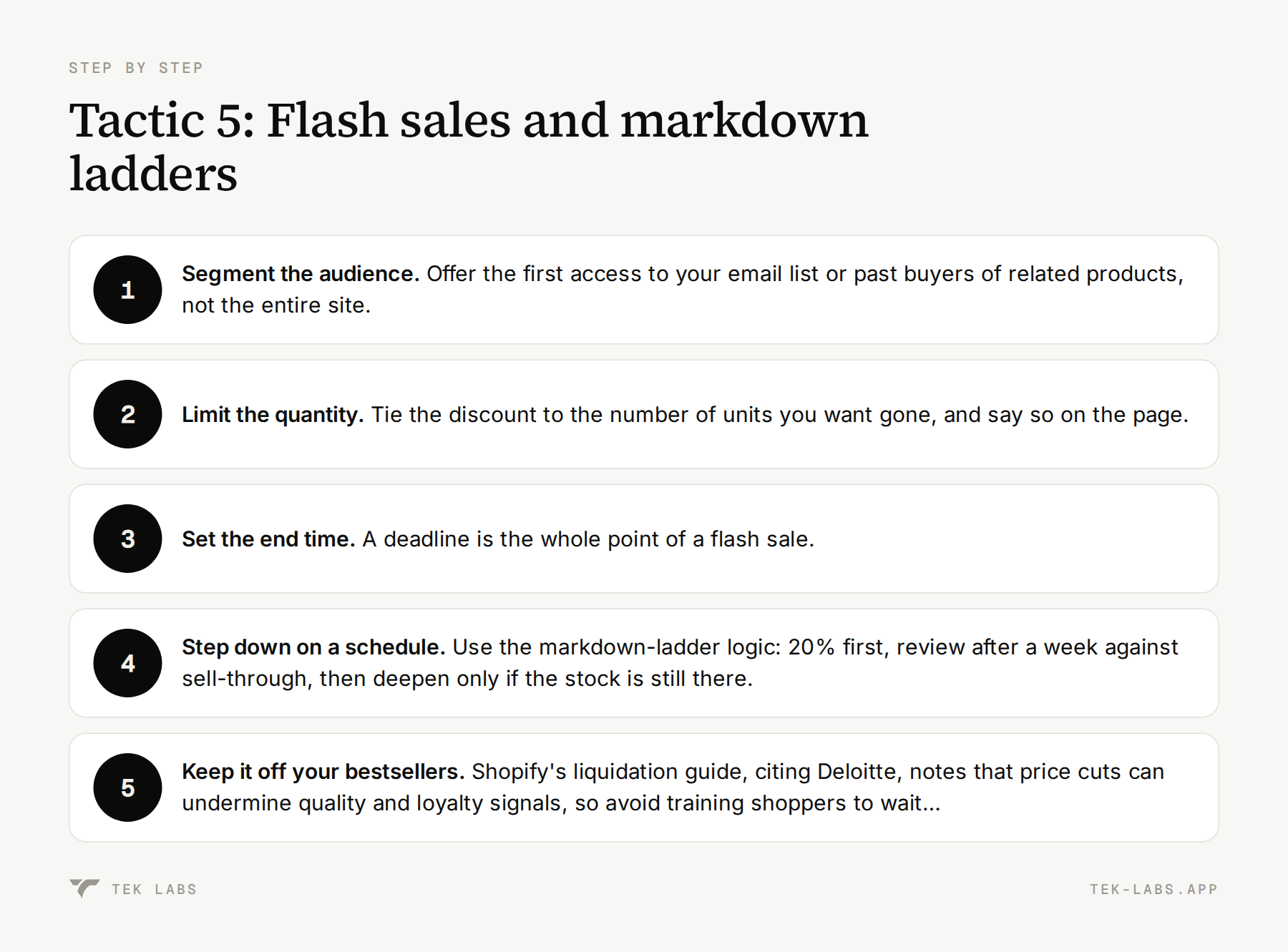
- Segment the audience. Offer the first access to your email list or past buyers of related products, not the entire site.
- Limit the quantity. Tie the discount to the number of units you want gone, and say so on the page.
- Set the end time. A deadline is the whole point of a flash sale.
- Step down on a schedule. Use the markdown-ladder logic: 20% first, review after a week against sell-through, then deepen only if the stock is still there.
- Keep it off your bestsellers. Shopify’s liquidation guide, citing Deloitte, notes that price cuts can undermine quality and loyalty signals, so avoid training shoppers to wait for discounts on your core line.
Tactic 6: An outlet section and other channels
When the discounts you can afford on your main store do not clear the stock, widen the audience. Shopify’s liquidation guide lists marketplaces and auctions, liquidation companies, wholesale and B2B buyers, and supplier returns. An outlet collection on your own store is the other option. Each has its own margin profile:
| Route | What you get | Watch out for |
|---|---|---|
| — | — | — |
| Outlet collection on your store | Full control over price and brand context | Needs promotion, can cannibalize the main collection |
| Online marketplaces and auctions (for example eBay) | New audiences that do not know your brand | Fees, price floors set by the market |
| Liquidation companies | One payment for the whole lot, fast cash | Price is negotiated, so get quotes and ask what resale channels they use |
| Wholesale and B2B buyers | Volume in one transaction | Contract terms and brand rules |
| Returning stock to suppliers | Can recover part of the cost | Depends on your supplier agreement |
Get at least two quotes for a lot you plan to sell outright, and compare the net figure with the carrying cost from the worked example. If a liquidator offers $1.50 a unit and your holding cost is $6 a unit a year, a year of waiting needs to bring in more than $1.50 plus $6 to be worth it.
Donating inventory: what the IRS says
This section is general information and not tax advice. Talk to a CPA or enrolled agent about your own situation, because the rules depend on your business structure and the recipient.
Donating excess stock keeps it out of a landfill and may bring a deduction, but the deduction is usually smaller than people expect. IRS Publication 526 says that if you contribute inventory and it was in your opening inventory for the year, the amount you can deduct is the smaller of its fair market value on the day you contribute it or its basis, and you must remove the deduction amount from opening inventory so it is not also part of cost of goods sold. The same publication says that if the cost of donated inventory is not included in your opening inventory, its basis is zero and you cannot claim a charitable deduction. The IRS tax guide for small business (Publication 334) repeats the rule for sole proprietors and similar businesses.
What this means in practice:
- A donation yields no revenue, so it competes with the liquidator quote, not with a full-price sale.
- Because the deduction is capped at basis for most inventory, donating an item you bought for $10 does not produce a $30 deduction just because it lists for $30.
- Food has its own rules. Publication 526 lists conditions for donations of apparently wholesome food, including that the food be used for the care of the ill, the needy or infants and that the organization give you a written statement.
- Publication 526 says it explains how individuals claim charitable deductions. Corporations follow different limits, so confirm with your adviser.
If you do not have a charity in mind, national programs exist. Good360 says it runs one of the largest corporate in-kind donation programs in the U.S., operating under no-resale agreements. Check the terms before you send a pallet.
Writing down stock you cannot sell
If stock is worth less than you paid, tax rules also address how it is valued on your books. IRS Publication 538 describes the lower of cost or market method: compare the market value of each item on hand on the inventory date with its cost and use the lower of the two, valuing each item separately. It also describes valuing goods you offer for sale at a price lower than market at that lower price minus the direct cost of disposition. The copy of Publication 538 we read is the January 2022 revision, and not every business uses this method (the IRS also describes an exception for small business taxpayers), so ask your accountant which applies to you before you change how you value inventory.
How Shopify stacks your offers
When you run bundles, gifts and a sale at the same time, the order in which Shopify applies discounts changes your margin. Shopify’s help center says that product discounts apply first to individual items, order discounts apply to the revised subtotal, and shipping discounts apply last. It also sets limits: a maximum of 25 active automatic discounts, including app-based discounts, and a maximum of 5 product or order discount codes and 1 shipping discount code on the same order.
Stacking example (hypothetical). A $50 slow-moving item that cost $20 is in a Black Friday collection with an automatic 20% discount, and a code gives a further 10% off the order. If both combine, the item sells at $50 x 0.80 x 0.90 = $36, a gross profit of $16 and an effective discount of 28%. If you meant your floor to be $40, you have just breached it. Before launch, add the clearance SKUs to a test cart with every code and automatic discount you plan to run, and check the final price against your floor.
A clearance plan for BFCM 2026
- This week: audit. Calculate sell-through and months of stock for every SKU, and label each slow, seasonal, perishable or dead.
- Next week: cost the options. Work out your carrying cost, get two liquidator quotes for the dead lines, and set a floor price per SKU.
- Mid-October: choose the tactic per label. Bundle the slow-but-healthy items, use free gifts for the cheapest overstock, use volume tiers for consumables, and schedule a flash sale for the seasonal lines.
- Early November: build and test. Create the offers, set usage limits, and test carts with every combination.
- Black Friday (November 27) to Cyber Monday (November 30): watch daily. Track units cleared, margin per order and bestseller sales, and pause any offer that dips below your floor.
- December: step down or exit. Move leftovers to the second markdown or to a liquidator before holiday carrying costs and January returns pile up.
- January: review and write down. Compare cleared stock with plan, talk to your accountant about write-downs and donations, and fix the buying pattern that created the excess.
For the rest of your promotion calendar, see promotion strategies for BFCM.
Common mistakes
- Discounting before measuring. A markdown on healthy slow stock throws margin away when a bundle or better placement could have worked.
- Valuing a gift at retail. A $4 gift that lists at $16 is not a $16 giveaway, and treating it that way makes good offers look bad. The opposite mistake is ignoring its cost completely.
- Giving the offer to people who would have bought anyway. Gifts and thresholds subsidize existing high spenders, so cap uses and test.
- Stacking by accident. Combination settings can push an item far below your floor.
- Training customers to wait. Run clearance on defined lines, not on your bestsellers.
- Treating a donation like a sale. The deduction is generally limited to basis, not retail value.
- Waiting too long on seasonal stock. Carrying cost is not the only cost: value falls once the season ends.
- Skipping the post-mortem. Overstock is a buying problem first, so use sell-through data to adjust next quarter’s orders.
Where our apps fit
If your plan relies on gifts, BOGO or volume tiers, Free Gifts BOGO & Upsell covers free gift with purchase, BOGO, Buy X Get Y, volume discounts and fixed bundles. Its App Store listing says gifts can be added to the cart automatically or chosen by the customer, which addresses the manual “get” item limitation of Shopify’s native discount, and it has a free plan. A multi-tier progress bar lets you put a surplus gift on a higher milestone. You can try the offers on the live demo store linked from the listing before you configure your own.
Frequently Asked Questions
What is the best way to liquidate excess inventory without losing margin?
Start with bundles, free gifts or volume tiers, which attach the slow item to a purchase you would have made anyway, and keep straight markdowns and flash sales for the stock that remains. Compare each option with your carrying cost so you know when a deeper discount is cheaper than waiting.
How do I calculate the carrying cost of inventory?
Add up what holding the stock costs in a year (storage, handling, insurance, taxes, depreciation, spoilage and the opportunity cost of the cash), divide by the value of the stock, and multiply by 100. In our hypothetical example, $14,400 on $48,000 of stock is a 30% annual carrying cost.
How deep should a clearance discount go?
Go only as deep as you need and review weekly. A 20% to 30% step with a review date usually preserves more margin than starting at 50%, and Adobe’s 2025 holiday data shows discounts peaking around 25% in apparel and about 30% in electronics, which gives you a market reference.
Can I deduct donated inventory on my taxes?
In many cases you can, but the IRS generally limits the deduction to the smaller of fair market value or your cost basis, and you must adjust opening inventory so you do not deduct the cost twice. This is not tax advice, so confirm the rules for your business with a CPA.
Does Shopify add a free gift to the cart automatically?
Not with the native Buy X get Y discount: Shopify’s help center says customers must add all items to the cart manually and the free item is never added automatically. Apps can automate that step, and Free Gifts BOGO & Upsell lists automatic gift add as a feature.