The best free shipping strategy for the 2026 holiday season is a threshold set modestly above your current average order value (AOV), shown in the cart with a progress bar, and priced from your real shipping cost and gross margin instead of a round number. Free shipping is never actually free, so run the math before Black Friday (November 27, 2026) and Cyber Monday (November 30, 2026), not after.
This is a full rewrite of our 2024 guide. We removed every statistic we could not re-verify, replaced the 2023 sales figures with 2025 results, and added the parts store owners keep asking us about: how to calculate the threshold, how Shopify applies shipping rates and discounts, and which carrier dates matter this year. Where a figure comes from a hypothetical store, we say so and show the arithmetic.
Key takeaways
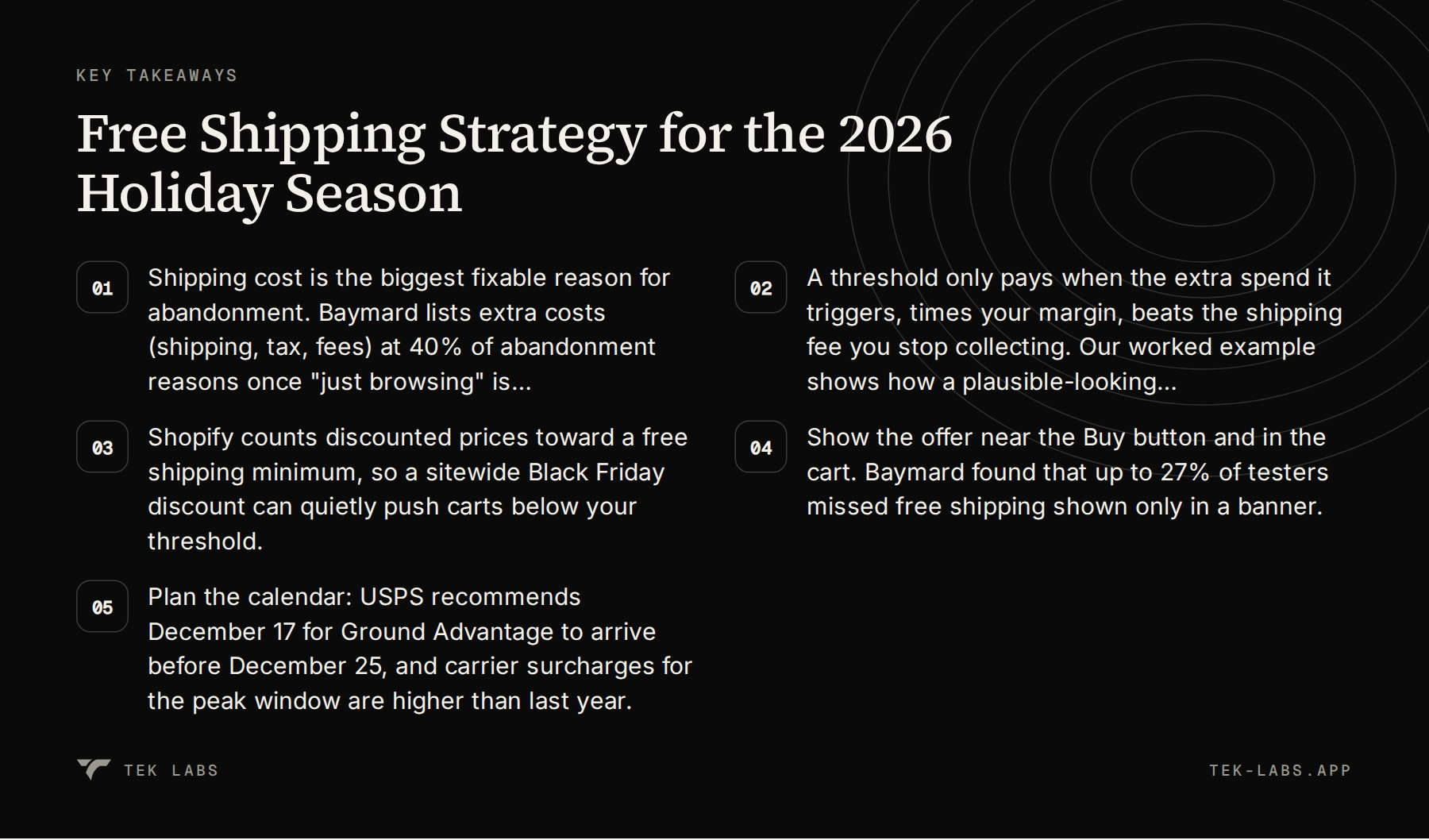
- Shipping cost is the biggest fixable reason for abandonment. Baymard lists extra costs (shipping, tax, fees) at 40% of abandonment reasons once “just browsing” is excluded.
- A threshold only pays when the extra spend it triggers, times your margin, beats the shipping fee you stop collecting. Our worked example shows how a plausible-looking $60 threshold can lose money.
- Shopify counts discounted prices toward a free shipping minimum, so a sitewide Black Friday discount can quietly push carts below your threshold.
- Show the offer near the Buy button and in the cart. Baymard found that up to 27% of testers missed free shipping shown only in a banner.
- Plan the calendar: USPS recommends December 17 for Ground Advantage to arrive before December 25, and carrier surcharges for the peak window are higher than last year.
Why shipping cost decides the cart
Baymard Institute pools 50 studies and puts the average documented cart abandonment rate at 70.22%. Many of those carts were never going to convert: in Baymard’s own quantitative study, 42% of US online shoppers said they had abandoned a cart because they were “just browsing / not ready to buy.” Strip those out and the remaining reasons look like this:
| Reason for abandonment (excluding “just browsing”) | Share |
|---|---|
| — | — |
| Extra costs too high (shipping, tax, fees) | 40% |
| Delivery was too slow | 20% |
| The site wanted me to create an account | 18% |
| Too long or complicated checkout process | 17% |
| I couldn’t see or calculate total order cost up-front | 12% |
Source: Baymard Institute, cart abandonment rate statistics. Baymard does not publish the sample size on that page, so treat the percentages as directional, not as a benchmark for your store.
Two details matter for a Shopify store. First, shoppers go looking for the number early. In Baymard’s product page testing, 64% of subjects looked for shipping costs on the product page before deciding to add an item to the cart, and Baymard reports that 43% of sites show no shipping cost or calculator there. Second, Baymard’s checkout research found that 21% of US online shoppers had abandoned an order in the last quarter because they could not see the total order cost up front. Uncertainty hurts almost as much as a high fee.
There is also an academic caution. Lewis, Singh and Fay studied an online retailer that tested many shipping fee schedules and found that free shipping and free shipping above a size threshold were “very effective in generating additional sales”, but that the lost shipping revenue and the lack of response from several customer segments were large enough to make such promotions unprofitable for that retailer. The paper is from 2006 and one retailer’s data, so do not read it as a law. Read it as a reason to model your own numbers, which we do below.
What the 2026 holiday season looks like
Demand is not the problem. Adobe Analytics reported that US shoppers spent a record $257.8 billion online from November 1 to December 31, 2025, up 6.8% year over year. Cyber Week (Thanksgiving through Cyber Monday) brought in $44.2 billion, up 7.7%, with Cyber Monday at $14.25 billion and Black Friday at $11.8 billion. The National Retail Federation counted a record 202.9 million shoppers over the five-day Thanksgiving weekend in 2025.
Those are 2025 results, and we could not find a published Adobe forecast for the 2026 holiday season as of October 1, 2026. What we can say is that the dates are fixed: Thanksgiving is November 26, Black Friday is November 27, Cyber Monday is November 30, and the carriers have already announced the calendar and surcharges that will shape your shipping costs (details below).
Three ways to structure free shipping
Shopify’s help center describes three main shipping strategies: flat rate, free shipping and carrier-calculated rates. In practice a store picks one of these as the base and layers a free shipping offer on top. The offer itself usually takes one of three forms.
| Structure | How it works | Best for | Main risk |
|---|---|---|---|
| — | — | — | — |
| Free shipping threshold | Free above a minimum order value (or item count) | Stores whose AOV is close to a natural bundle size | Subsidizes customers who would have spent that much anyway |
| Flat rate | One predictable fee for every order, or a small fee under the threshold | Heavy or bulky items, narrow margins | Shoppers compare your fee against “free” competitors |
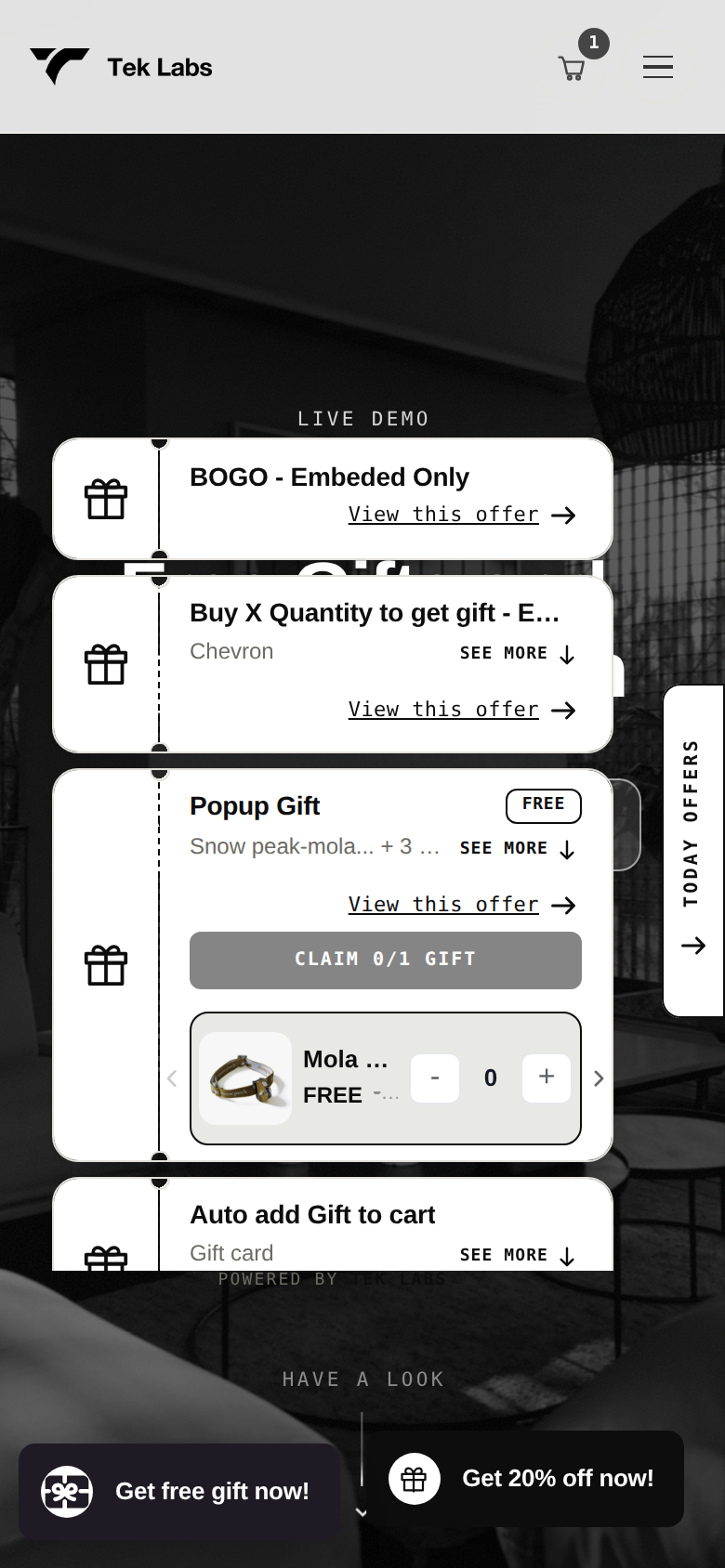
| Milestone reward | Free shipping is one reward on a multi-step progress bar, alongside gifts or discounts | Stores with a cheap gift or overstock to move | More moving parts to configure and test |
Free shipping threshold
This is the default for most Shopify stores. Shopify’s own guidance says free shipping “can have positive impact on your cart conversion rate” and can raise order value when tied to a cart minimum, but warns that shipping fees “need to be accounted for elsewhere and can affect your profit margins.” Shopify’s blog adds, citing AlixPartners, that 56% of retailers require a minimum order value for free shipping. That is a secondhand figure from a 2026 study we did not open ourselves, so we mention it only to show that the threshold is the common choice, not to prove it is the best one.
Flat rate
Shopify notes that a flat rate “allows you to set clear shipping expectations before checkout and avoid checkout abandonment,” and that you must estimate shipping costs yourself. A flat fee also gives you something to publish on a shipping page before checkout, which addresses the “can’t see the total” problem. The drawback is the one Baymard’s data hints at: a visible fee is a visible reason to leave.
Free shipping as a milestone reward
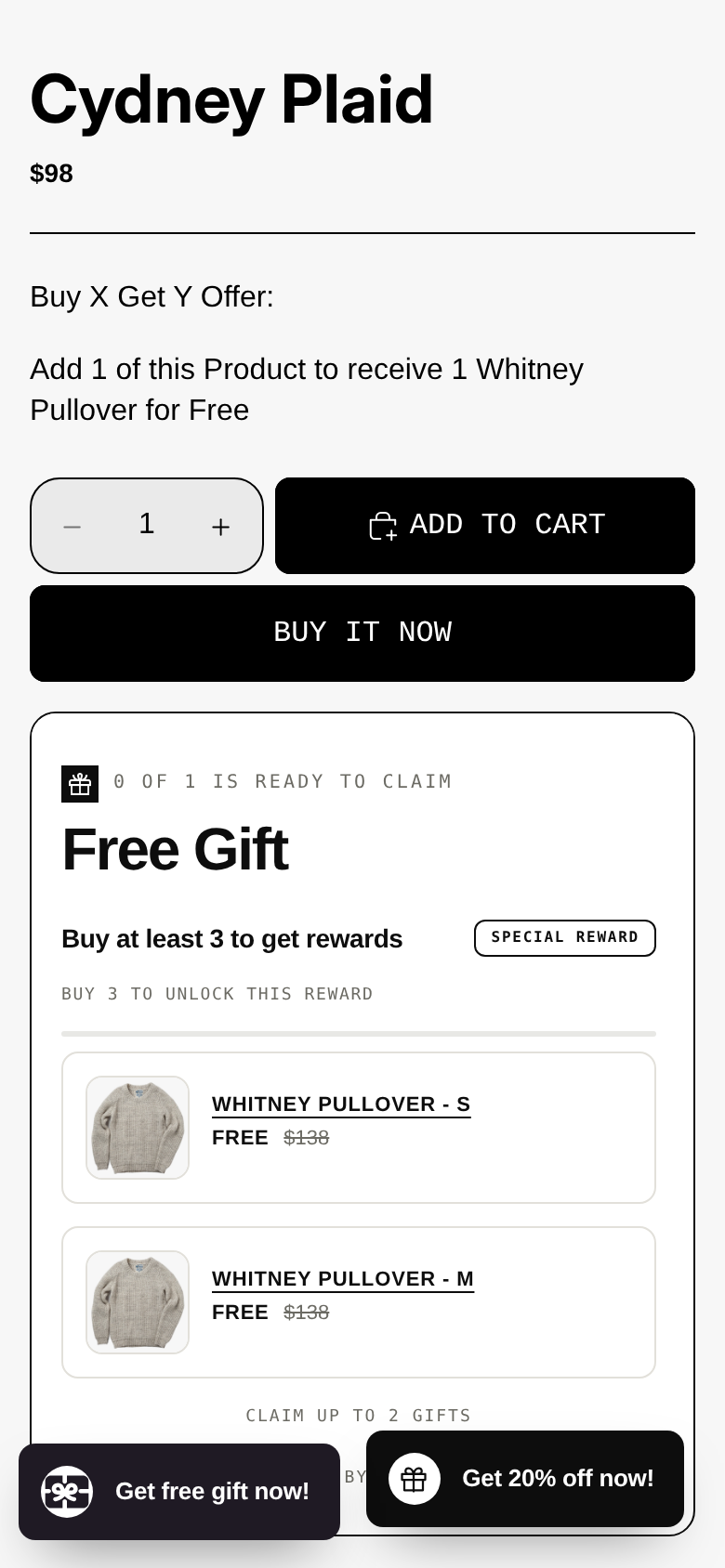
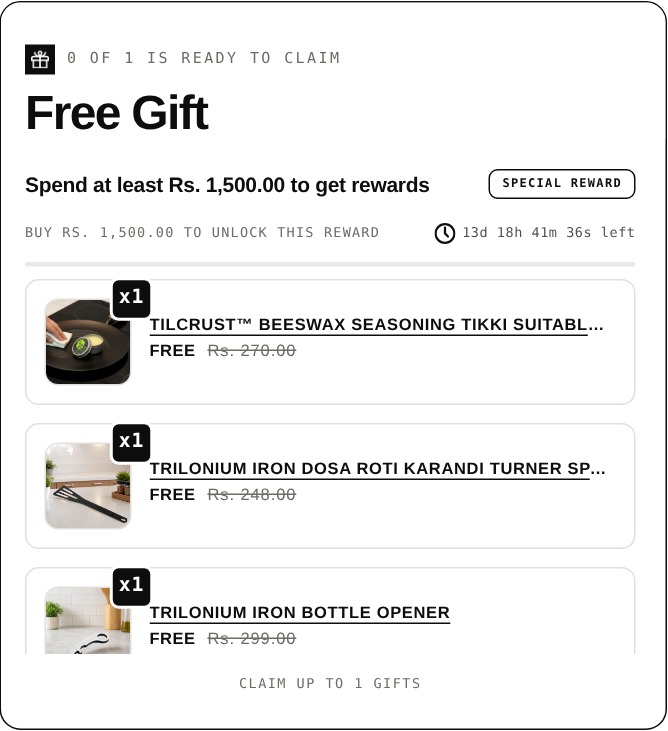
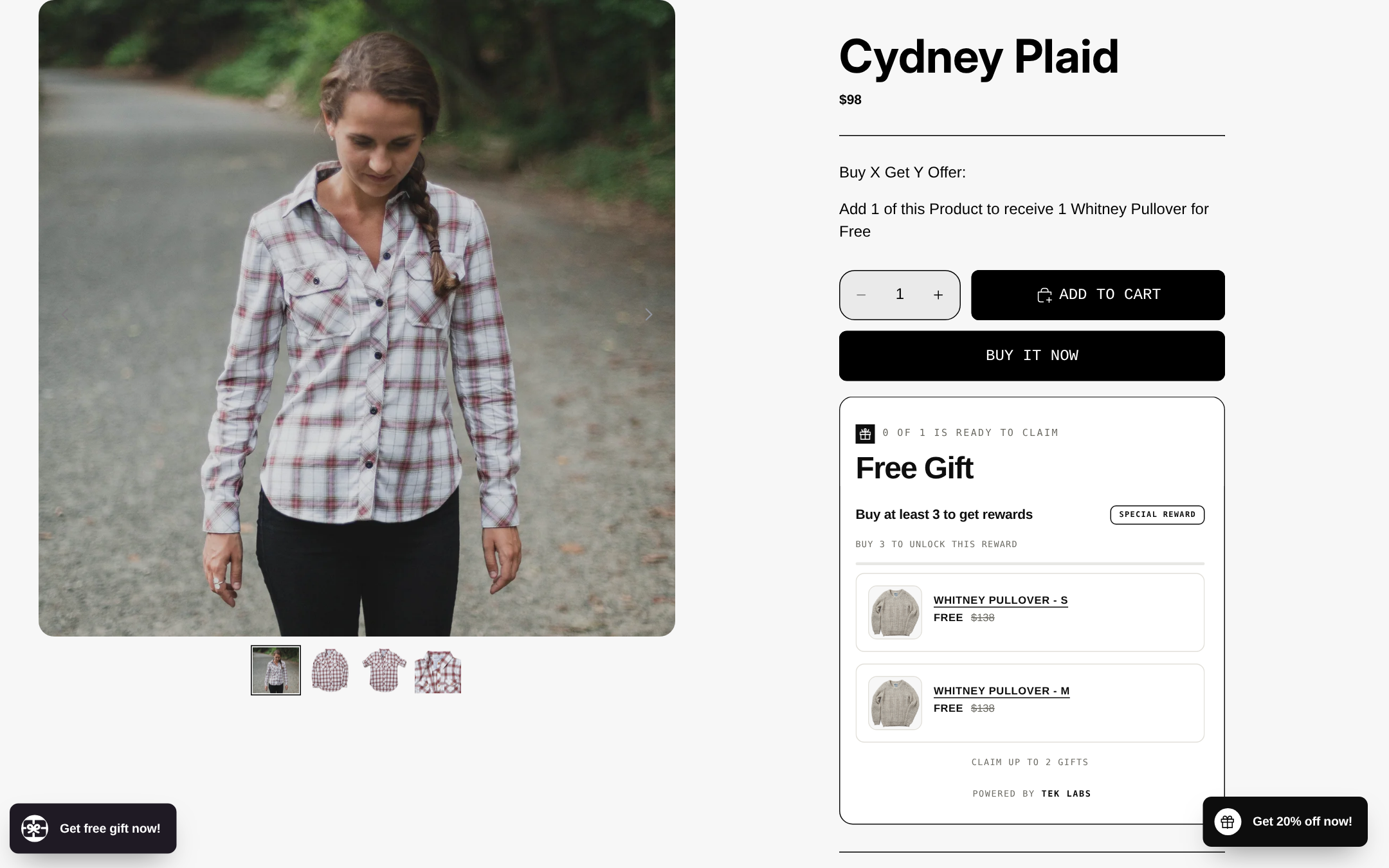
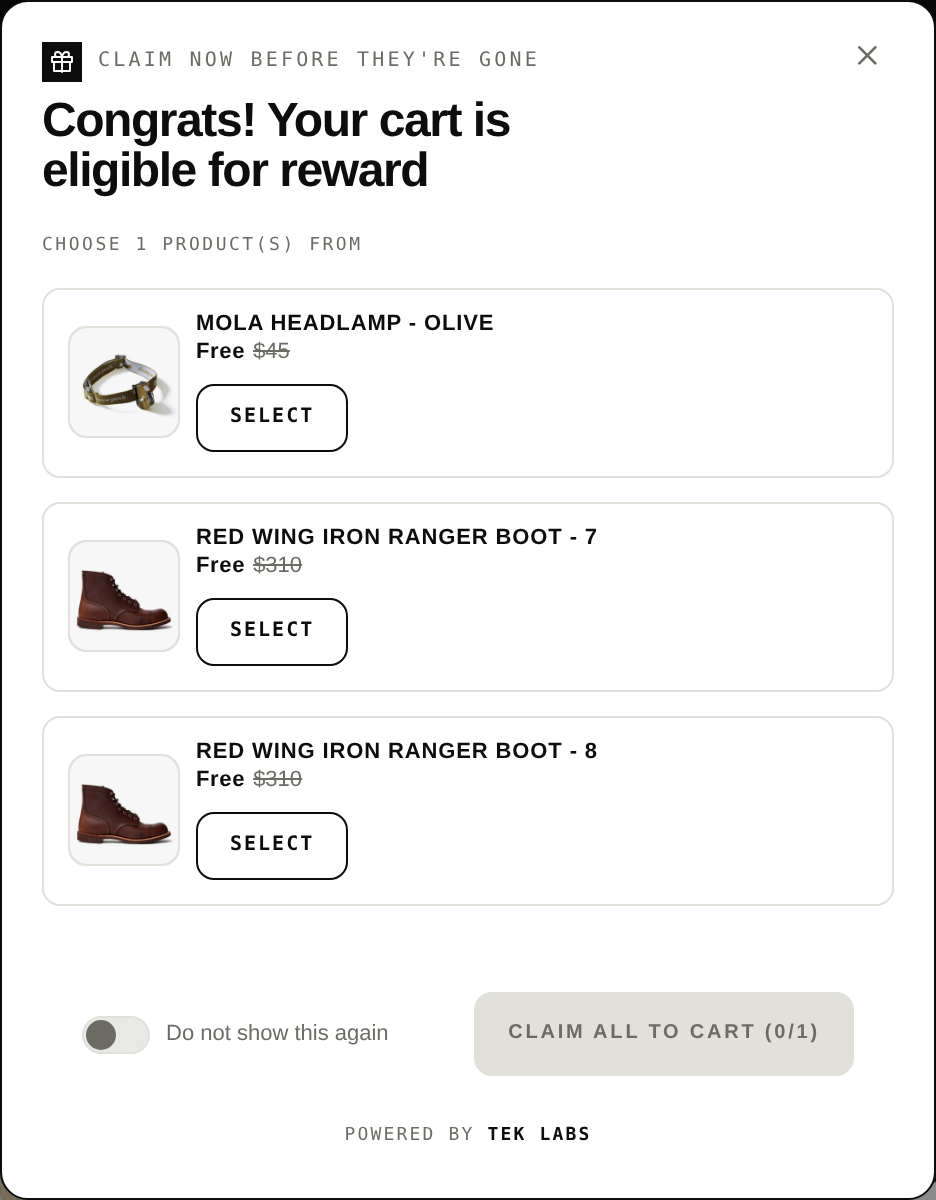
A milestone bar treats free shipping as the first step of a ladder, for example free shipping at one amount, a free gift at a higher amount, and a percentage discount above that. The bar shows progress, so the shopper sees what the next step costs. The advantage for margin is that the free shipping tier is not your last offer, and higher tiers can carry a gift that costs you far less than its retail price. We show the arithmetic in the worked example below.
How to set the threshold: a step-by-step method
Round numbers feel natural ($50, $75, $100), but a threshold should come from three inputs you can look up today.
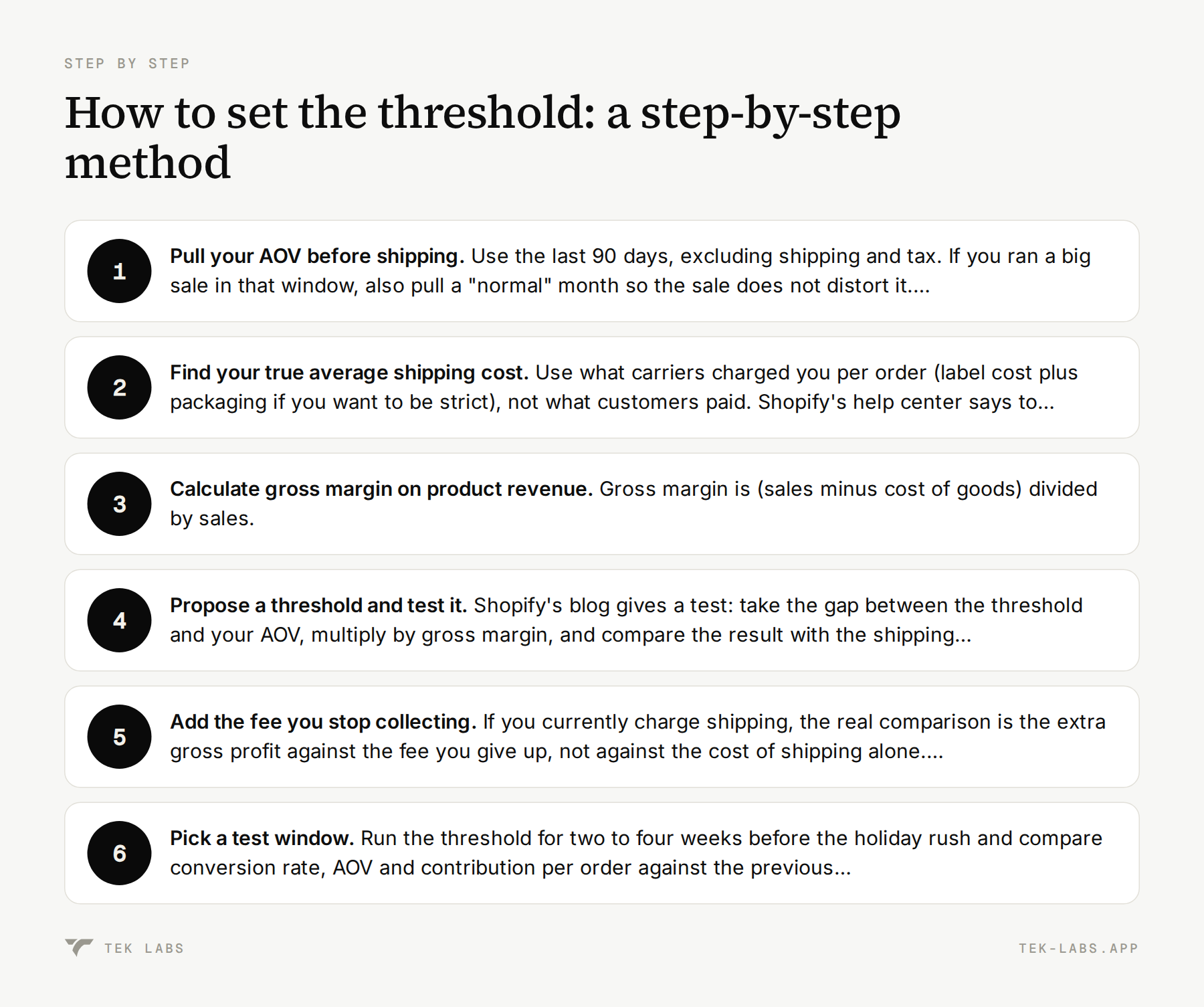
- Pull your AOV before shipping. Use the last 90 days, excluding shipping and tax. If you ran a big sale in that window, also pull a “normal” month so the sale does not distort it. If AOV is new to you, our glossary entry for AOV explains the term.
- Find your true average shipping cost. Use what carriers charged you per order (label cost plus packaging if you want to be strict), not what customers paid. Shopify’s help center says to calculate “the average cost to ship your product” and add a buffer into product prices.
- Calculate gross margin on product revenue. Gross margin is (sales minus cost of goods) divided by sales.
- Propose a threshold and test it. Shopify’s blog gives a test: take the gap between the threshold and your AOV, multiply by gross margin, and compare the result with the shipping cost. In Shopify’s example, AOV is $40, average shipping is $8 and gross margin is 40%. A $45 threshold adds $5 of order value, which at 40% margin is $2 of gross profit, leaving $6 of the $8 shipping cost uncovered.
- Add the fee you stop collecting. If you currently charge shipping, the real comparison is the extra gross profit against the fee you give up, not against the cost of shipping alone. This is the step most calculators skip, and it decides the example below.
- Pick a test window. Run the threshold for two to four weeks before the holiday rush and compare conversion rate, AOV and contribution per order against the previous period.
If you want a quick version of steps 1 to 4 for a free gift or reward tier, we built a free gift threshold calculator.
Worked example: when a $60 threshold loses money
This is a hypothetical store. Every input below is an assumption chosen to make the arithmetic easy to follow, not a benchmark.
Assumptions: 1,000 orders a month. Gross margin of 45% on product revenue. The store pays $8.50 per order to ship and currently charges every customer a flat $6.95. Order mix: 300 orders average $80, 400 orders average $45, and 300 orders average $20. That gives an AOV of (300 x $80 + 400 x $45 + 300 x $20) / 1,000 = $48.
Baseline (flat $6.95 on every order):
- Gross profit: 1,000 x $48 x 0.45 = $21,600
- Shipping revenue minus shipping cost: 1,000 x ($6.95 minus $8.50) = minus $1,550
- Monthly contribution: $21,600 minus $1,550 = $20,050
Proposal: free shipping over $60. Assume 100 of the 400 mid-range orders (25%) add $15 to reach $60, and nothing else changes.
- Gross profit: 300 x $80 x 0.45 = $10,800; 100 x $60 x 0.45 = $2,700; 300 x $45 x 0.45 = $6,075; 300 x $20 x 0.45 = $2,700. Total $22,275.
- Shipping revenue: 600 orders still pay $6.95 = $4,170. Shipping cost: 1,000 x $8.50 = $8,500. Net: minus $4,330.
- Monthly contribution: $22,275 minus $4,330 = $17,945, which is $2,105 less than baseline.
The reason is in one line of arithmetic. Each customer who tops up by $15 adds $15 x 0.45 = $6.75 of gross profit but stops paying the $6.95 fee, a net change of minus $0.20. Meanwhile the 300 customers who already spent $80 now get free shipping they did not need, which costs 300 x $6.95 = $2,085. A top-up only pays for itself when the added spend, multiplied by margin, exceeds the fee you stop collecting. At 45% margin and a $6.95 fee, that means customers must add more than $6.95 / 0.45 = $15.44.
| Scenario (hypothetical) | Extra orders vs baseline | Monthly contribution | Change vs baseline |
|---|---|---|---|
| — | — | — | — |
| Baseline, flat $6.95 | 0 | $20,050 | n/a |
| Free shipping over $60, no new orders | 0 | $17,945 | minus $2,105 |
| Same, plus 109 extra orders | 109 | about $20,060 | about break-even |
| Same, plus 150 extra orders | 150 | about $20,855 | plus $805 |
The extra orders are assumed to be $62 orders with free shipping, so each earns $62 x 0.45 minus $8.50 = $19.40. Dividing the $2,105 shortfall by $19.40 gives 108.5, so this store needs roughly 109 additional orders (an 11% lift) just to break even. That is a plausible conversion lift if shipping cost is really what stops your shoppers, and an unlikely one if it is not. The takeaway is not “never use a threshold.” It is that the threshold needs a job: lift conversion by a known amount, or reach customers whose top-up is small.
Two changes would improve this store’s result without abandoning free shipping: raise the threshold only slightly above the middle group so the top-up is small (a $55 threshold needs only a $10 top-up, which falls under the $15.44 limit), or move to a milestone bar where the first tier is cheap and the higher tier carries a low-cost gift.
The same store with a milestone bar
Keep the same assumptions and look at one order at each tier. Suppose the store adds a free gift at $90 using a surplus item that cost the store $5 (a retail price the shopper might see as $20).
| Order (hypothetical) | Gross profit at 45% | Shipping, net | Gift cost | Contribution |
|---|---|---|---|---|
| — | — | — | — | — |
| $48, pays $6.95 shipping | $21.60 | minus $1.55 | $0 | $20.05 |
| $60, free shipping | $27.00 | minus $8.50 | $0 | $18.50 |
| $90, free shipping plus gift | $40.50 | minus $8.50 | $5.00 | $27.00 |
The first tier costs $1.55 per order compared with a $48 order that pays shipping, which is the same lesson as above. The second tier earns it back: a $90 order contributes $27.00 even after the gift. A bar that nudges shoppers past $60 toward $90 is doing more for margin than a bar that stops at $60.
How Shopify applies shipping rates and discounts
Free shipping can be built in two different places in Shopify, and they behave differently. Getting this wrong is a common cause of “my free shipping isn’t working” support tickets.
| Free shipping rate (Settings, Shipping and delivery) | Free shipping discount (Discounts) | |
|---|---|---|
| — | — | — |
| Where it lives | A rate inside a shipping zone and profile | A discount code or automatic discount |
| Condition options | Flat, order amount or weight-based rates, with an “Offer free shipping” minimum | Minimum purchase amount or minimum quantity of items |
| Country control | Set by shipping zone | All countries or selected countries |
| Cap on the shipping cost covered | Not applicable | Optional “exclude shipping rates over a certain amount” |
| Start and end dates | Stays live until you edit it | Active dates, with optional start and end date |
| Stacking with other discounts | Not set up in the Discounts area | Governed by the Combinations settings |
Shopify’s help center says flat rate shipping can charge a fixed amount, offer free shipping, or vary by order value or weight, and gives the example of free shipping on orders over $100. One detail from the same page is easy to miss when you use several shipping profiles: Shopify combines price-based rates across profiles. Its example is a discounted $5 rate active in two profiles for orders over $50, so a $55 order with products from both profiles shows a combined $10 at checkout. If free shipping looks wrong at checkout, check how many profiles are involved.
For a free shipping discount, Shopify says the minimum purchase amount “counts product prices only, and other costs such as taxes are never included.” It also says products are counted at their discounted price, and that gift cards in the cart count toward the minimum. The practical effect during a sale is easy to miss.
A Black Friday example (hypothetical). Your free shipping minimum is $60. A shopper has $70 of products in the cart. You run an automatic 20% off sitewide discount that is set to combine with free shipping. The discounted product total is $70 x 0.80 = $56, which is $4 under the minimum, so the free shipping discount does not apply. Shopify’s help page confirms that this only happens with discounts that can be combined. The fix is either to lower the threshold for the sale period or to show the progress bar in discounted dollars so the shopper sees the true gap.
Combination rules add a few limits worth knowing before the rush. Shopify’s combination documentation states:
- Shipping discounts apply last, after product and order discounts.
- A customer can use a maximum of 5 product or order discount codes and 1 shipping discount code on the same order.
- You can have a maximum of 25 active automatic discounts, and that total includes app-based discounts.
- Multiple shipping discounts cannot apply to the same order.
- If a shipping discount cannot combine with a product or order discount already in the cart, the shopper may see “You already have a better combination.” Shopify calls that expected behavior, because the discounted cart value is used to calculate shipping options.
Set your combination boxes deliberately and test with real carts, including a cart with a discount code, a cart with an automatic discount, and a cart that mixes both.
Where to show the offer
Baymard’s product page benchmark found that 32% of sites only show free shipping in a banner or site-wide header, and in testing as many as 27% of users missed it. Baymard also notes that when the condition is a simple spend threshold, the message (“Orders over $75 ship for free”) fits wherever the free shipping notice sits on the product page. The practical placement list:
- Next to the Buy button on the product page, with the threshold stated in plain numbers, not behind an asterisk or “see details” link.
- In the cart, as a progress bar that updates as items are added, so the remaining gap is visible. Baymard recommends that free shipping notices update to the shopper’s context, for example “Spend $35 more to qualify for free shipping.”
- In the cart drawer on mobile, where more than half of holiday orders now happen. Adobe reported that 56.4% of online transactions in the 2025 holiday season came through a smartphone.
- On a shipping policy page, with a table of rates, because Shopify suggests publishing flat rates there so customers can check costs before checkout.
The 2026 carrier calendar
Shipping deadlines belong in the offer, not only in your help center. A free shipping promotion that runs past the last safe ship date promises something you cannot deliver.
USPS
USPS announced its recommended 2026 holiday dates on September 22, 2026. For delivery before December 25, the USPS holiday shipping page lists these send-by dates for the contiguous US:
| Service | Recommended send-by date (Lower 48) |
|---|---|
| — | — |
| USPS Ground Advantage | Thursday, December 17 |
| First-Class Mail | Thursday, December 17 |
| Priority Mail | Friday, December 18 |
| Priority Mail Express | Saturday, December 19 |
For Alaska, Hawaii, Puerto Rico and US territories, Ground Advantage moves up to December 16. USPS’s announcement says the full list of dates for military and international addresses will appear on the holiday page starting in mid-October, so check back if you ship abroad.
USPS also filed for a temporary price change on Priority Mail Express, Priority Mail, Ground Advantage and Parcel Select. According to the USPS notice, the change is pending Postal Regulatory Commission review and, if approved, runs from October 4, 2026 to January 17, 2027. For commercial Ground Advantage and Priority Mail in Zones 1 to 4, the planned increase is $0.40 for 0 to 3 lb packages and $0.65 for 4 to 10 lb packages. We read the notice as filed on August 25, so confirm the final rates before you update your shipping cost input.
FedEx
FedEx’s surcharge schedule matters more than its cutoff dates for margin planning. Supply Chain Dive reported that FedEx’s Ground and Home Delivery residential demand surcharge ranges from $0.50 to $0.80 per package depending on the date, and will peak at $0.80, compared with $0.65 last year, with the peak window running November 23 through December 27 and all surcharges active by October 26 and running until January 17, 2027. If you use FedEx through a negotiated account, ask your representative for the exact figures that apply to you.
FedEx also publishes a “2026 Peak Last Day to Ship” PDF on fedex.com. When we tried to open it for this update, the site blocked our automated request, so we are not quoting its dates. Open the FedEx PDF directly and copy the dates for the services you use.
UPS
UPS publishes its schedule on its holiday shipping schedule page. That page also blocked our automated request, and we could not confirm whether UPS has posted recommended last-ship dates for 2026 delivery before Christmas. We are therefore not stating any UPS dates here. Check the page yourself before you finalize your cutoff messaging.
What to do with these dates
Add a “order by” date to your free shipping banner in early December, based on the slowest service you offer. A simple rule is to use the carrier’s own recommended date minus one working day for packing, and to state it by service level so a shopper choosing the cheapest option sees the earliest cutoff. Because Cyber Monday is November 30 and the first USPS cutoff is December 17, there are only 17 days between the end of Cyber Week and the Ground Advantage deadline, so late-December orders should be handled with an expedited upsell, not a free standard shipping promise.
A free shipping plan for the 2026 holiday season
- By mid-October: confirm your costs. Pull the last 90 days of carrier invoices, update your average shipping cost, and add the carrier surcharges that apply from your peak window.
- By late October: model your threshold. Run the steps above with your own numbers, including the fee you stop collecting. Decide your threshold, and your fallback threshold if margin turns out thinner than you thought.
- Early November: set the offer in Shopify. Choose either a free shipping rate or a free shipping discount, set combination rules, and test carts with every discount you plan to run.
- Before Black Friday: make it visible. Add the offer next to the Buy button, in the cart, and in your announcement emails. If you use a progress bar, check that it reflects discounted dollars.
- Black Friday to Cyber Monday: watch three numbers. Conversion rate, AOV and contribution per order, checked daily. If AOV does not move by the third day, your threshold may be too far from your customers’ baskets.
- First week of December: add the cutoff. Put the “order by” date into the banner and the cart message for each shipping method.
- After December 17: change the promise. Move from free standard shipping to an expedited option, or switch the message to “ships in January.”
For ideas on what else to run during the same window, see our guide to promotion strategies for BFCM and our look at tackling cart abandonment.
Common mistakes
- Setting the threshold from competitors, not from your margin. A competitor’s $75 may sit on a different margin and a different shipping cost.
- Giving free shipping to everyone and calling it a test. Without a control period or a before-and-after comparison, you cannot tell whether conversion rose.
- Ignoring the fee you stop collecting. As the worked example shows, the comparison is against the fee, not only against the shipping cost.
- Burying the condition. Baymard’s testing shows that conditions behind a link or asterisk are often missed, which produces surprise at checkout.
- Forgetting that discounts change the cart value. A sale can push the discounted total under the minimum, so shoppers think the offer disappeared.
- Running free shipping past the last safe ship date. The offer should end with the carrier cutoff, or change to an expedited option.
- Using one threshold for every market. Shopify lets you scope a free shipping discount to selected countries, and a threshold that works domestically may not cover international costs.
Where our apps fit
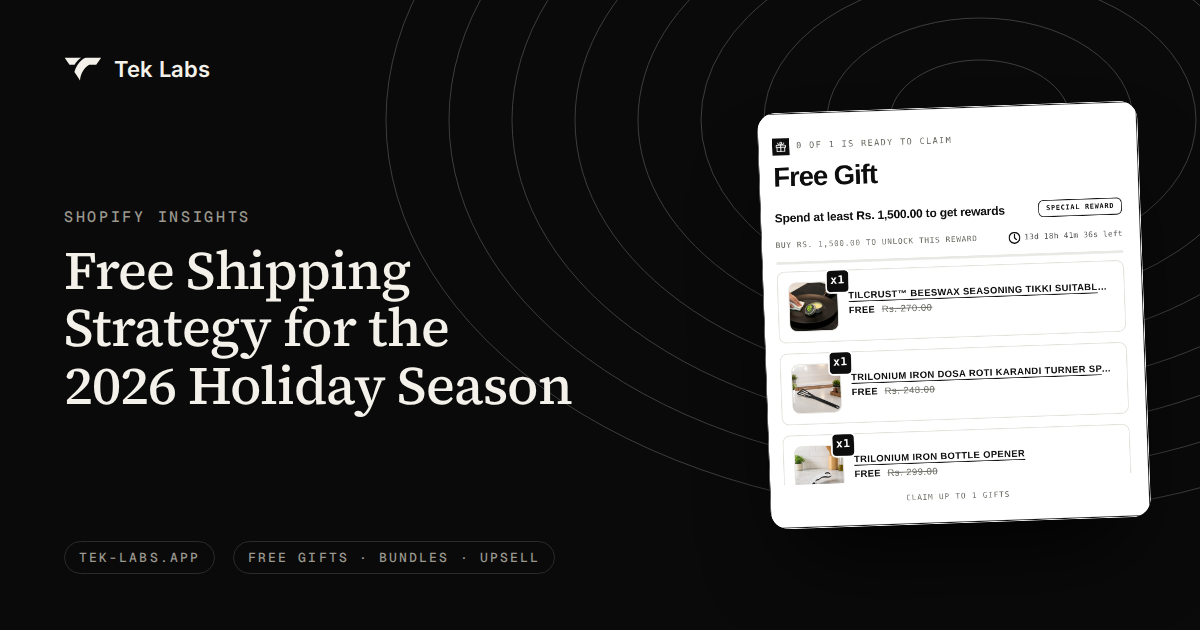
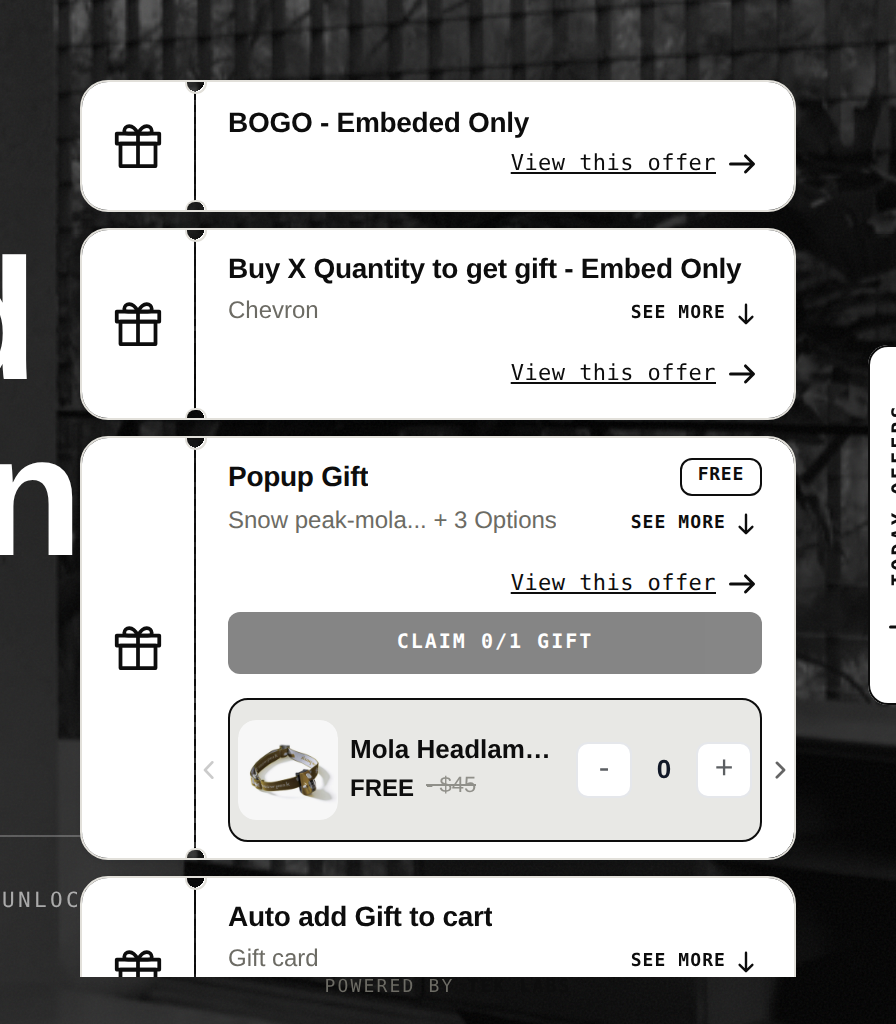
If you want free shipping to work as a reward ladder instead of a single line, Free Gifts BOGO & Upsell includes a cart upsell progress bar with multi-tier rewards, and its App Store listing lists free shipping among its offer types. Gifts can be added automatically or chosen by the customer, which is how the $90 tier in the example above would work. Mix & Match Bundles lists free shipping among its discount options, which suits stores that want shipping to be unlocked by a bundle size. Both have a free plan, so you can test the structure before the rush. Check the live demo stores linked from the App Store listings to see the progress bar before you decide.
Frequently Asked Questions
What is a good free shipping threshold?
A good threshold is one your numbers support: usually modestly above your current AOV, and low enough that the typical top-up is smaller than your shipping fee divided by your gross margin. Shopify’s own example uses a $45 threshold for a $40 AOV. Test two or three thresholds before the holiday rush.
Is free shipping worth it if it cuts into my margin?
It can be, if it lifts conversion or order value enough to cover the fee you stop collecting. In our hypothetical store, a $60 threshold needed about 109 extra orders a month to break even. Model it with your own AOV, margin and shipping cost before you commit.
Should I use a free shipping rate or a free shipping discount in Shopify?
Use a free shipping rate if you want a simple, always-on threshold tied to your shipping zones. Use a free shipping discount if you need a time-limited offer, a country limit, or a code. Check the combination settings either way, because shipping discounts apply last and only one shipping discount can apply per order.
When should I stop promising holiday delivery in 2026?
For USPS, the recommended send-by date for delivery before December 25 is December 17 for Ground Advantage and First-Class Mail, December 18 for Priority Mail, and December 19 for Priority Mail Express in the lower 48 states. Check the FedEx and UPS pages for their dates, because we could not read them for this update.
Why did my free shipping stop applying during a sale?
Shopify counts products at their discounted price toward a free shipping minimum when the discounts can be combined. A 20% sale can drop a $70 cart to $56, under a $60 minimum. Lower the threshold for the sale or show the progress bar in discounted dollars.