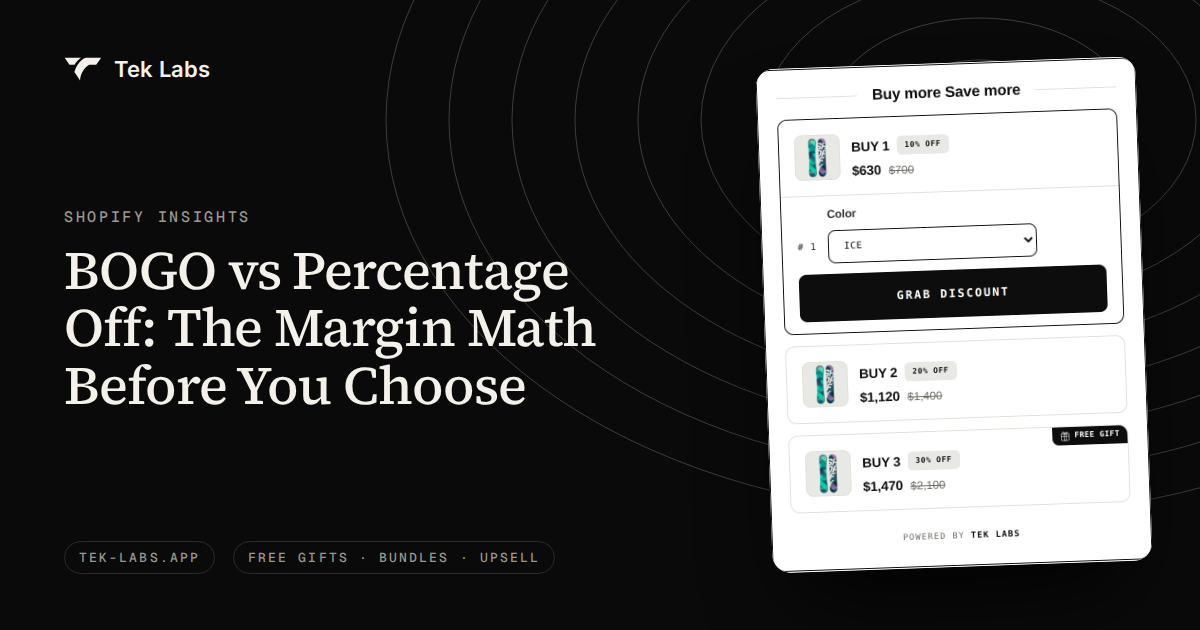
Neither one wins on math alone. A “buy one, get one free” offer is the same as 50 percent off every unit, so if your product margin is below 50 percent, every unit sold under that offer loses money before shipping and fees, while a percentage discount lets you pick a depth you can afford and apply it to a single unit. Choose BOGO when the free item is cheap for you to give away or when you want to move stock, and choose percentage off when margin is thin or the item is expensive.
Key takeaways
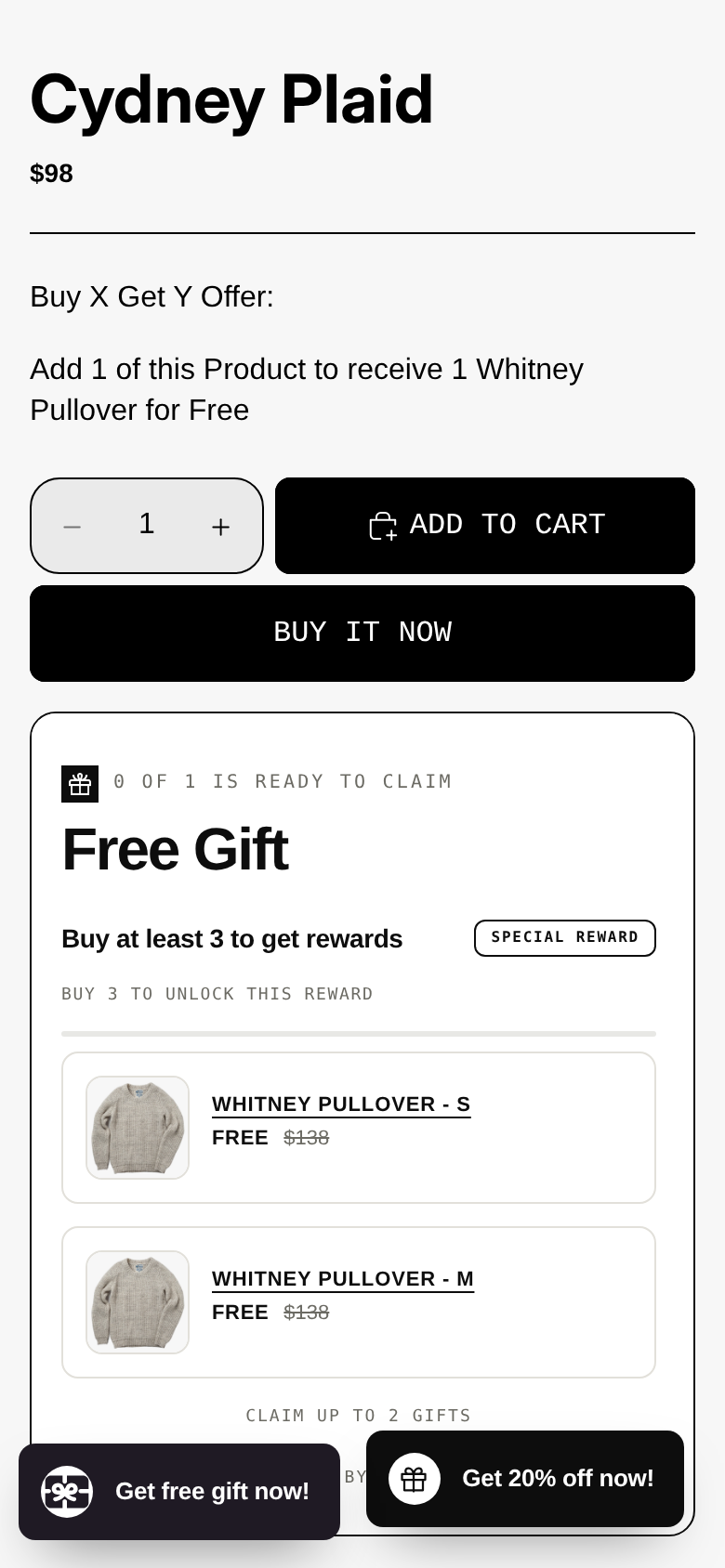
- “Buy one get one free” equals 50 percent off per unit, “buy one get one 50% off” equals 25 percent off per unit, and “buy 2 get 1 free” equals 33.3 percent off per unit. Compare offers at the per-unit level first.
- On a hypothetical $60 item, BOGO free loses $24 and $12 per order at 30 and 40 percent gross margin and earns $6 at 55 percent. A 20 percent discount on one unit earns $6, $12 and $21 at the same margins.
- To match the contribution of selling one unit at full price, a 20 percent discount needs 3.0, 2.0 or 1.6 times the units at 30, 40 and 55 percent margin. Deeper offers need far more, or can never break even.
- Shoppers do prefer bonus-pack framing in studies, but that is a reason to test, not a reason to skip the arithmetic. A free item that costs you little (a different, low-cost product) keeps the appeal without the 50 percent give-away.
- Shopify’s native Buy X Get Y never adds the free item for the customer, and items inside it cannot take extra product discounts in most plans, so plan the cart experience and the stacking rules before you launch.
Same discount, different shape: convert every offer to a per-unit price
Merchants often argue about BOGO versus percentage off as if they were different kinds of discount. They are the same arithmetic in a different wrapper. The wrapper changes what the shopper has to do (buy a second unit or not) and how the offer feels, but the price per unit is fixed by the numbers. The FTC lists these formats side by side in its guide on the word “free”, naming “Free”, “Buy 1-Get 1 Free”, “2-for-1 Sale” and “50% off with purchase of Two” as typical language for such offers (16 CFR 251.1(a)).
| Offer | What the shopper pays | Effective discount per unit | Units the shopper must buy |
|---|---|---|---|
| Buy 1 get 1 free | $60 for 2 units of a $60 item | 50.0% | 2 |
| Buy 1 get 1 at 50% off | $90 for 2 units | 25.0% | 2 |
| Buy 2 get 1 free | $120 for 3 units | 33.3% | 3 |
| Buy 3 get 1 free | $180 for 4 units | 25.0% | 4 |
| 50% off one unit | $30 for 1 unit | 50.0% | 1 |
| 20% off one unit | $48 for 1 unit | 20.0% | 1 |
The table above uses a hypothetical $60 item. The formula is simple: effective discount equals the value given away divided by the full price of all units. For “buy 3 get 1 free” that is $60 divided by $240, which is 25 percent.
Two things follow immediately. First, “BOGO free” is the deepest common offer. Adobe’s data on Cyber Monday 2025 put discount peaks at 31 percent off listed price for electronics, 28 percent for toys and 25 percent for apparel (Adobe, December 2025), so a 50 percent effective discount sits far beyond what the biggest online shopping day of the year reached in those categories. Second, BOGO forces a quantity: the shopper only gets the deal by taking a second unit, which changes your inventory draw, your pick and pack cost and the weight of the parcel.
The margin math: a $60 item at 30, 40 and 55 percent gross margin
Gross margin here means (price minus landed product cost) divided by price. A $60 item at 30 percent margin costs you $42, at 40 percent it costs $36 and at 55 percent it costs $27. All figures below are hypothetical and exist to show the arithmetic. Substitute your own landed cost (product, inbound freight, duties).
Contribution per order after product cost
Contribution is revenue minus product cost for every unit in the order. The first row is the baseline, one unit at full price.
| Order the shopper places | Revenue | Units | At 30% margin (cost $42) | At 40% margin (cost $36) | At 55% margin (cost $27) |
|---|---|---|---|---|---|
| 1 unit, full price | $60 | 1 | +$18 | +$24 | +$33 |
| 1 unit, 20% off | $48 | 1 | +$6 | +$12 | +$21 |
| 1 unit, 50% off | $30 | 1 | -$12 | -$6 | +$3 |
| BOGO free (2 units) | $60 | 2 | -$24 | -$12 | +$6 |
| BOGO 50% off (2 units) | $90 | 2 | +$6 | +$18 | +$36 |
| Buy 2 get 1 free (3 units) | $120 | 3 | -$6 | +$12 | +$39 |
Read the BOGO free row. At 30 and 40 percent margin the order loses money, because you hand over two units and collect the price of one. At 55 percent it earns $6, which is $27 less than the baseline order. A shopper who would have bought one unit anyway now costs you the full product cost of the second unit.
How many extra units do you need to break even?
Because discounting cuts the margin on every unit, you have to sell more units to earn the same total contribution dollars. The break-even multiple is the old margin per unit divided by the new margin per unit. In percentage terms, with gross margin m and effective discount d, the multiple is m divided by (m minus d). If m minus d is zero or negative, no volume ever recovers it.
| Effective discount | Offer examples | 30% margin | 40% margin | 55% margin |
|---|---|---|---|---|
| 20% | 20% off | 3.0x | 2.0x | 1.6x |
| 25% | BOGO 50% off, buy 3 get 1 free | 6.0x | 2.7x | 1.8x |
| 33.3% | Buy 2 get 1 free | never | 6.0x | 2.5x |
| 50% | BOGO free, 50% off | never | never | 11.0x |
Example from that table: a store at 40 percent margin that runs 20 percent off needs twice as many units as before (2.0x) just to earn the same contribution dollars. The same store running BOGO free loses money on every unit it sells, so no extra volume rescues it. A store at 55 percent margin can run BOGO free, but it needs 11 times the units. These multiples ignore fixed costs and customer lifetime value, so they set a floor for the incremental demand you need, not a forecast.
Add fees and fulfillment to see the real order
Product cost is only part of the bill. The next table adds hypothetical variable costs for the 40 percent margin case: payment processing of 2.9 percent plus $0.30 per order, and fulfillment (pick, pack, packaging) of $7.00 for the first unit and $1.50 for each additional unit. Shipping is assumed to be paid by the customer. These are assumptions, so check your own processor and 3PL rates.
| Order (40% margin, $36 cost) | Revenue | Product cost | Payment fee | Fulfillment | Contribution |
|---|---|---|---|---|---|
| 1 unit, full price | $60.00 | $36.00 | $2.04 | $7.00 | +$14.96 |
| 1 unit, 20% off | $48.00 | $36.00 | $1.69 | $7.00 | +$3.31 |
| 1 unit, 50% off | $30.00 | $36.00 | $1.17 | $7.00 | -$14.17 |
| BOGO free (2 units) | $60.00 | $72.00 | $2.04 | $8.50 | -$22.54 |
| BOGO 50% off (2 units) | $90.00 | $72.00 | $2.91 | $8.50 | +$6.59 |
| Buy 2 get 1 free (3 units) | $120.00 | $108.00 | $3.78 | $10.00 | -$1.78 |
With fees and handling, the 20 percent discount leaves $3.31 per order against $14.96 at full price. That is a 78 percent drop in contribution per order, and the break-even multiple becomes about 4.5 orders for every baseline order. Fixed per-order costs hurt single-unit offers more than multi-unit ones, which is the one structural argument for BOGO-style offers: they spread the $7.00 first-unit cost over more units.
A third option: BOGO with a different, cheap item
The math above assumes the free item is the same $60 product. The cost of a free item to you is its landed cost, not its shelf price. If the free item is a different product with a high margin, the picture changes. In the hypothetical below, the shopper buys the $60 item (cost $36) and gets a $25 accessory (landed cost $8) free.
| Offer on a $60 item (40% margin) | Shopper sees | What it costs you | Contribution after product cost |
|---|---|---|---|
| 20% off | Saves $12 | $12 of revenue | +$12 |
| BOGO free, same item | Saves $60 | $36 of product cost | -$12 |
| Free $25 accessory (cost $8) | Gets $25 of product | $8 of product cost | +$16 |
After payment fees and fulfillment (the same assumptions as above, plus $1.50 to pack the accessory) the free accessory order leaves $5.46, which beats the $3.31 from 20 percent off, while the shopper receives $25 of product instead of a $12 saving. The accessory has to be something the shopper wants and that you can afford to give away at scale. This is the logic behind gift-with-purchase offers, which we cover in how to set a free gift threshold.
There is also research on why a free item holds its value. Palmeira and Srivastava found that “consumers willingness to pay for the product after the promotion is retracted is higher when it was offered for free than when it was offered at a low, discounted price” (Journal of Consumer Research, 2013). That is a lab finding about one effect, so treat it as a reason to test, not a guarantee.
What the evidence says about why shoppers like BOGO
If the arithmetic is so unforgiving, why does BOGO keep appearing? Because it often outsells the equivalent discount. Three sources are worth knowing, each with limits.
- Field experiment on bonus packs. Chen, Marmorstein, Tsiros and Rao ran a field experiment in a retail setting and report “a substantial advantage in sales volume for a bonus pack over an economically equivalent price discount”, with mall surveys and lab studies identifying when the preference appears. Their explanation is base value neglect: shoppers overlook base values when judging percentage changes (Journal of Marketing, 2012). The setting was physical retail, not a Shopify store.
- Eye tracking. Gordon-Hecker and colleagues found that “people prefer BOGO deals, and they tend to choose them over price reductions even when the deals are equal in terms of net value”, and that BOGO deals attract more attention when the discount is relatively high. The authors also warn shoppers not to be “lured by the first BOGO deal that captures their attention” (Journal of Business Research, 2020). More attention is not the same as more profit.
- Stated preference. Shopify cites Impact’s 2025 US holiday research: 38 percent of online shoppers preferred percentage discounts on a single item and 38 percent preferred BOGO or similar offers, with 21 percent preferring a free gift with purchase and 20 percent bundle deals (Shopify). The split is even, so your own customers decide.
Notice what is missing: none of these tell you what happens to profit. They show that framing changes behavior. Your job is to decide whether the behavior change is worth the margin you give up, which is why the break-even multiples above matter.
When BOGO wins, and when percentage off wins
Use the table as a first filter, then run your own numbers.
| Situation | Better fit | Why |
|---|---|---|
| Margin below 50 percent on the item | Percentage off, BOGO 50% off, or a free item that is a different product | BOGO free on the same item cannot be profitable below 50 percent gross margin. |
| Margin well above 50 percent and stock is slow | BOGO or buy 2 get 1 | You can afford the give-away and you remove inventory that is costing storage. |
| Expensive item that shoppers buy one at a time | Percentage off | A second unit is rarely wanted, so BOGO subsidizes people who would not have taken it. |
| Consumables the shopper will use up (coffee, supplements, skincare) | BOGO or multi-buy | A second unit has a natural use and may pull a repeat purchase forward. |
| Acquiring a first-time customer | Percentage off with a minimum, or a gift | You can cap the depth on a single unit and keep the first order margin positive. |
| A cheap, high-margin add-on exists | BOGO or gift using the add-on | Perceived value is high and your cost is the add-on cost, not the main product cost. |
A second filter is the objective. If the goal is a higher average order value, remember how Shopify reports it. Since January 2023 Shopify Analytics defines AOV as an order’s “gross sales minus discounts”, excluding adjustments made after the order was created (Shopify Changelog). A BOGO free order with two $60 units has $120 of gross sales and $60 of discounts, so it reports an AOV of $60, the same as a single full-price unit. Units per order doubled and the AOV report did not move. Track units per order and contribution per order beside AOV.
How Shopify actually runs a BOGO offer
The mechanics decide whether the offer works in practice. The following points are stated on Shopify’s Buy X get Y help page.
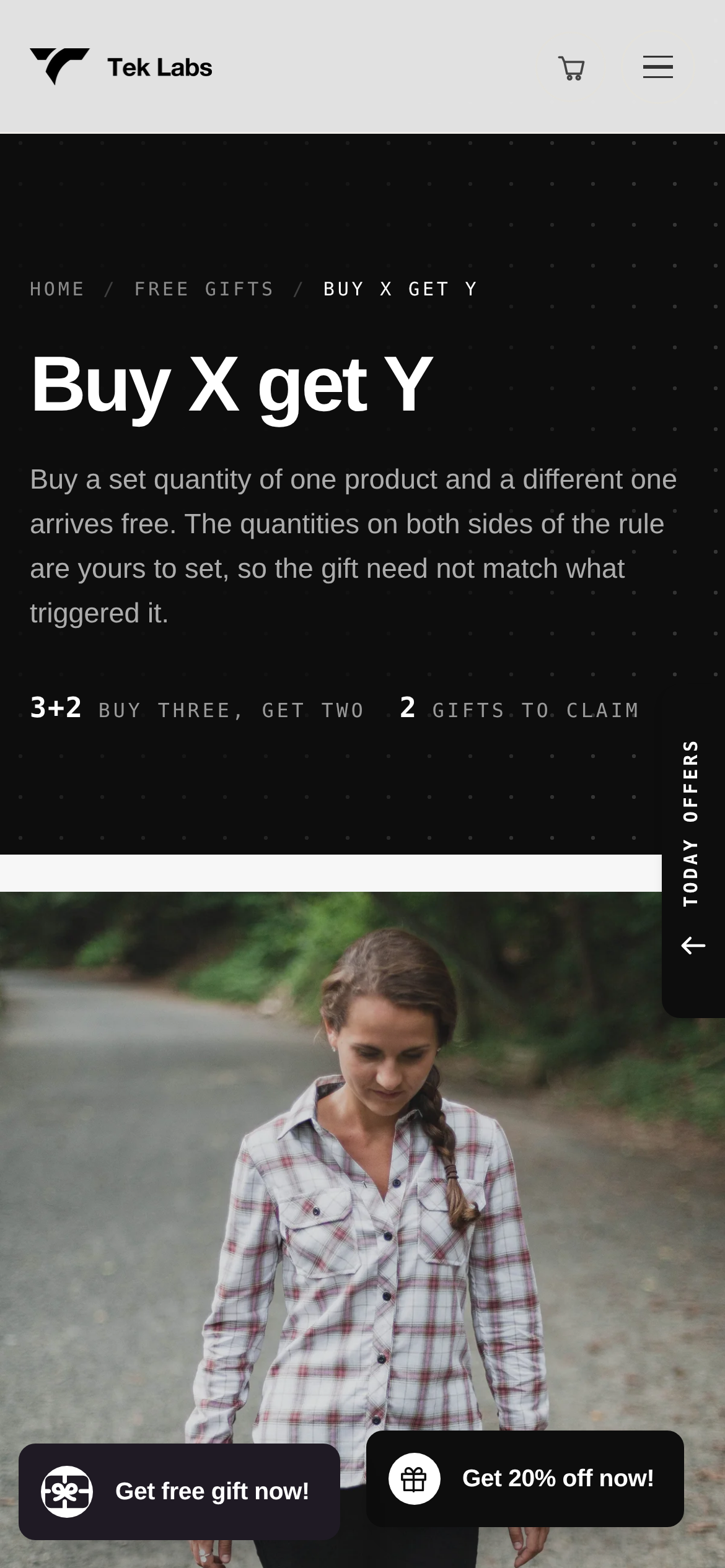
- The free item is never added for the shopper. “Customers must add all items to their cart manually. The free or discounted ‘get’ item is never automatically added to the cart.” Shoppers who miss the instruction pay full price and may blame the store.
- The “get” value can be a percentage, an amount off each item, or free. One tool therefore covers BOGO free, BOGO 50% off and a free accessory.
- Same product or collection means the cheaper item is discounted. If the “buys” and “gets” selections are the same, “the lower-priced item that the customer chooses is the item that the customer gets at a discount.” In a collection with $60 and $45 items, the free unit is the $45 one, and shoppers learn to pair them that way.
- You can cap uses per order. A maximum number of uses per order stops a shopper from buying 20 units to get 10 free, which matters for scarce stock.
- Free stock is real stock. If the inventory of the free product reaches zero, the product shows as sold out and customers cannot take the discount.
- Minimum purchase counts products at full price only. Shipping and taxes never count, and an item that already carries another combined product discount does not count at all.
- Channels. On POS Lite, Buy X get Y works only in online checkout; POS Pro supports both. Discounts created in the admin do not apply to the post-purchase page.
Stacking with other discounts
Shopify’s rules on discount combinations change the effective depth of your offer. For most stores, “all products that are part of a Buy X get Y discount are ineligible for further product discounts.” Stacking a 10 percent code on top of BOGO free on the same items does not work, which caps your depth at 50 percent but also surprises customers who arrive with a welcome code. Shopify Plus merchants can combine product discounts on the same line item with tags. Other limits on that page: up to 5 product or order discount codes plus 1 shipping code on an order, and a maximum of 25 active automatic discounts including app-based ones. Test every combination in a draft cart before launch.
Our earlier guide on Shopify default Buy X Get Y versus third-party providers walks through the setup screens, so we will not repeat them here.
Rules you have to respect when you advertise BOGO
This section is general information from the FTC guide, not legal advice. Ask your counsel about your specific offers.
- A “free” item rests on a regular price. The FTC says that when a purchaser is told an article is free if another is bought, the word free “indicates that he is paying nothing for that article and no more than the regular price for the other.” A purchaser “has a right to believe that the merchant will not directly and immediately recover, in whole or in part, the cost of the free merchandise or service by marking up the price of the article which must be purchased.”
- “Regular price” has a 30-day test. It is the price at which the seller openly and actively sold the product “for a reasonably substantial period of time, i.e., a 30-day period.” If no substantial sales were made at that price, “a ‘Free’ or similar offer would not be proper.” Do not raise the price in October to fund a Black Friday BOGO.
- Conditions go next to the offer. “All the terms, conditions and obligations should appear in close conjunction with the offer of ‘Free’ merchandise or service.” A footnote reached by an asterisk is not regarded as disclosure at the outset. Put “Buy 2 jackets, the cheaper one is free, limit 2 per order” beside the headline.
If your site also shows a crossed-out “was” price on the same product, the FTC’s separate guide on former price comparisons applies: the former price must be the actual, bona fide price at which the article “was offered to the public on a regular basis for a reasonably substantial period of time” (16 CFR 233.1). The quotations on “free” offers come from the guide text as published on Cornell LII (16 CFR 251.1).
Returns: decide what happens to the free item
A BOGO order raises a question few merchants answer in advance: if the shopper returns the paid unit, do they keep the free one? The policy is yours, and your returns tool has to follow it. Some returns apps document their own rule. Swap, for example, states the refund as “Total originally paid – full (undiscounted) price of items kept” when a return breaks the discount condition, with a minimum refund of zero (Swap help center). That is one app’s method, not a Shopify rule. Write the rule you want, put it on the offer page and check that your returns flow applies it.
Extra costs matter to the shopper too. In Baymard Institute’s compilation of 50 studies the average documented cart abandonment rate is 70.22 percent, and the top reason after “just browsing” is extra costs that are too high (shipping, tax, fees), at 40 percent (Baymard). A BOGO that doubles the parcel weight can raise shipping at the last step, so show shipping early or set a free shipping tier above the BOGO basket.
How to test BOGO against percentage off in 14 days
Do not decide from a spreadsheet alone. Run a controlled comparison and judge it on contribution, not on sales.
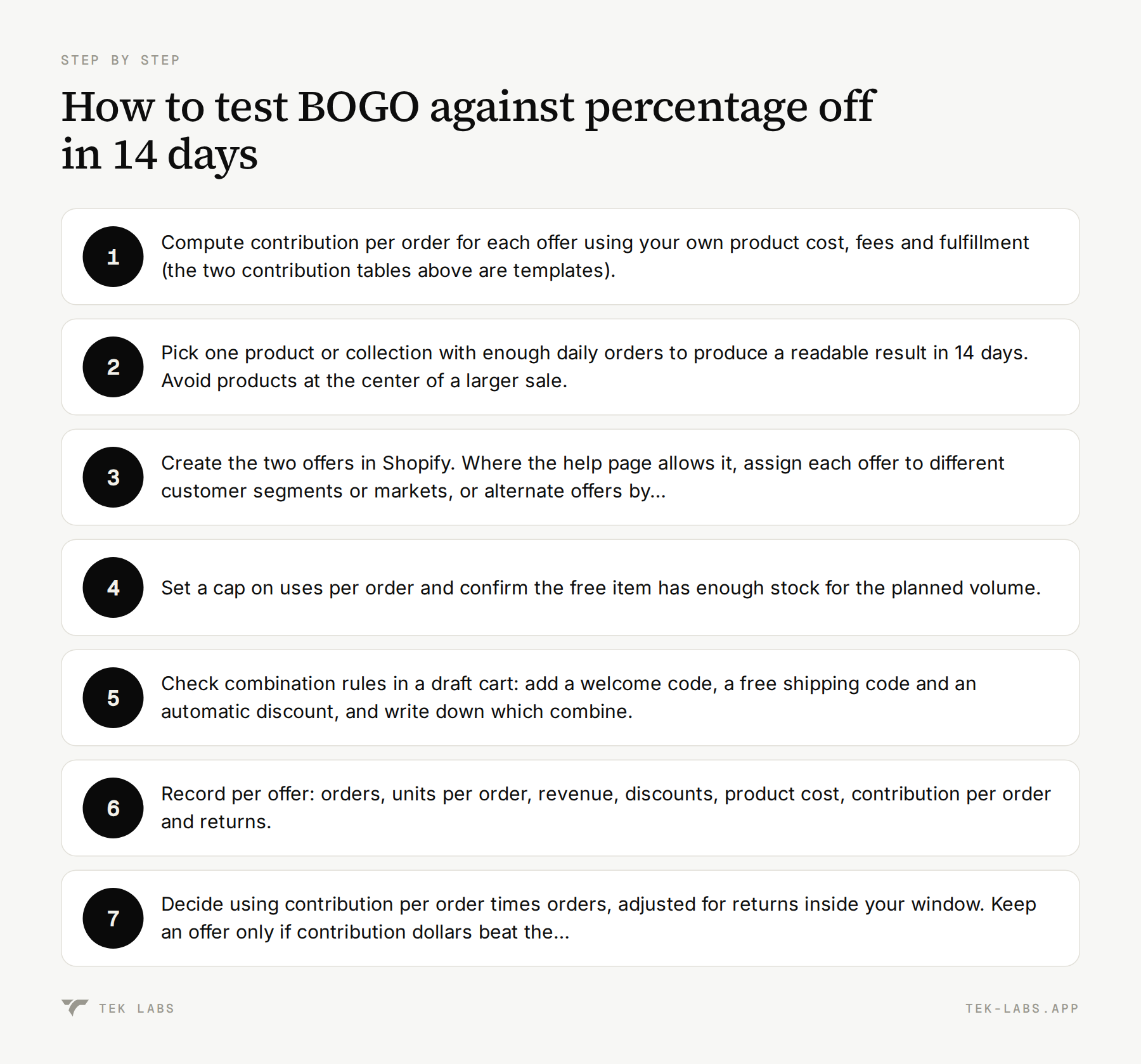
- Compute contribution per order for each offer using your own product cost, fees and fulfillment (the two contribution tables above are templates).
- Pick one product or collection with enough daily orders to produce a readable result in 14 days. Avoid products at the center of a larger sale.
- Create the two offers in Shopify. Where the help page allows it, assign each offer to different customer segments or markets, or alternate offers by week and avoid overlap with email campaigns.
- Set a cap on uses per order and confirm the free item has enough stock for the planned volume.
- Check combination rules in a draft cart: add a welcome code, a free shipping code and an automatic discount, and write down which combine.
- Record per offer: orders, units per order, revenue, discounts, product cost, contribution per order and returns.
- Decide using contribution per order times orders, adjusted for returns inside your window. Keep an offer only if contribution dollars beat the baseline.
Common mistakes
- Comparing offers by name, not by per-unit price. BOGO free and 50 percent off are the same price per unit.
- Running BOGO free on the same item below 50 percent margin. Every unit loses money, so volume cannot fix it.
- Ignoring who would have bought anyway. Every shopper who would have paid full price for one unit now gets a second unit free, and that cost never shows up in a sales report.
- Reading AOV alone. Shopify’s AOV subtracts discounts, so a BOGO that doubles units can leave AOV flat.
- Forgetting the cart step. The native free item is never added automatically, so the offer has to be visible on the product page and in the cart.
- Raising prices before the sale. It breaks the regular price test for “free” offers and the former price test for crossed-out prices.
Running the offer in Salepify
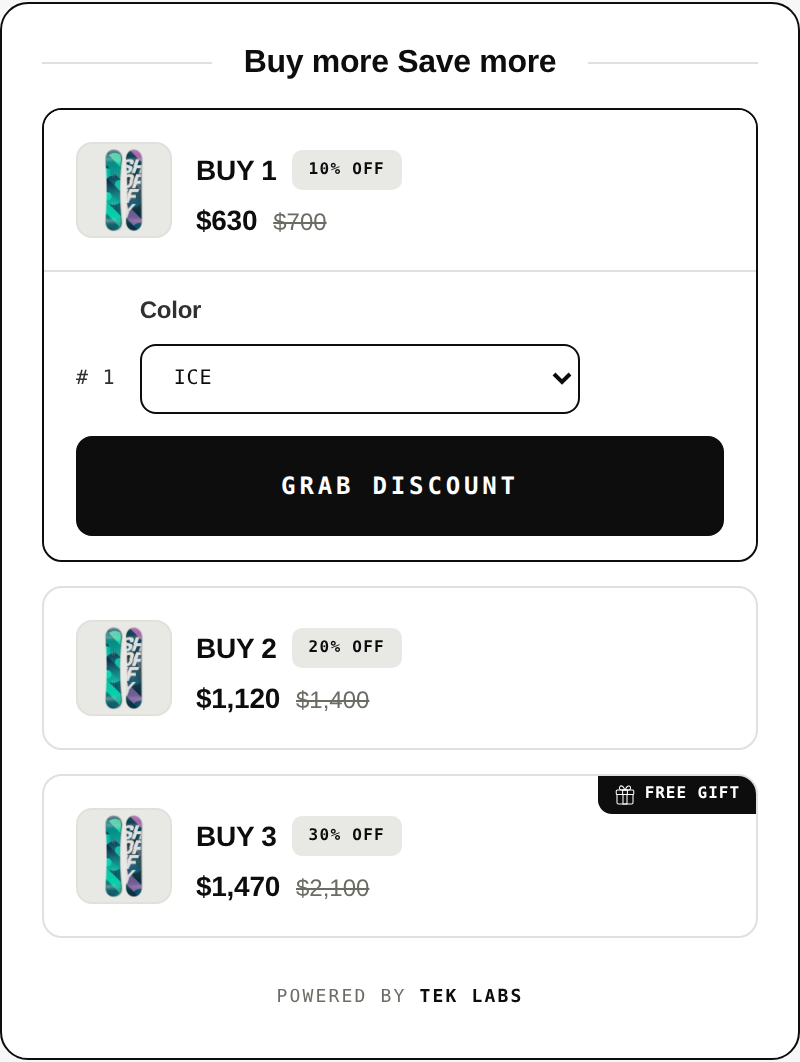
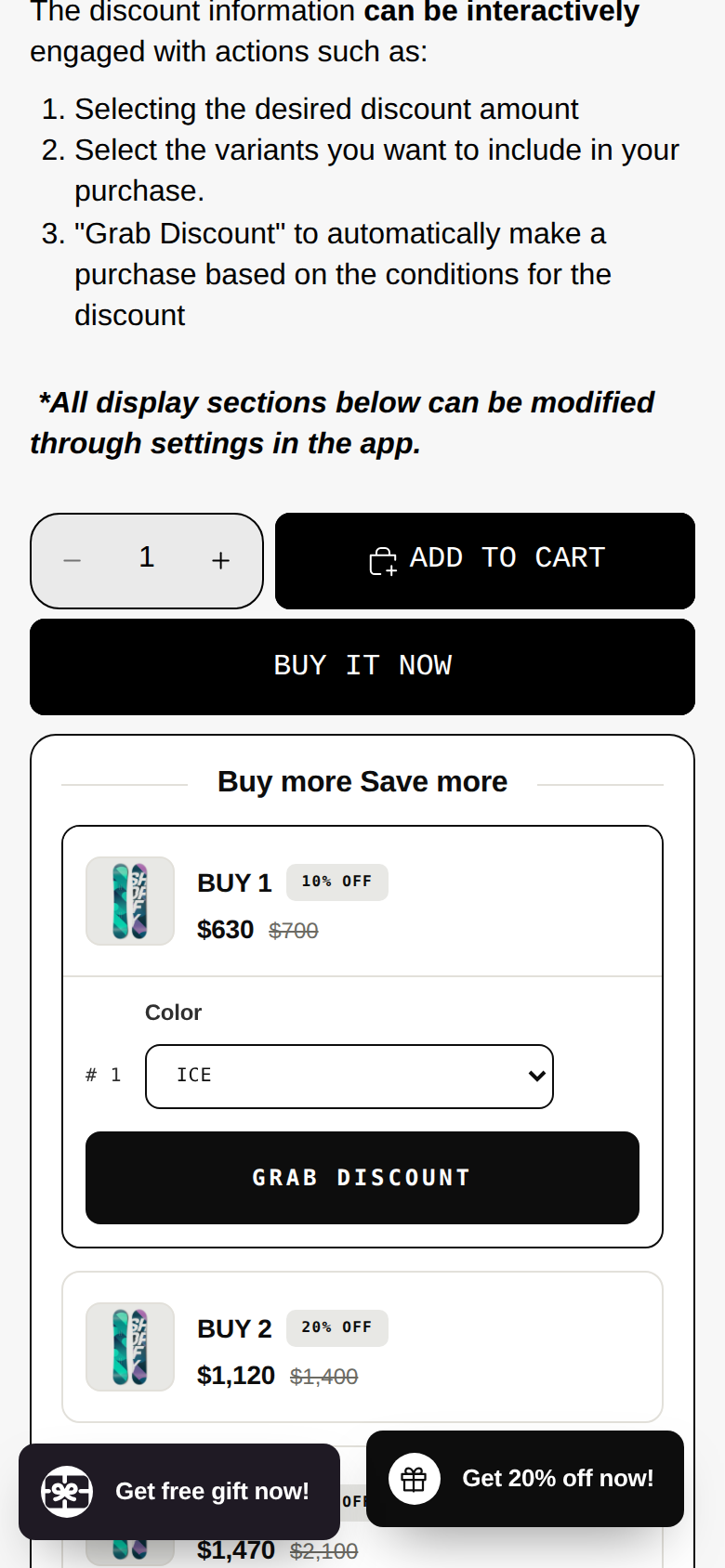
If you want BOGO, Buy X Get Y, volume tiers or a free gift in one place, Free Gifts BOGO & Upsell (Salepify) covers all of them. Its App Store listing describes support for free gift with purchase, Buy X Get Y and BOGO offers, volume discounts, a cart progress bar with multi-tier gift rewards, and the choice to add the gift to the cart automatically or let the customer pick, which addresses the manual cart step above. It has a free plan, and you can try offers on our demo store (store password: 1). The free gift calculator can help you size a gift offer, and our glossary defines the terms used here.
Frequently Asked Questions
Is BOGO better than a percentage discount?
Not by price: BOGO free is 50 percent off per unit. It can work better for volume because shoppers respond to the framing, but it only protects profit when margin is high or when the free item is a cheap, different product.
What margin do you need to run BOGO free?
Above 50 percent gross margin on the item, and even then it earns less per order than a full-price sale. At 55 percent margin on a $60 item, BOGO free earns $6 per order against $33 for one full-price unit.
Is “buy one get one 50% off” cheaper to run than BOGO free?
Yes, it is a 25 percent discount per unit, half the depth of BOGO free. At 40 percent margin, a $60 item earns $18 per order under BOGO 50% off against a $12 loss under BOGO free.
Can I stack a discount code on a Shopify Buy X Get Y offer?
For most stores, no: products in a Buy X get Y discount are ineligible for further product discounts, although other discount classes can combine as the combination rules allow. Shopify Plus can combine product discounts on the same line item using tags.
Do BOGO offers affect AOV in Shopify?
Shopify defines AOV as gross sales minus discounts, so a BOGO order that doubles units can show the same AOV as a single full-price unit. Watch units per order and contribution per order as well.