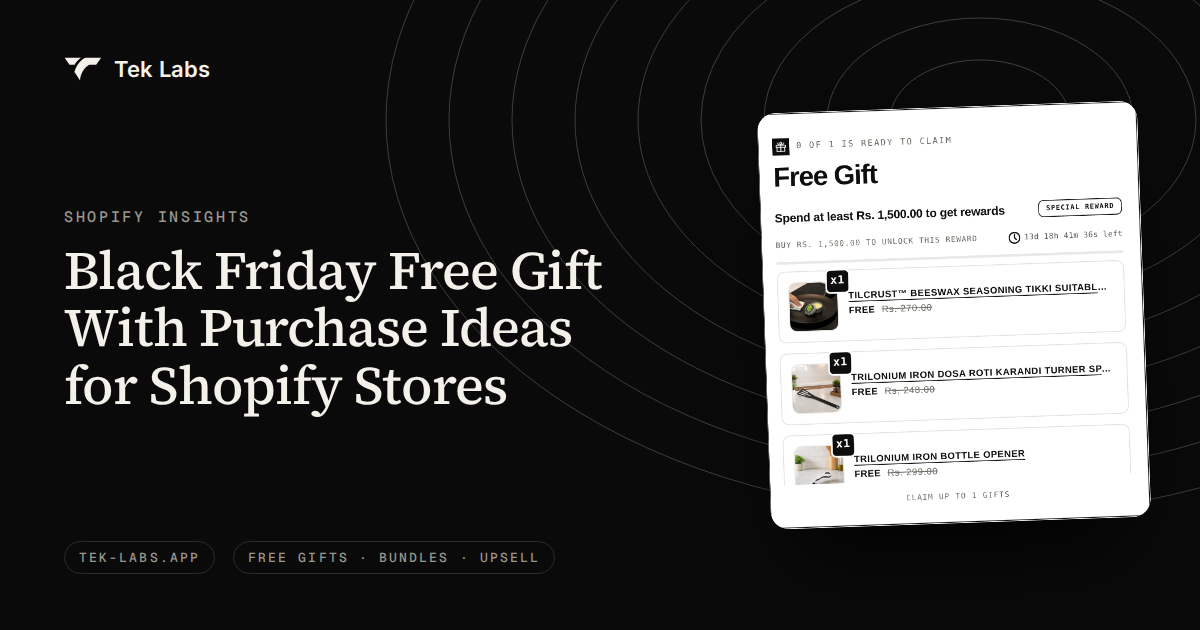
The best Black Friday free gift with purchase is cheap to land, looks worth more than it costs, matches what is in the cart and cannot run you out of stock. In practice that usually means a complementary accessory, a deluxe sample or a pick-one-of-three choice, unlocked at a threshold above your normal basket. The eight ideas below are ranked by landed cost against perceived value, with notes on how each one is delivered on Shopify.
Key takeaways
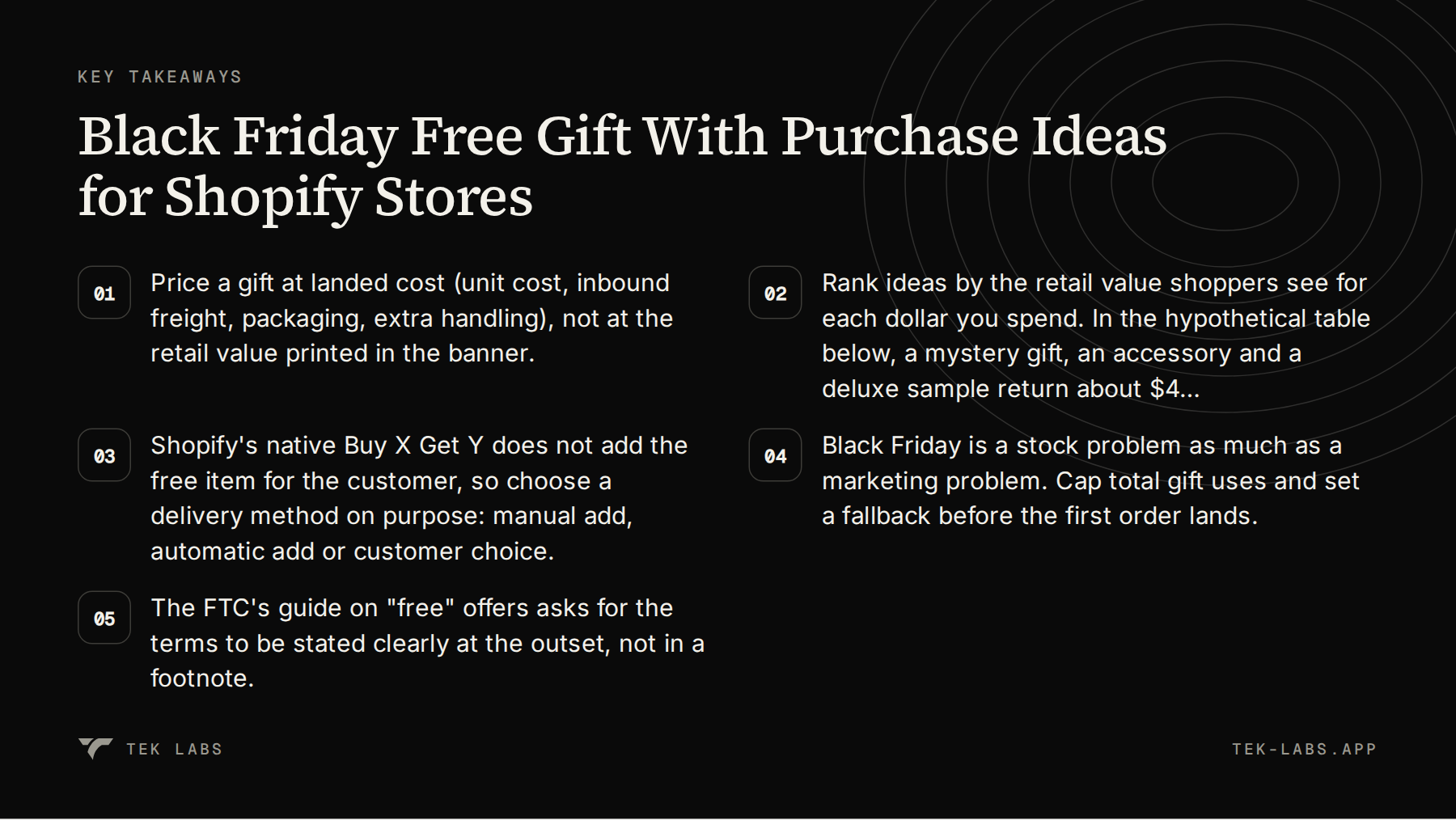
- Price a gift at landed cost (unit cost, inbound freight, packaging, extra handling), not at the retail value printed in the banner.
- Rank ideas by the retail value shoppers see for each dollar you spend. In the hypothetical table below, a mystery gift, an accessory and a deluxe sample return about $4 to $5 of shown value per $1 of cost, while a full-size product returns about $2.86.
- Shopify’s native Buy X Get Y does not add the free item for the customer, so choose a delivery method on purpose: manual add, automatic add or customer choice.
- Black Friday is a stock problem as much as a marketing problem. Cap total gift uses and set a fallback before the first order lands.
- The FTC’s guide on “free” offers asks for the terms to be stated clearly at the outset, not in a footnote.
What a Black Friday gift has to do
A gift with purchase has three jobs during the sale. It should lift the basket, it should not teach customers to wait for the next promotion, and it should leave a margin after the discount competition around you. The third job is the one that most idea lists skip.
Competition matters because shoppers compare. Adobe’s 2025 Cyber Monday analysis reported discount levels of 31% off listed price for electronics, 28% for toys, 25% for apparel and 23% for computers, and record online spending of $11.8 billion on Black Friday and $14.25 billion on Cyber Monday (Adobe). If your category runs around 25% off, a $100 cart is competing with a $25 saving. A gift that your shopper sees as worth $25 and that costs you $5 is a far cheaper way to compete than giving up $25 of margin.
There is also a reason to be modest about gifts. Shopify’s BFCM ideas article quotes Impact’s 2025 US holiday research: 38% of online shoppers preferred percentage discounts on a single item, 38% preferred BOGO or similar offers, 35% preferred flash sales, 21% preferred a free gift with purchase and 20% preferred bundle deals. A free gift is not the most popular promotion. It works best as the reward for a threshold, where it competes on the cost side, and not as your only headline.
One more piece of evidence supports giving, not discounting. Palmeira and Srivastava found in the Journal of Consumer Research that willingness to pay for a product after the promotion is retracted was higher when it had been offered for free than when it had been offered at a low discounted price. It was a controlled study and not a forecast for your store, but it points the same direction.
If you have not yet worked out where the threshold should sit, start with our worked example of setting a free gift threshold. It shows why every order already above the line also costs you a gift. This post is about what to put behind the line. For the wider promotion mix around a gift, see our BFCM promotion strategies.
How to price a gift before you choose it
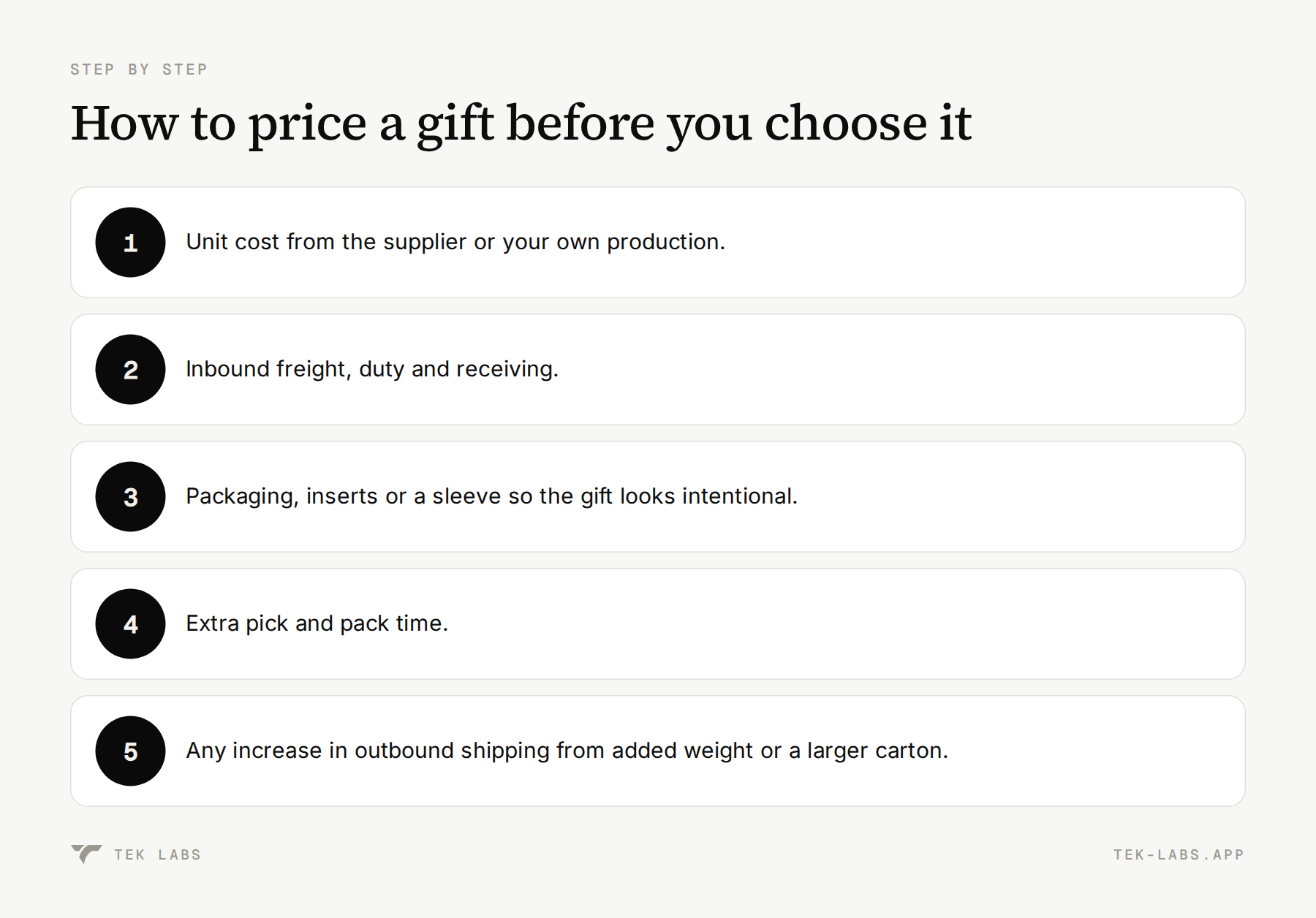
Use landed cost, which is everything that leaves your bank account because one more gift went into one more box:
- Unit cost from the supplier or your own production.
- Inbound freight, duty and receiving.
- Packaging, inserts or a sleeve so the gift looks intentional.
- Extra pick and pack time.
- Any increase in outbound shipping from added weight or a larger carton.
Then compare the landed cost with two numbers: the retail value you will show, and the break-even gift cost for your threshold. The second one is the figure that matters, and the method for calculating it is in the linked post. For reference, Intelligems describes the target as a low-cost, high-perceived-value gift and illustrates it with a gift of about $8 in cost of goods that has a perceived value of $30 to $40. That is a vendor illustration, not a benchmark, and you should test what your own shoppers think a gift is worth.
Eight Black Friday free gift ideas, ranked
Everything in the table is hypothetical. The costs are built up from plausible components, and the “retail value” is the price you would show next to the gift. Ranking is by retail value per $1 of landed cost, highest first, with a separate column for how likely the perceived value is to disappoint.
| Rank | Gift idea | Retail value shown | Landed cost | Value per $1 of cost | Perception risk |
|---|---|---|---|---|---|
| 1 | Digital gift (guide, template, class) | $10 | $0.50 | 20.0 | High |
| 2 | Mystery gift | $25 | $5.00 | 5.0 | Medium |
| 3 | Complementary accessory | $15 | $3.50 | 4.29 | Low |
| 3 | Deluxe sample or mini | $12 | $2.80 | 4.29 | Low |
| 5 | Pick one of three | $15 average | $4.00 worst case | 3.75 | Low |
| 6 | Limited-edition exclusive | $20 | $6.00 | 3.33 | Medium |
| 7 | Bounce-back gift card | $10 face | $3.50 expected | 2.86 | Low |
| 7 | Full-size product | $40 | $14.00 | 2.86 | Low |
The ratio rewards cheap items, so read the last column alongside it. A digital gift tops the table on arithmetic but depends entirely on whether shoppers believe the $10 number. A deluxe sample or accessory ranks lower on the ratio and lower on risk, which is why they are the safe default. Here is how each landed cost is built and what to watch for.
1. Digital gift
A buying guide, a recipe pack, a template or a short video class. Landed cost in the table is $0.50 for delivery, support time and production spread over about 1,000 claimants. The risk is value: only quote a “$10 value” if you could defend it, for example because you sell the same item at that price elsewhere. It suits stores where the product comes with a learning curve, and it is a poor fit for gift buyers who want something to unwrap.
2. Mystery gift
Shopify’s article reports that Our Place offered shoppers a free mystery gift with orders over a certain amount during a past BFCM promotion. The mystery format lets you move overstock without naming the item. In the table the average landed cost is $5.00: $3.70 unit cost, $0.40 packaging, $0.40 pick time and $0.50 inbound. The two risks are a gift that undershoots the promised value and a gift that is worth more than your budget on the day the wrong item ships. Pick a fixed pool of three or four items, cap the cost of each, and state the minimum retail value only if every item in the pool meets it.
3. Complementary accessory
A travel pouch with a skincare set, a sleeve with a candle, a cleaning cloth with eyewear. It scores well because relevance does the work. Landed cost is $3.50: $2.50 unit, $0.35 inbound, $0.25 packaging and $0.40 pick time. Choose an item that sits in your catalog already, so reorder and returns are simple.
3. Deluxe sample or mini
A mini version of a core product, at $2.80 landed in the table: $1.80 unit, $0.30 inbound, $0.30 packaging and $0.40 pick. It has two uses: a reason to cross the threshold and a trial that can lead to a full-size order. If the product is regulated (cosmetics, supplements, food), check the labeling rules for samples before you ship them. We do not cover those rules here.
5. Pick one of three
Offer three gifts and let the shopper choose. The worst-case landed cost is the most expensive of the three, since the best-liked item tends to be picked most, so budget at $4.00 when the three cost $3.00, $3.50 and $4.00. Shopper choice removes the “I would never use that” problem, and you learn which gift people actually want. Digismoothie’s guide suggests a gift list of 3 to 4 products and a tiered structure of free shipping around $20 to $30 and gift selection from $50.
6. Limited-edition exclusive
Something shoppers cannot buy elsewhere: a Black Friday colorway, an engraved tin, a numbered print. Landed cost is $6.00 in the table because of the design and packaging spend: $4.20 unit, $1.00 for custom packaging amortized, $0.40 inbound and $0.40 pick. Scarcity is the point, so cap the run and say how many exist. The risk is leftover stock on December 1, so pick a design that can be sold or gifted later.
7. Bounce-back gift card
Shopify’s guide explains the format: set a minimum order threshold and shoppers who reach it receive a gift card toward a future purchase, and gift cards can be created and issued in the Shopify admin under Products > Gift cards. The cost is not a purchase of goods but forgone margin when it is used. The table assumes a $10 card and 35 percent redemption, an expected face cost of $3.50. The redemption rate is my assumption, so replace it with data from your own gift card history. The card also pulls a second order into January, which is why some stores prefer it over a physical gift.
7. Full-size product
A $40 item that costs $14.00 landed: $11.00 unit, $1.40 inbound, $0.60 packaging and $1.00 pick. It is the most generous idea and the easiest for shoppers to understand. It needs a high threshold, or a clearance purpose such as ageing stock, since the cost per gift order is large. Reserve it for a top tier on a milestone ladder, not the first rung.
Which gifts should be auto-added and which chosen by the shopper
Delivery is where a good idea often fails. If the shopper has to find and add the gift alone, many will not.
Shopify’s help page on Buy X Get Y discounts says customers must add all items to their cart manually and that the free or discounted “get” item is never automatically added. Shopify’s own BFCM article describes the same feature as adding the free item automatically. Those two statements conflict. Treat the help page as the mechanics reference and run a test order on your own store before you design the banner around either behavior.
This table is my recommendation, not a platform rule:
| Gift idea | Better delivery | Why |
|---|---|---|
| Digital gift | Auto-add (or email) | Nothing to choose, no stock |
| Mystery gift | Auto-add | Choice would defeat the mystery |
| Complementary accessory | Auto-add, or choice if several fit | Relevance is already built in |
| Deluxe sample or mini | Customer choice if you have several lines | Samples work best when they match the shopper |
| Pick one of three | Customer choice by definition | The format is the choice |
| Limited-edition exclusive | Auto-add with a hard cap | Scarcity should be visible and fair |
| Bounce-back gift card | Issued after purchase | Redeemed later, not in the cart |
| Full-size product | Customer choice at a high tier | High cost, so the shopper should want it |
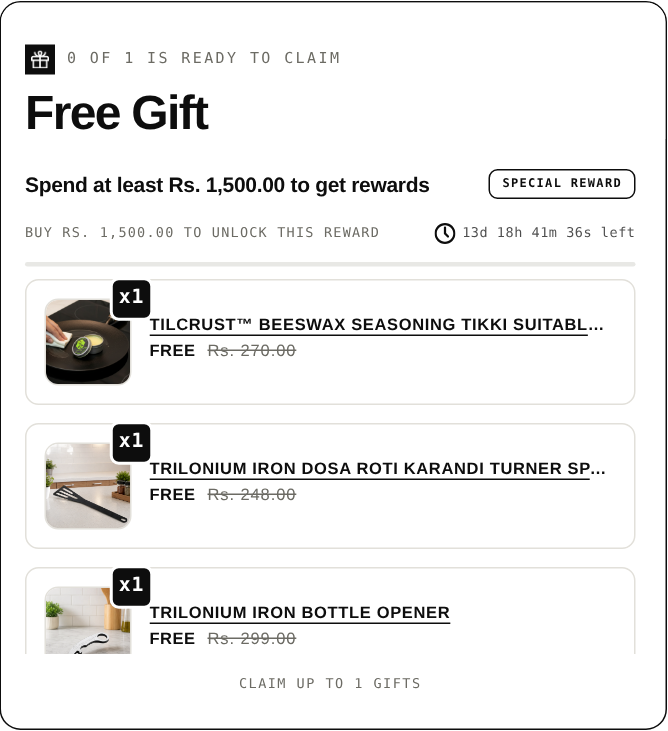
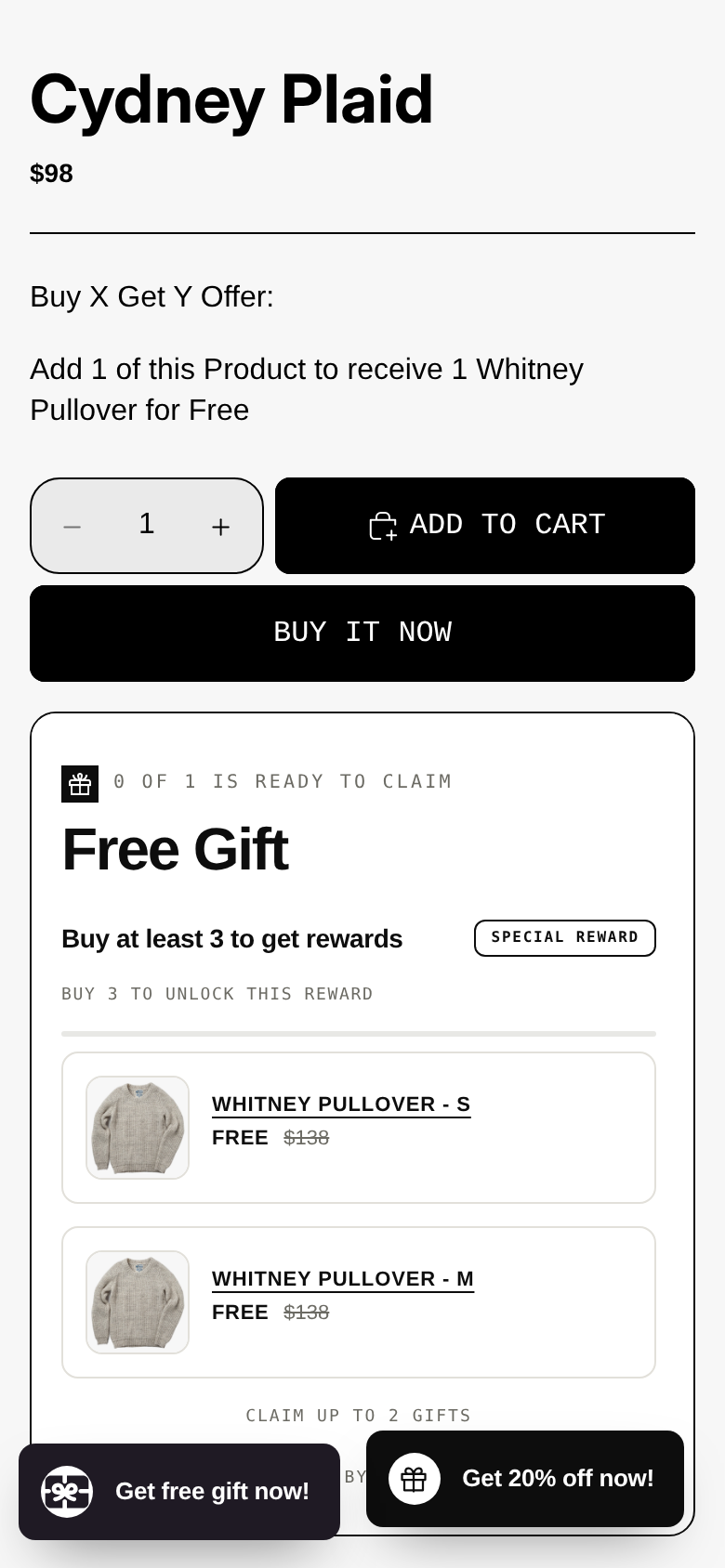
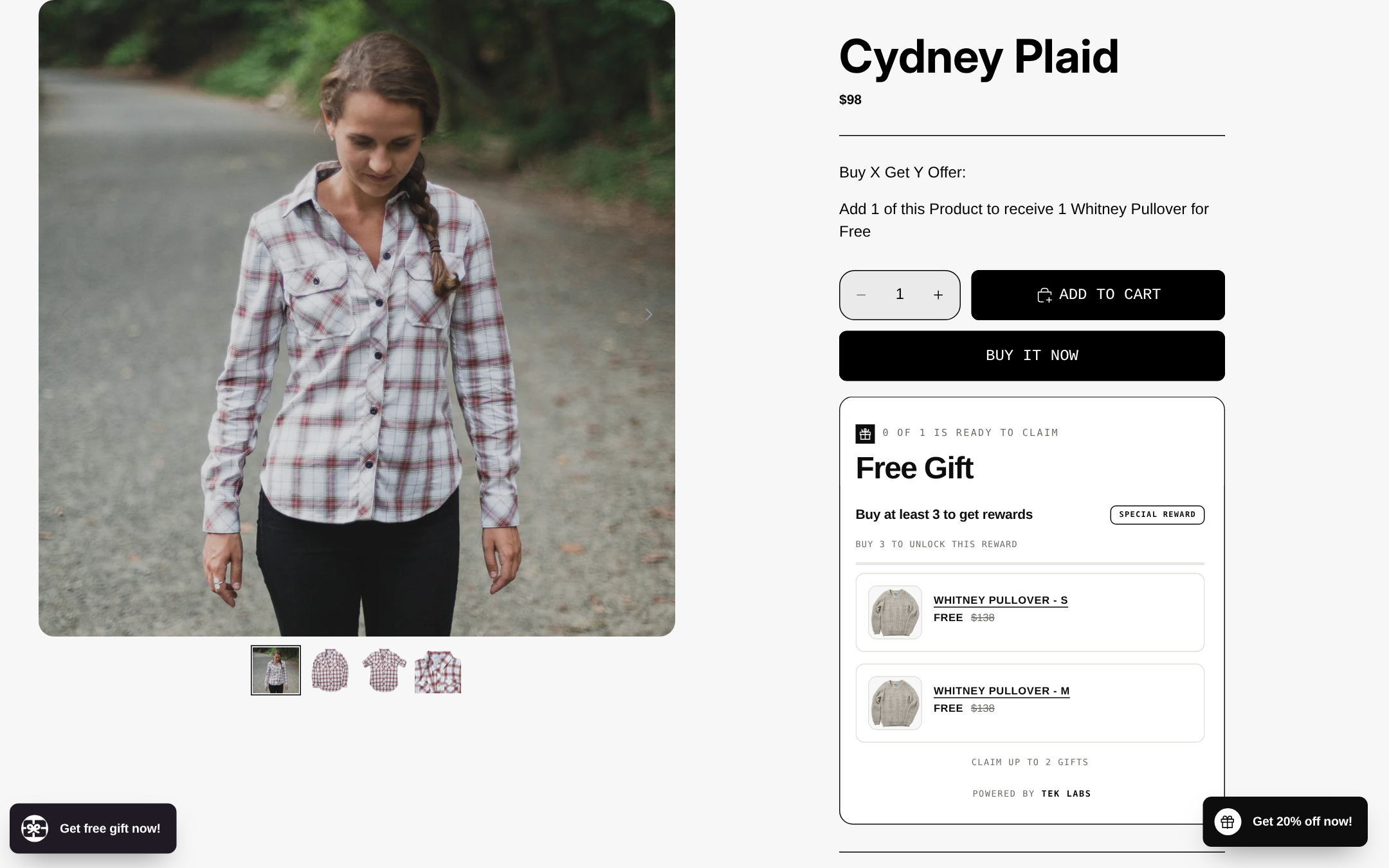
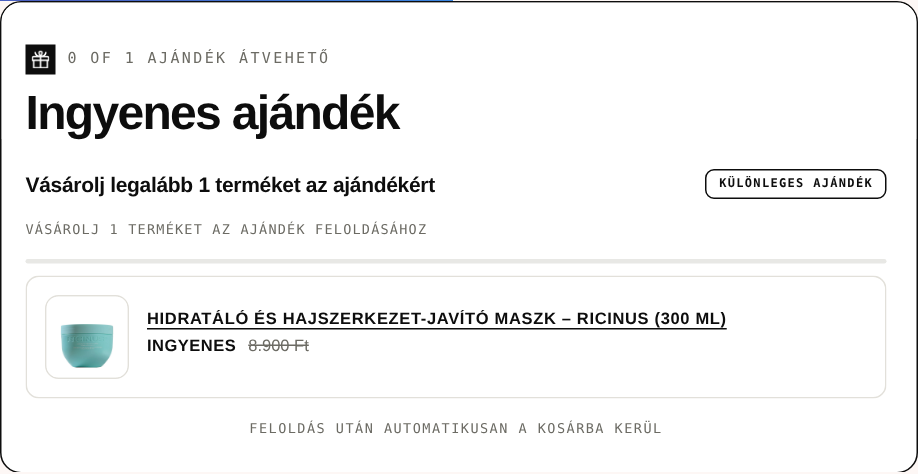
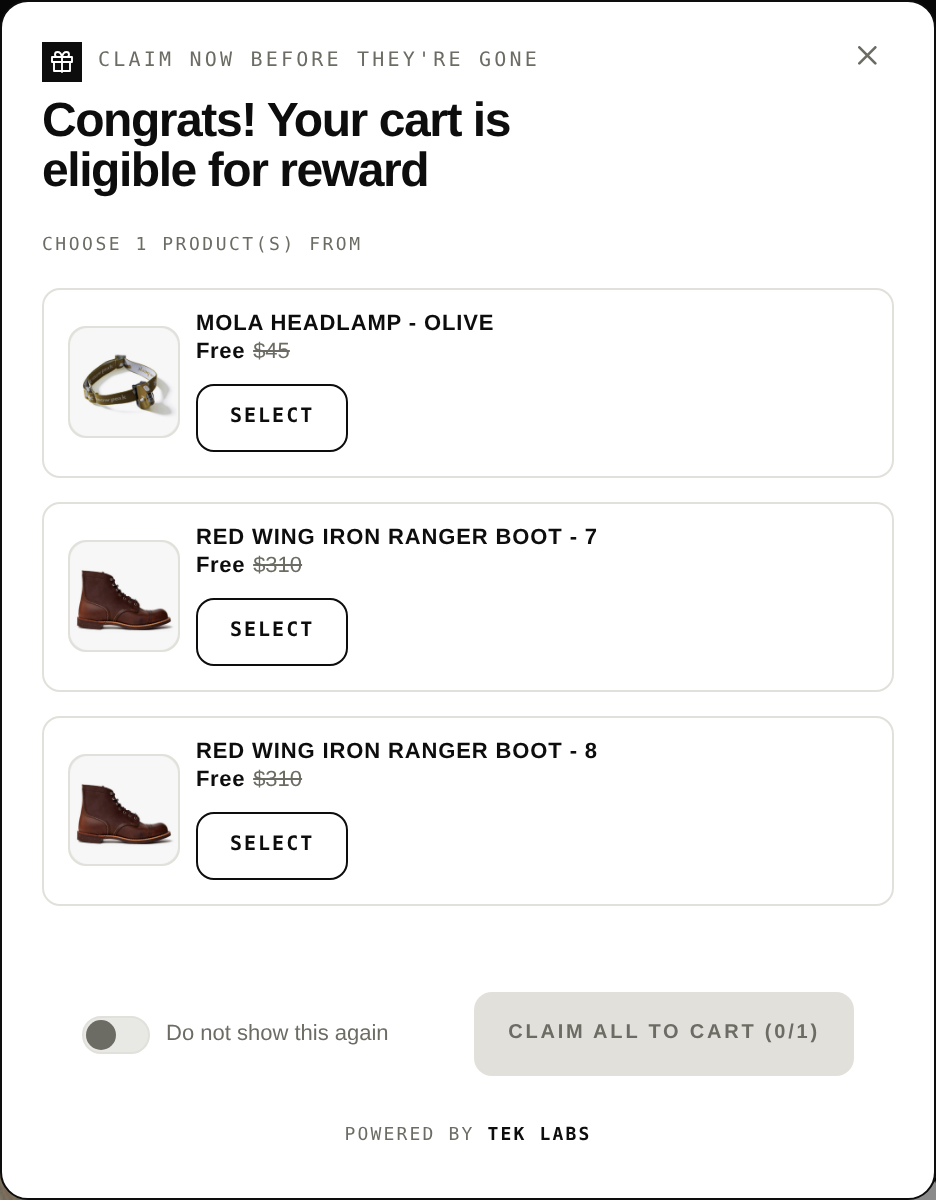
With Tek Labs’ Free Gifts BOGO & Upsell the choice is a setting. Per the user guide, you can add all listed gifts automatically, add only the first available gift (the next one is used if the first is out of stock), let customers choose manually, or discount the cheapest product in the cart instead of giving a separate item. The App Store listing summarizes it as automatically adding the gift or letting customers choose.
The “discount the cheapest product” mode is a useful option for stores with no spare gift stock: the gift is one of the items the customer is already buying, so there is no extra unit to ship. It is a different promise from a bonus item, so word the banner accordingly.
Stock, caps and fallbacks for Black Friday
Black Friday 2026 falls on November 27 and Cyber Monday on November 30. A few settings in the user guide matter most when volume spikes:
- Total usage limit. Sets a cap across all orders. Once it is reached the offer stops for everyone, which the guide describes as useful for limited-stock campaigns.
- Limit per order. By default the offer repeats, so a $100 spend gives one gift and $200 gives two. The guide recommends setting the limit to 1 if you do not want that.
- First available gift. Falls back to the next product when the first is out of stock.
- Hide out-of-stock items. Prevents shoppers from picking a gift you no longer have.
- Auto remove. Takes the gift out of the cart if the cart drops below the condition.
- Validate offer. Checks widget placement and auto-add behavior before you go live.
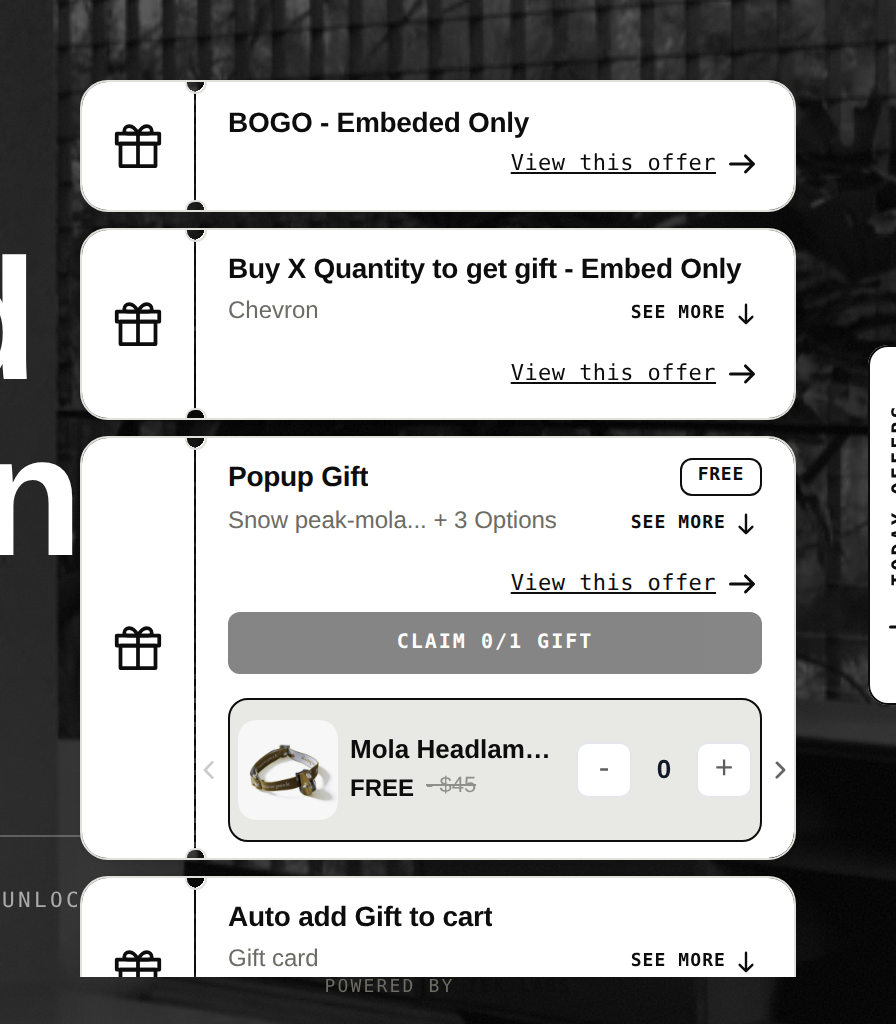
If you want more than one gift tier, the progress bar type supports up to 6 milestones in a rule, each a free gift, cart discount or shipping discount. A common shape is free shipping first, a gift in the middle and a bigger reward at the top, matching Digismoothie’s suggested tiers. The live demo store at demo-salepify-app.myshopify.com (store password: 1) shows the widgets, pop-up and drawer.
Stacking with your sale discount
A gift offer rarely runs alone on Black Friday. Shopify’s combinations page caps active automatic discounts at 25, including app-based ones, and says that on non-Plus plans products that are part of a Buy X Get Y discount are ineligible for further product discounts. So if your Black Friday banner says 20 percent off the collection and the gift qualifies from the same products, check what the cart does with an item that sits in both offers. In the app you can decide whether the gift combines with product, order and shipping discounts, and the guide recommends enabling it when you use other Shopify discounts. Test every combination you advertise, with and without a code.
A 50-day plan from today
Black Friday is 50 days from October 8. The dates below are suggestions for the order in which to work, not deadlines from any platform.
- By October 15. Decide threshold and gift type. Work out landed cost using the method above.
- By October 22. Order the gift and any packaging. Get a written delivery date from the supplier.
- By October 29. Build the offer, validate it and run a test order with each discount you will advertise.
- By November 1. Write the banner and the terms. Put the threshold and every exclusion in the same line as the gift.
- November 1 to 13. Tease the offer to subscribers. NRF reports that approximately two out of every five holiday shoppers have started browsing and buying before November (NRF), so waiting for Thanksgiving week means missing a share of them.
- November 20. Freeze the setup. Check stock against a worst case of all gifts claimed.
- November 27 to 30. Watch stock and the cart twice a day. Have a replacement gift ready to swap in.
Mobile matters in this window. Adobe reported that 57.5% of online sales on Cyber Monday 2025 came through a mobile device (Adobe). A choice-based gift needs a pop-up or widget that works with a thumb, on a small screen, with the claim button visible without scrolling.
Disclosure: what the FTC guide says
The Federal Trade Commission’s guide on “free” offers, 16 CFR 251.1, applies directly to a gift with purchase. Three points matter for a Black Friday banner.
- Conditions up front. All terms, conditions and obligations on which the free item depends should be set out clearly and conspicuously at the outset, in close conjunction with the offer. The guide says a footnote reached by an asterisk is not disclosure at the outset. Put “free with orders of $100 or more, one per order, while the 500 gifts last” in the banner itself.
- No price markup. A purchaser has a right to believe the merchant will not directly and immediately recover the cost of the free item by marking up the price of the article that must be purchased. Do not raise prices for the sale to pay for the gift.
- Frequency. A single size of a product should not be advertised with a “free” offer for more than 6 months in any 12-month period. If you give away the same sample every month, check with counsel.
This is a summary of public guidance and not legal advice. A mystery gift raises an extra question about any value claim, so only state a minimum value if every possible item meets it.
Common mistakes
- Pricing the gift at retail. A $15 accessory that costs $3.50 is a $3.50 decision. Treating it as a $15 giveaway makes you under-offer, while ignoring the landed cost makes you overspend.
- Forgetting that the threshold gives the gift to everyone above it. Orders that would have qualified anyway are a cost. The linked worked example shows how large that share can be.
- Choosing a gift that competes with your own product. A full-size item at a low threshold cannibalizes sales.
- No stock cap. The banner says “free gift” and the stock is gone by Friday evening. Use a total usage limit.
- Leaving delivery to chance. If the shopper must add the gift manually and the page does not say so, many will not.
- Burying the terms. An asterisk is not a disclosure under the FTC guide.
- Running the offer too long. Something that is always free is not a Black Friday event, and the FTC’s frequency guidance applies.
Putting it into practice
If you want to run a gift offer on your store, Free Gifts BOGO & Upsell has a free plan, so you can build the rule, validate it on a test cart and compare delivery modes before the sale starts. Use the demo store linked above to see the widgets and pop-up first (store password: 1).
Frequently Asked Questions
What is a good free gift with purchase for Black Friday?
A complementary accessory, a deluxe sample or a pick-one-of-three choice usually gives the best balance of low landed cost and clear value. Choose something that ships with the order and that you can describe in one line in the banner.
Does Shopify add the free gift to the cart automatically?
Shopify’s help page for Buy X Get Y says customers must add all items to the cart manually and that the free item is never automatically added. Shopify’s own BFCM article describes it differently, so test on your store. An app can add the gift or let the shopper choose.
How much should a Black Friday gift cost me?
Less than the break-even gift cost for your threshold, which depends on your margin and how many orders already qualify. The table in this post uses hypothetical landed costs from $0.50 to $14.00 and shows why cost per dollar of shown value varies so much.
Do I have to disclose the conditions of a free gift?
The FTC’s guide says the terms and conditions of a free offer should be stated clearly and conspicuously at the outset, in close conjunction with the offer. Put the threshold, limits and any stock cap in the banner instead of a footnote.
Should I offer a free gift or a percentage discount?
It depends on your margin and your category. Impact’s 2025 research, quoted by Shopify, found 21% of online shoppers preferred a free gift with purchase against 38% for percentage discounts and 38% for BOGO, so many stores combine a threshold gift with another offer.