The best holiday gift bundle is the one that matches your catalog size and how well the buyer knows the recipient: a fixed set for 3 to 8 hero products, a pick-any-3 set for a dozen or more items at similar prices, and a build-a-box for a range of consumables. Shopify’s free Bundles app covers fixed bundles and multipacks, while sets the customer composes need an app. Plan the format and pricing in mid-October, because the NRF says about two out of every five holiday shoppers start browsing and buying before November.
Key takeaways
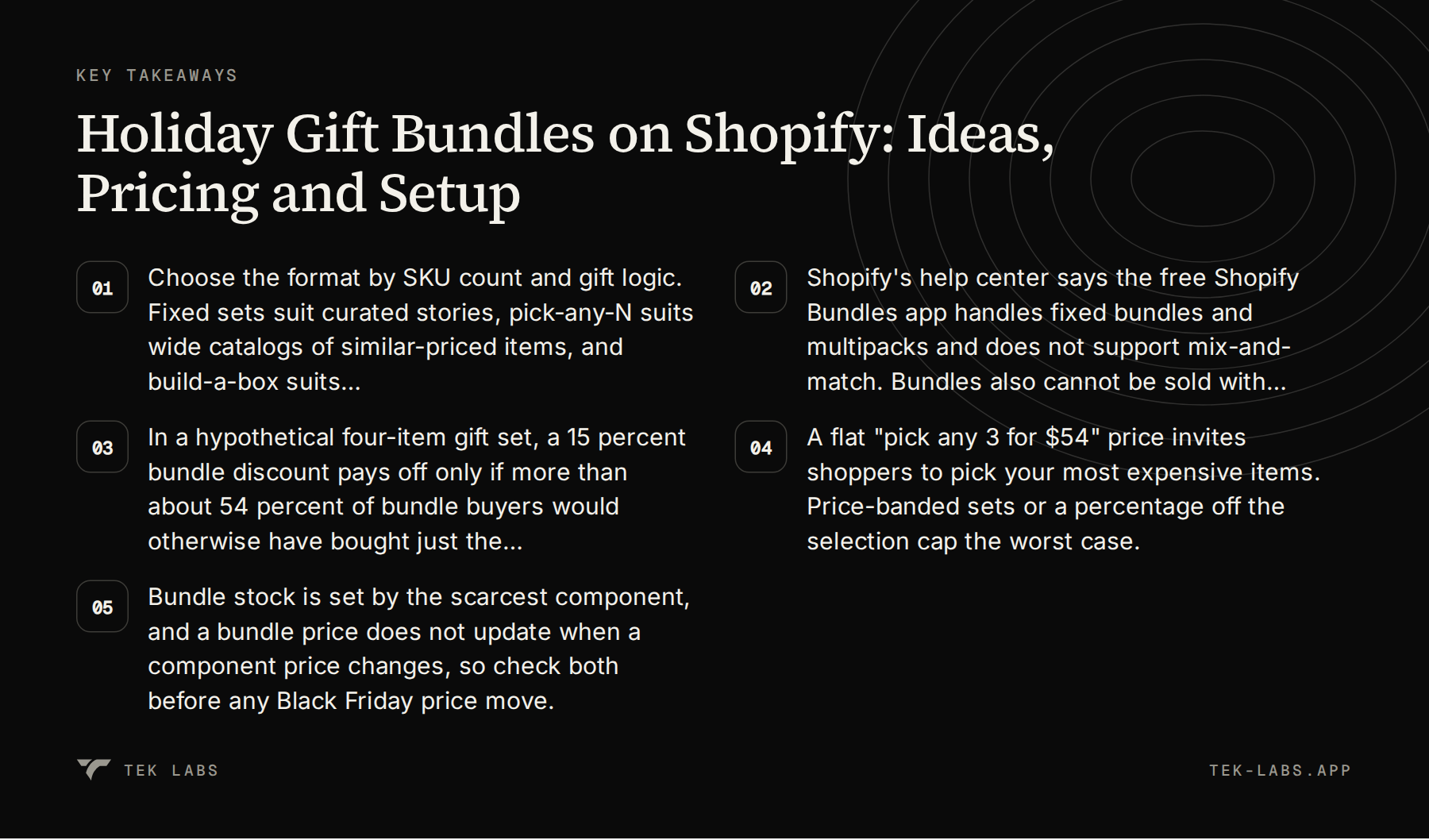
- Choose the format by SKU count and gift logic. Fixed sets suit curated stories, pick-any-N suits wide catalogs of similar-priced items, and build-a-box suits consumables with slots.
- Shopify’s help center says the free Shopify Bundles app handles fixed bundles and multipacks and does not support mix-and-match. Bundles also cannot be sold with selling plans such as subscriptions or pre-orders.
- In a hypothetical four-item gift set, a 15 percent bundle discount pays off only if more than about 54 percent of bundle buyers would otherwise have bought just the lead item. Run that break-even before you pick a discount.
- A flat “pick any 3 for $54” price invites shoppers to pick your most expensive items. Price-banded sets or a percentage off the selection cap the worst case.
- Bundle stock is set by the scarcest component, and a bundle price does not update when a component price changes, so check both before any Black Friday price move.
Why mid-October is the right moment to build gift bundles
The NRF defines the winter holidays as November 1 through December 31. Its FAQ also says that “for the last several years, approximately two out of every five holiday shoppers have started browsing and buying before November,” most often to spread out their budget, avoid last-minute stress and avoid crowds, and that most will “wrap up in December” (NRF Winter Holiday FAQs). A bundle that goes live in the first days of November therefore meets an audience that is already partway through its list, and a bundle that goes live in late November competes with every Black Friday banner on the web.
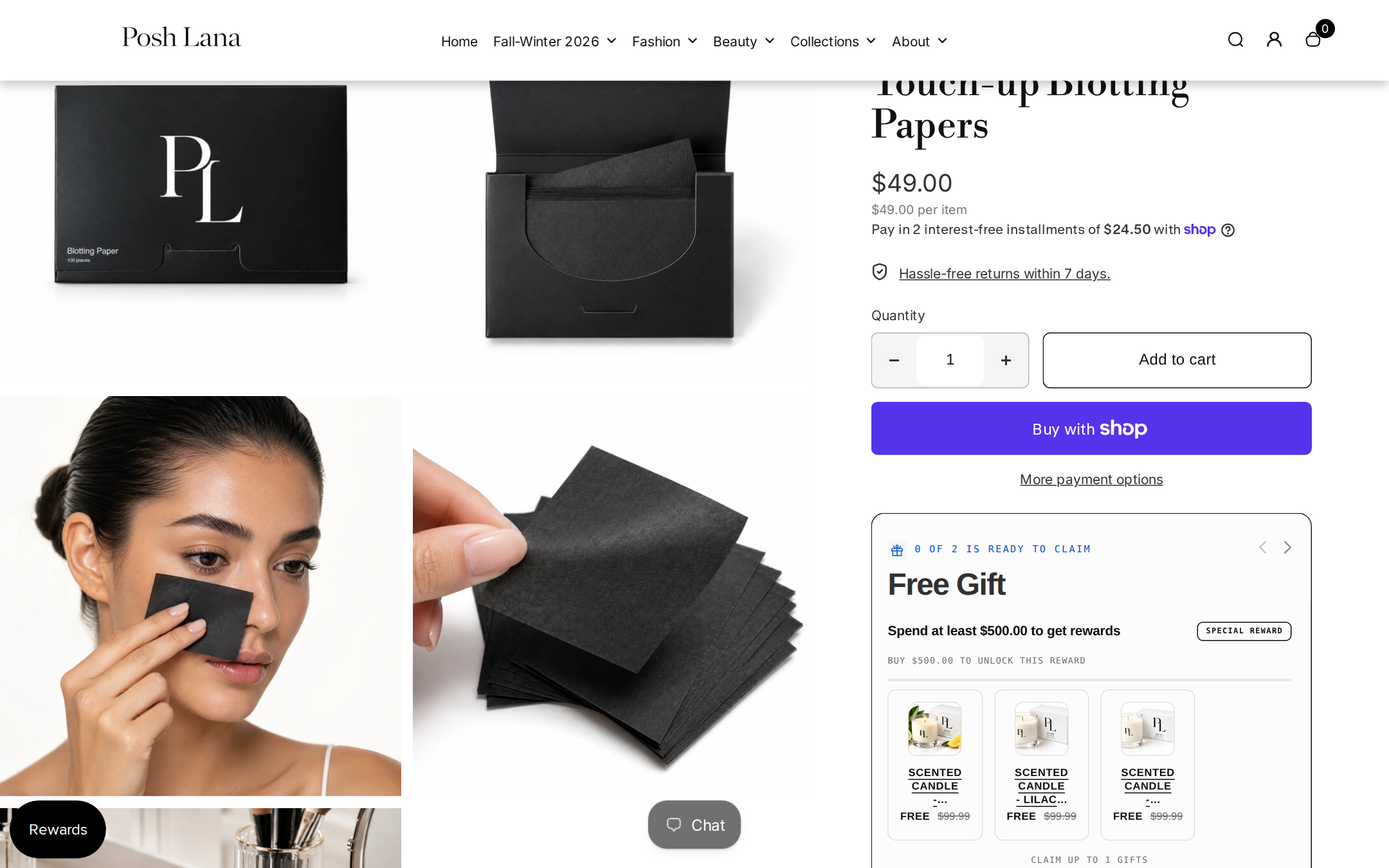
Bundles are also not the only promotion shoppers want. Impact’s 2025 US holiday research, as cited by Shopify, found that 44 percent of respondents chose free and reliable shipping as the most-preferred online holiday promotion, while 21 percent preferred a free gift with purchase and 20 percent bundle deals (Shopify). Read that as a design constraint: a gift bundle works best when it also solves a shipping problem (one parcel, one price) and does not sit alone. Our guide to Black Friday free gift with purchase ideas covers the gift side of that pairing, and our roundup of cross-selling and upselling apps covers the wider toolkit.
Adobe’s numbers show the size of the prize and the price pressure: online spending from November 1 to December 1, 2025 reached $137.4 billion, and apparel discounts peaked at 25 percent off listed price on Cyber Monday (Adobe). A gift bundle that saves 10 to 15 percent is not competing on depth. It competes on convenience, curation and a clear gift story.
Five bundle formats and when each fits
The mistake in most bundle advice is to start with the tool. Start with two facts about your catalog: how many products you could realistically include, and how much the buyer knows about the person receiving the gift.
| Format | Best catalog fit | Gift logic | Shopify native? | Main risk |
|---|---|---|---|---|
| Fixed set (3 to 8 products) | 5 to 20 hero products that already look good together | Buyer does not know the recipient and wants a ready answer | Yes, Shopify Bundles app | One slow item holds the whole set back |
| Multipack (same product, N units) | A single best seller with a low unit price | Stocking stuffers, team gifts, “one for you, one for them” | Yes, Shopify Bundles app | Discount erodes margin on your best seller |
| Pick any 3 (mix and match) | 12 to 60 products at similar price points | Buyer knows the recipient’s taste and wants control | No, needs an app | Shoppers pick the priciest items |
| Build a box (slots or sizes) | Consumables with natural categories | Hosts, clients, teachers: a box of 4, 6 or 8 | No, needs an app | Inventory and shelf life across many components |
| Tiered quantity break | Any product people give in multiples | Buy 3 gifts, save more per gift | Partly, via discounts | Discount depth stacks with other offers |
Shopify’s own help center draws the same line. It defines fixed bundles (“a predetermined set of products and associated variants”), multipacks, and mix-and-match bundles (“made of interchangeable products”, where the customer composes the bundle). It then states that for Fixed or Multipack bundles you can use the free Shopify Bundles app, while for mix-and-match you can use a third-party bundle app, or on Plus build a custom offering with the Bundles APIs (Shopify Help Center). It also states that “the Shopify Bundles app doesn’t support mix-and-match bundles.”
Eight holiday bundle ideas you can price this week
These are structures, not product recommendations. Fill them with your own best sellers and check the margin math in the next sections.
- The starter set. Your best seller plus the two items most often bought with it, packed as one gift. Fixed bundle.
- The price ladder. Three fixed sets at three gift budgets, for example $25, $50 and $100. The NRF reports an average planned holiday spend of $890 per person on gifts, food, decorations and other seasonal items in its 2025 survey, so budgets differ widely and a ladder lets buyers self-select.
- The host gift. Two or three consumables with a presentation box. Fixed bundle or build-a-box.
- The stocking stuffer pack. A multipack of the smallest, cheapest item you sell, three or five units.
- The one-for-everyone pick-3. A mix-and-match set across a wide catalog for buyers who know the recipient. Group the items by price band.
- The mystery bundle. A discounted selection without revealing every item up front. Shopify notes that this can move slower-selling inventory, but because it does not use component-level tracking, “stock for the listing needs to be managed manually” (Shopify).
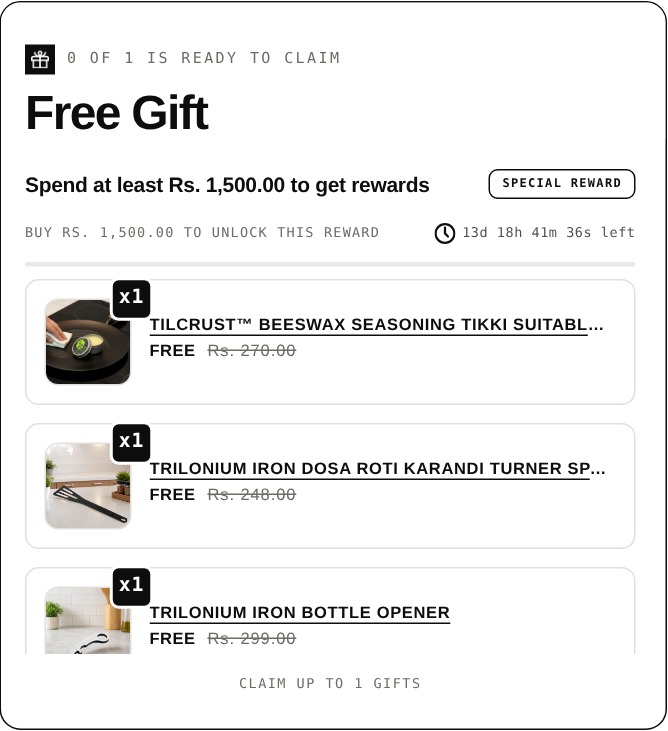
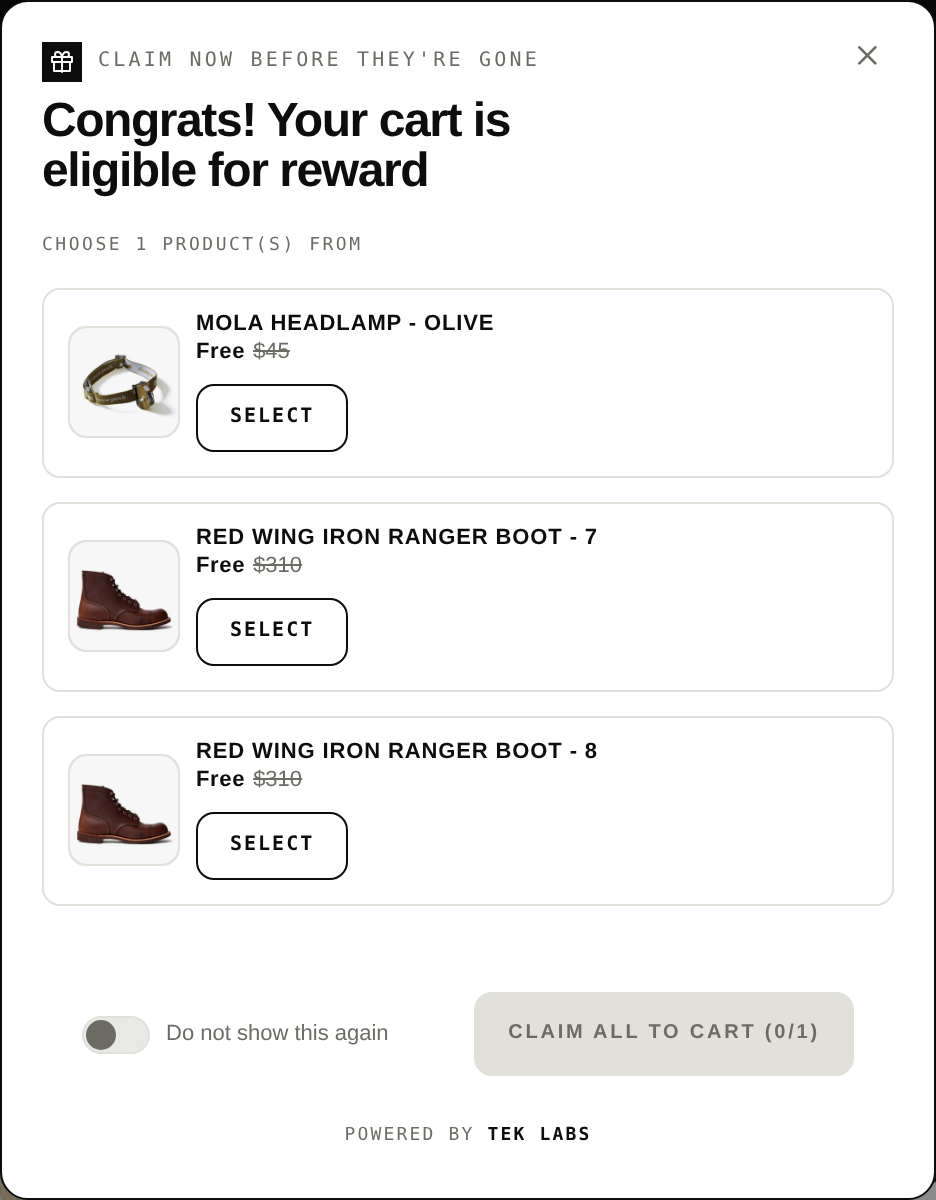
- The bundle plus a gift. Offer a small free item once the bundle is in the cart, which keeps the bundle discount shallow. See our margin math on BOGO versus percentage off for why a cheap free item costs you less than a deeper discount.
- The “for the one who has everything” set. A fixed set built around a hero item with a story, not around a discount.
What Shopify handles natively, and what needs an app
The limits below come straight from Shopify’s documentation and should shape the format you pick.
Shopify Bundles app limits
- Fixed bundles can have up to 30 components, with up to 2,000 units per component, and a maximum of 3 options and 100 variants per bundle (Shopify Help Center).
- Bundles must use the Online Store or Headless storefronts as sales channels; other channels are unsupported on the help page.
- Bundles “can’t be sold with selling plans, such as subscriptions, pre-orders, and try-before-you-buy” (Shopify developer docs). A sold-out gift set cannot go on pre-order through a bundle.
- Bundles cannot contain other bundles, and they cannot be used in exchanges, even when exchanging for an identical bundle (eligibility page).
- Bundles do not have their own shipping profiles. “Shipping rates are calculated based on the shipping profiles of the individual products within the bundle.”
- If a component’s SKU changes, the help center says you need to delete and recreate the entire bundle.
- The store must use an upgraded checkout. Stores that use checkout.liquid customizations are incompatible with product bundles.
Where an app is the practical choice
| What you need | Shopify Bundles app | Tek Labs Mix & Match Bundles |
|---|---|---|
| Fixed bundle or multipack | Yes | Yes, according to its App Store listing |
| Customer picks items from sets (mix and match) | Not supported per the help center | Listed: mix-and-match, build a box, sample packs |
| Quantity breaks, tiered pricing | Discount codes or automatic discounts on the parent bundle, or a manually set bundle price | Listed: tiered pricing, quantity breaks, flat and percentage discounts, free shipping, BOGO |
| Theme-matched picker UI | Fixed bundles work on existing product pages without theme changes (Shopify developer docs) | Listed: customize the bundle UI with custom CSS to match the theme |
| Plan | Free, all Shopify plans | Free plan available |
We build Mix & Match Bundles, so check each claim against its App Store listing and the help pages above before you decide. If your gift range is under 10 products and you sell every item as a fixed set, the free native app is likely enough.
Worked example 1: pricing a fixed gift set
This example is hypothetical. A candle and home fragrance store sells four items. Prices and landed costs are assumptions for the arithmetic.
| Item | Price | Landed cost |
|---|---|---|
| Candle | $32.00 | $11.00 |
| Hand soap | $14.00 | $4.50 |
| Hand balm | $12.00 | $3.50 |
| Matchbox | $9.00 | $2.50 |
| Total if bought separately | $67.00 | $21.50 |
Add a gift box at $2.50 and fulfillment of $10.00 for the four-item parcel. Payment fees are assumed at 2.9 percent plus $0.30. A shopper who buys only the candle costs $11.00 in product, $1.23 in fees and $7.00 in fulfillment, so that order contributes $32.00 minus $19.23, which is $12.77.
| Bundle discount | Bundle price | Product + box cost | Fees | Fulfillment | Contribution | Margin on price |
|---|---|---|---|---|---|---|
| 0% (sum of items) | $67.00 | $24.00 | $2.24 | $10.00 | $30.76 | 45.9% |
| 10% off | $60.30 | $24.00 | $2.05 | $10.00 | $24.25 | 40.2% |
| 15% off | $56.95 | $24.00 | $1.95 | $10.00 | $21.00 | 36.9% |
| 20% off | $53.60 | $24.00 | $1.85 | $10.00 | $17.75 | 33.1% |
Every row beats the $12.77 candle-only order, which is why bundles can lift profit. The risk is that a discounted bundle also gets bought by shoppers who would have paid full price for all four items. At 15 percent off, such a shopper costs you $9.76 ($30.76 minus $21.00). A shopper who would only have bought the candle gains you $8.23 ($21.00 minus $12.77). The bundle breaks even when the share of buyers who would otherwise have bought only the candle (call it g) satisfies 8.23 times g equals 9.76 times (1 minus g), so g is 9.76 divided by 17.99, which is 54 percent.
| Bundle discount | Gain if buyer would have bought only the candle | Loss if buyer would have bought all four at full price | Break-even share of “candle-only” buyers |
|---|---|---|---|
| 10% off | +$11.48 | -$6.51 | 36% |
| 15% off | +$8.23 | -$9.76 | 54% |
| 20% off | +$4.98 | -$13.01 | 72% |
Use this as a decision rule. If your data suggests most bundle buyers are new to the set and would buy one item, a deeper discount is affordable. If your best customers already buy several of these items together, keep the discount at 10 percent or give a small free item instead. Lab research suggests a framing point as well: Yadav found that buyers “anchored their evaluation on the item perceived as most important” and then adjusted for the other items (Journal of Consumer Research, 1994). That is an old laboratory result, but it supports a practical choice: name the bundle and lead its photo with the hero item (here, the candle), not with the cheapest add-on.
Shopify’s own overview of price bundling lists the trade-off plainly: bundling “reduces profit margins on individual products,” and it recommends offering “both bundles and standalone purchasing options” so customers who want a single item are not pushed away (Shopify).
Worked example 2: why “pick any 3 for $54” can backfire
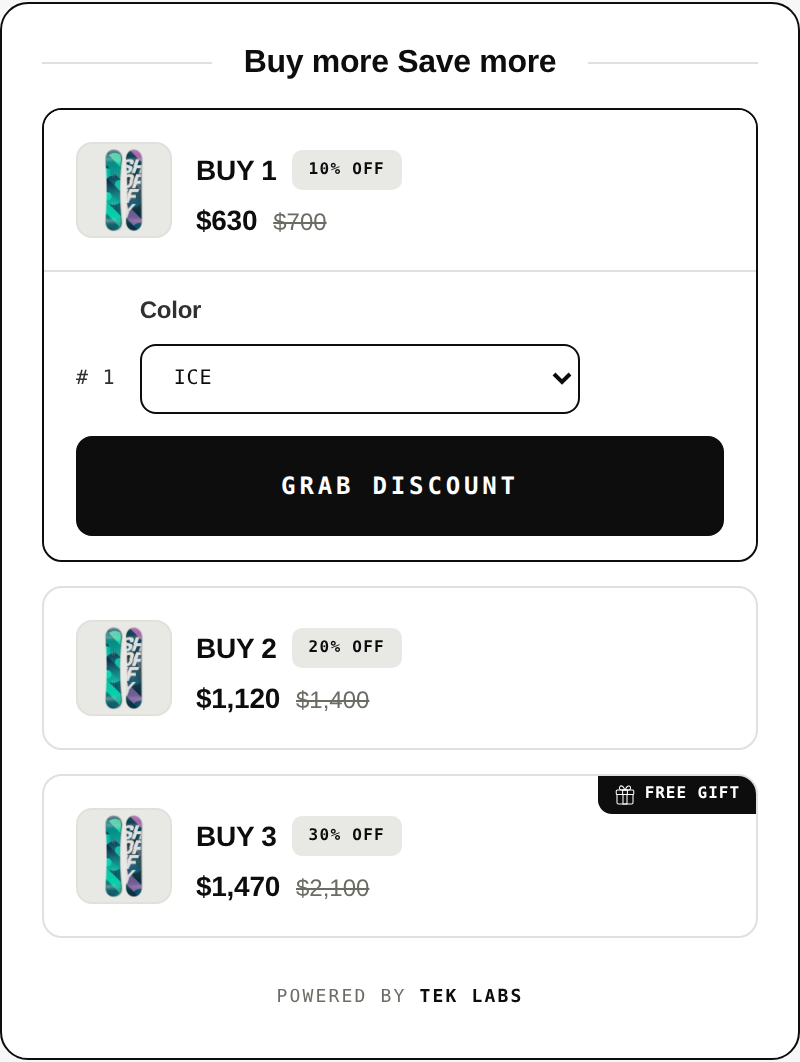
Mix-and-match sets need one more pricing decision: a flat price or a percentage off whatever the shopper picks. Take a hypothetical catalog of 12 items in three price bands: four candles at $32 (cost $11), four soaps and balms at $14 (cost $4.50) and four small items at $9 (cost $2.50). The average item price is about $18, so a store might set “pick any 3 for $54”.
| What the shopper picks | List price | Product cost | Contribution at flat $54 | Contribution at 15% off the picks |
|---|---|---|---|---|
| 3 candles | $96.00 | $33.00 | $21.00 (shopper saves 44%) | $48.60 |
| 1 candle, 1 soap, 1 small item | $55.00 | $18.00 | $36.00 (shopper saves 2%) | $28.75 |
| 3 small items | $27.00 | $7.50 | Nobody buys: $54 exceeds list | $15.45 |
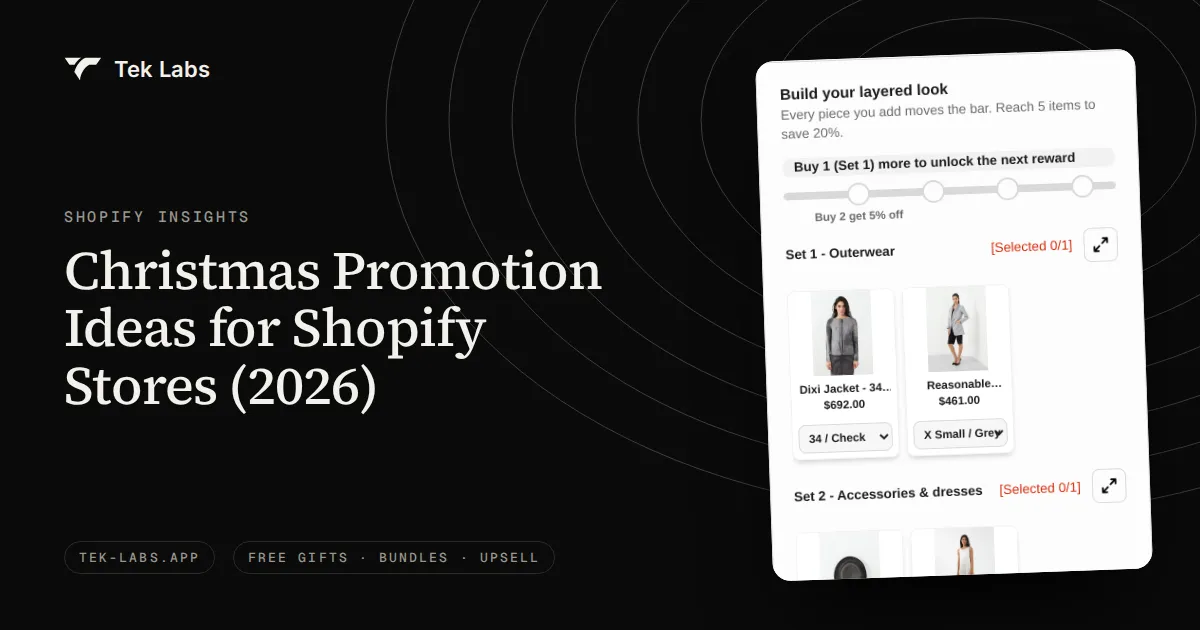
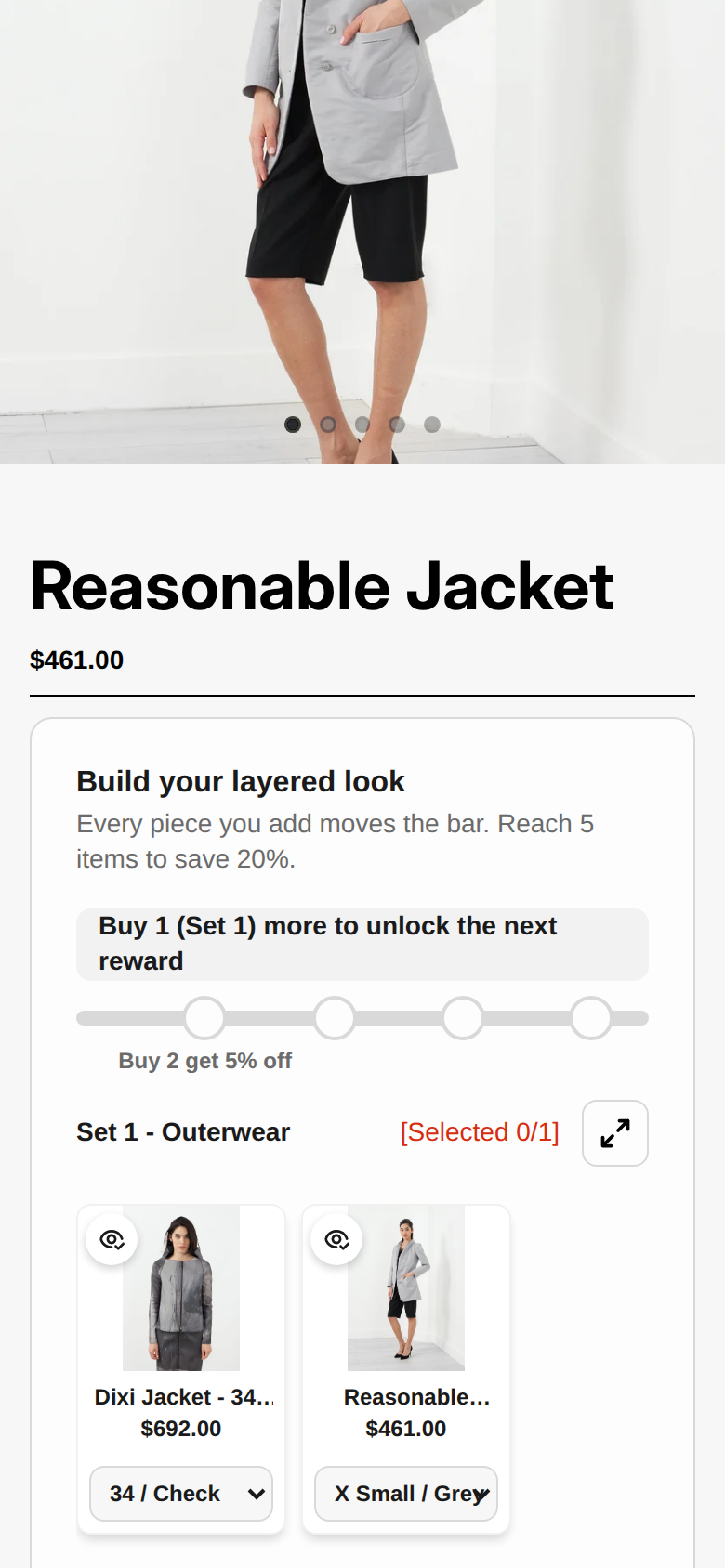
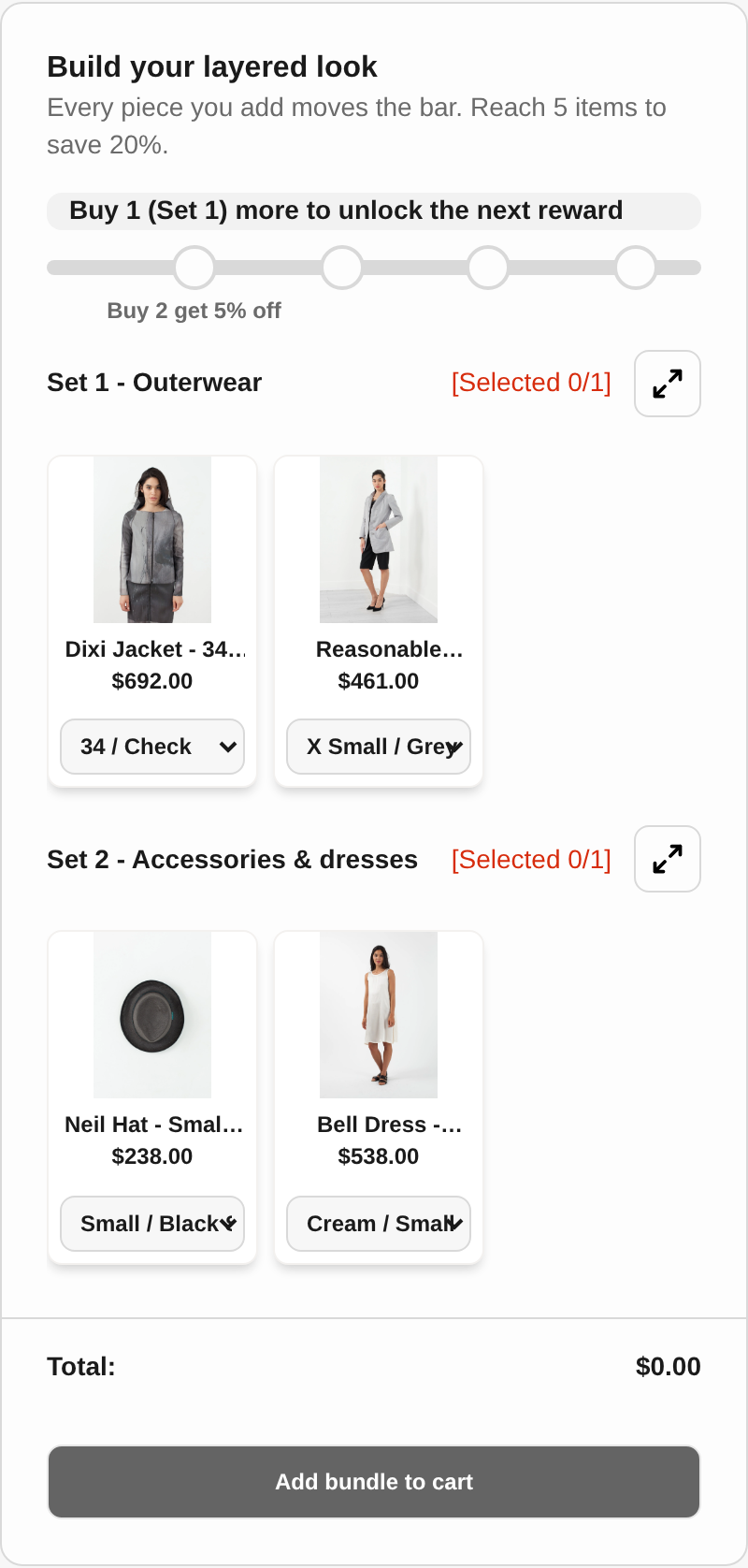
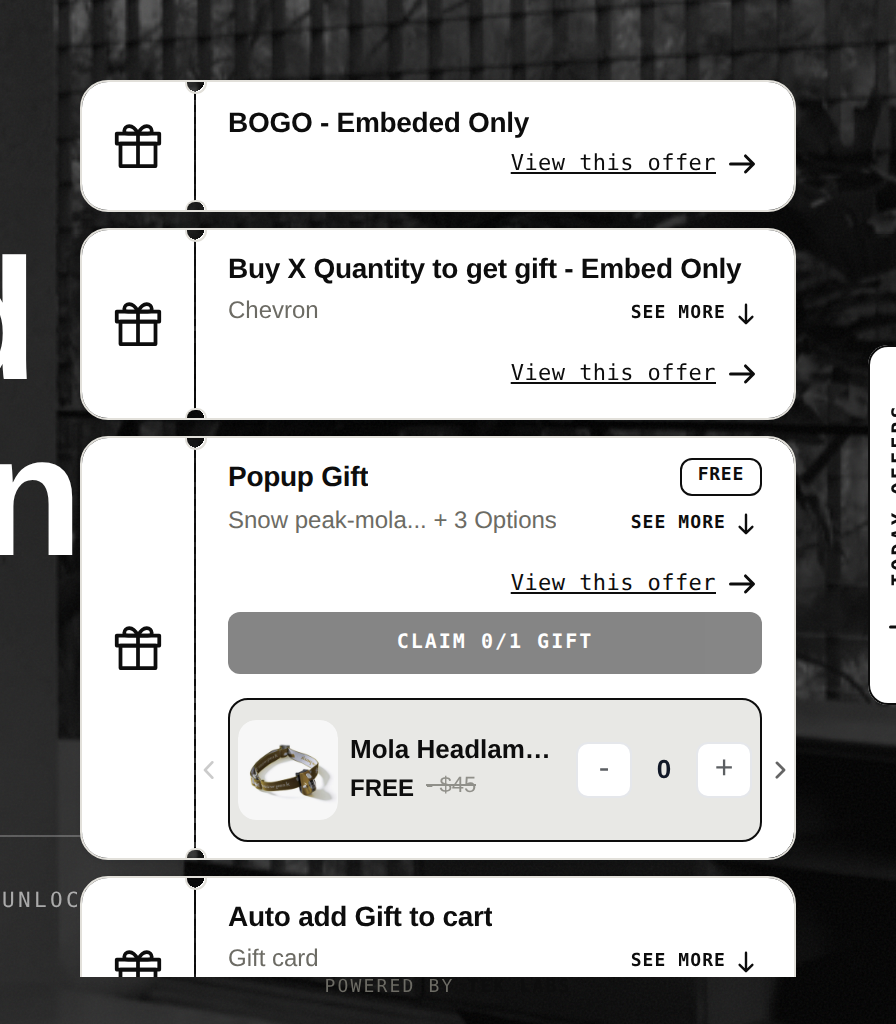
The flat price gives the biggest discount to the shopper who picks three candles and almost no discount to the shopper who mixes. A percentage off the selection avoids the problem and costs more on the biggest baskets but less on the worst case. A third approach is price-banded sets. The demo “Build your layered look” set above separates items into Set 1 (Outerwear) and Set 2 (Accessories), and the same idea works for gifts: one pick from the premium set and two from the small set, at a price that is correct for that combination.
Inventory: the scarcest component sets your stock
Shopify calculates bundle availability from the components. Per its help page, you divide each component’s available inventory by the quantity the bundle needs, and “the lowest resulting number (rounded down to the nearest whole number) determines how many complete bundles can be sold” (eligibility page). Inventory that is not tracked, or set to continue selling when out of stock, is ignored in that calculation.
| Component | Per bundle | Stock | Bundles it supports |
|---|---|---|---|
| Candle | 1 | 40 | 40 |
| Hand soap | 1 | 120 | 120 |
| Hand balm | 1 | 25 | 25 |
| Matchbox | 2 | 300 | 150 |
This hypothetical set supports 25 bundles, limited by hand balm, even though matchboxes could supply 150. If you plan 200 gift sets for the season, order 175 more balms, and remember that balm sold on its own also draws from the same stock. Decide up front how much of each component you reserve for bundles. Shopify notes that when one item in a bundle sells out, the bundle becomes unavailable (Shopify).
Prices, compare-at and the rules for “was” prices
Three price traps are worth checking before Black Friday.
- A bundle price does not follow its components. The Shopify Bundles help page states that when the price of a bundled product updates, “either manually or from price imports, the bundle price doesn’t update.” If you change item prices for a sale, update the bundle price by hand.
- Discounts apply to the parent. When creating product or collection discounts, the help page says to include the parent bundle product, and a discount that targets only the components will not apply. The discount is then allocated to components by weighted price.
- Display of compare-at prices. Shopify says compare-at prices appear on product and collection pages, but “only the sale price is displayed at checkout,” while discount savings show a crossed-out price at checkout (Shopify sale pricing).
If you show “$67 value” next to a $60.30 bundle, the former price should be real. The FTC guide on former price comparisons says a former price provides a legitimate basis for a comparison if it is “the actual, bona fide price at which the article was offered to the public on a regular basis for a reasonably substantial period of time” (16 CFR 233.1). The sum of your items sold separately at their usual prices fits that description, but a price you raised last week to show a bigger saving does not. This is general information, not legal advice.
Shipping, returns and exchanges for gifts
- Shipping. Rates come from the shipping profiles of the individual products, so a gift set with a heavy item will ship at that item’s weight and profile. Price the bundle with shipping in mind or set a free shipping threshold above it.
- Returns. You cannot define a bundle as final sale in return rules. Eligibility “is based on whether the individual products within the bundle are set as final sale items” (eligibility page). Customers can request returns for any eligible component.
- Exchanges. Bundles cannot be used in exchanges, even for an identical bundle, so plan a manual path for size or scent swaps.
- Timing. The NRF says “the vast majority of returns occur in January,” and that many shoppers use holiday returns to make another purchase (NRF). A clear gift-return policy on the bundle page helps both.
- Surprise costs. Baymard’s compilation of 50 studies reports that 40 percent of shoppers who abandoned a cart cited extra costs (shipping, tax, fees) as a reason (Baymard). Show shipping early for bundle buyers.
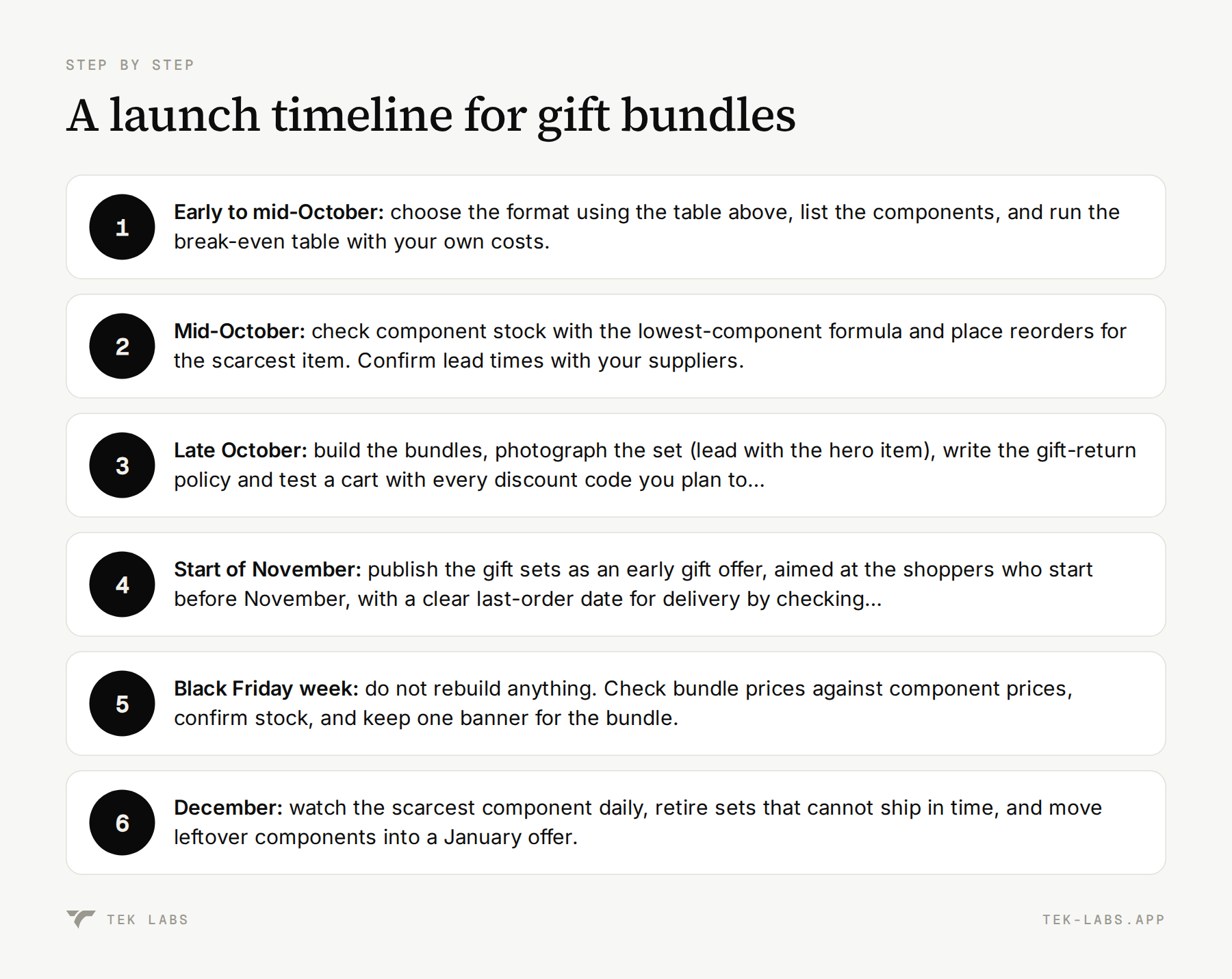
A launch timeline for gift bundles
- Early to mid-October: choose the format using the table above, list the components, and run the break-even table with your own costs.
- Mid-October: check component stock with the lowest-component formula and place reorders for the scarcest item. Confirm lead times with your suppliers.
- Late October: build the bundles, photograph the set (lead with the hero item), write the gift-return policy and test a cart with every discount code you plan to run.
- Start of November: publish the gift sets as an early gift offer, aimed at the shoppers who start before November, with a clear last-order date for delivery by checking each carrier’s published holiday cutoffs.
- Black Friday week: do not rebuild anything. Check bundle prices against component prices, confirm stock, and keep one banner for the bundle.
- December: watch the scarcest component daily, retire sets that cannot ship in time, and move leftover components into a January offer.
Common mistakes
- Choosing a format by the tool you already have. A pick-any-3 catalog forced into fixed sets leaves most items unsold.
- Discounting by feel. Without the break-even table you may pay full-price buyers to take a discount.
- A flat price for open choice. Shoppers choose the premium items, and your margin shrinks on exactly the baskets you want.
- Stale bundle prices. Component price changes do not update the bundle price.
- Ignoring the weakest component. One slow or scarce item can make the whole gift set unavailable.
- Planning pre-orders or subscriptions on a bundle. Shopify bundles cannot be sold with selling plans.
Building the sets in Mix and Match Bundles
If your gifts are pick-any-N or build-a-box sets, Mix & Match Bundles is our app for them. Its App Store listing lists mix-and-match, fixed bundles, multipacks, build a box and sample packs, with tiered pricing, quantity breaks and flat or percentage discounts, a theme-matching interface with custom CSS, and a free plan. You can try the shopper experience on the demo store (store password: 1), and our glossary defines the bundle terms used here.
Frequently Asked Questions
Can I sell mix-and-match gift sets with the free Shopify Bundles app?
No. Shopify’s help center says the Shopify Bundles app handles fixed bundles and multipacks and does not support mix-and-match bundles, which need a third-party app or a custom build on Shopify Plus.
When should I launch holiday gift bundles?
Aim for the start of November at the latest and build in mid-October. The NRF says about two out of every five holiday shoppers start before November.
How much should a gift bundle discount be?
Calculate it. In our hypothetical set, 15 percent off pays off only if about 54 percent of bundle buyers would otherwise have bought a single item, while 10 percent needs 36 percent. Start shallow and test.
Can I put a gift bundle on pre-order or subscription?
Not with Shopify bundles. Shopify’s developer docs say bundles cannot be sold with selling plans such as subscriptions, pre-orders and try-before-you-buy.
What limits the number of bundles I can sell?
The component with the lowest ratio of available stock to the quantity the bundle needs. Shopify divides each component’s stock by its per-bundle quantity and rounds the lowest result down.