A beauty gift with purchase works when the gift costs you a few dollars, feels worth far more to the shopper, and sits at a spend threshold just above what shoppers usually spend. The version that fits most Shopify brands is a ladder of two or three thresholds, with a “pick 1 of 3” choice at the middle rung, terms stated up front, and the cost of each rung checked against the margin on the extra spend. This playbook shows the cost arithmetic with hypothetical numbers, two real brand offers you can study, the Shopify mechanics that decide how the gift reaches the cart, and the rules to check before launch.
Key takeaways
- Price the gift by its landed cost (item, insert, packing time, extra weight), then compare it with the margin on the extra spend you are asking for. A bigger gift needs a smaller share of “would have spent that anyway” orders to break even.
- A free gift is a stronger frame than a discount for a product you later sell: a peer-reviewed lab study found willingness to pay after the promotion was higher when the product had been free than when it had been discounted. It is lab evidence, so treat it as a reason to test, not a guarantee.
- Use a ladder, not a single threshold. The first rung sits close to your typical order, the middle rung offers a choice of three gifts, and the top rung is a full-size item for your best customers.
- Shopify’s native Buy X Get Y never adds the free item automatically, so auto-added or customer-chosen gifts need an app. Decide how your threshold counts discounts, gift cards and shipping, and print that rule next to the offer.
- State conditions clearly and at the outset, never recover the gift cost by raising the price of qualifying items, and do not assume minis or samples are exempt from cosmetic labeling rules. I could not verify any such exemption, so this post makes no claim about one.
Why a gift beats a discount in beauty
A percentage-off code can teach shoppers to wait for the next one. A gift with purchase changes the question from “how much off?” to “what do I get?” That reframing has some research behind it. In a Journal of Consumer Research study, Palmeira and Srivastava found that willingness to pay for a product after the promotion ended was higher when the product had been offered for free than when it had been offered at a low, discounted price. Their explanation is anchoring: a discounted price becomes the reference point for the product’s value, while a free product is judged against other anchors, such as the price of the main purchase. The authors conclude that a free offer does not devalue the product at all and, at a minimum, devalues it less than a low discounted price would.
For a beauty brand that matters in a specific way. If you give away a deluxe serum sample and later sell the full size, the sample was never priced, so there is no low price to anchor to. If you sell the same sample for $2 at checkout, you have created that anchor.
Keep the limits of the finding in view. It comes from experiments, not from beauty store data, and it measures willingness to pay, not repeat purchase. It supports testing a gift against a discount; it does not prove a gift always wins. If you want to run that test properly, our guide to free gift thresholds walks through the arithmetic for a single threshold, and the Black Friday free gift ideas post compares gift types.
The season also matters. Adobe Digital Insights reported that cosmetics online spend on Cyber Monday 2025 reached $0.5 billion, up 7.0 percent year over year. Black Friday 2026 is on November 27 and Cyber Monday on November 30, so shoppers will be comparing offers across brands within the same few days. A clear gift ladder gives them a reason to choose you without a deeper discount.
Two real offers to study
Brands that run gifts with purchase every season have settled on patterns worth copying. These two offers were live when I read their pages on October 2, 2026, and both ended in early October, before this post was published. The offers are gone, but the structure is what matters.
| Brand | Offer (as stated on the page when I read it) | How the gift reaches the cart | Terms worth copying |
|---|---|---|---|
| Charlotte Tilbury (Canadian storefront) | Free full-size lip oil (8 ml) for spending over $200 in one transaction; ran until October 5, 2026 | Was added to the bag automatically; the customer had to be a logged-in loyalty member | Gift cards, consultations, subscriptions, shipping and gift wrap were excluded from the qualifying amount; while stocks lasted |
| Clinique (US) | Choose 4 travel essentials with an eligible $75 purchase; ran until October 11, 2026 | Shopper picked from a carousel at checkout | Minimum was measured before tax and shipping and after other promotions and discounts; limit one per order; selection could vary |
What each one teaches you:
- Charlotte Tilbury gated the gift behind loyalty. The offer was for logged-in members of its loyalty program, which turned a promotion into a reason to create an account. If you collect accounts or points, this is a clean way to reward them. The same page also showed the qualifying amount in euros on its Netherlands storefront (over 120 euros), a reminder to set thresholds per market, not by exchange rate.
- Clinique let shoppers build the gift. Four picks from a set, at one threshold, is the “choose your gift” format discussed below. The footnote also said how the threshold was counted (after other discounts), which removes a common support question.
- Both stated exclusions and stock limits. Gift cards, shipping, backorders and pre-orders were listed as not counting, and both said quantities were limited. Write those lines before launch, not after the first complaint.
I am describing what the pages said, not judging how either brand runs its promotions. Use them as a checklist for your own terms.
Build a threshold ladder with cost math
Everything below uses a hypothetical brand: a skincare store with an average order value of $48 and a 72 percent gross margin on product after payment fees. The numbers are illustrative; replace them with yours.
Step 1: price the gift at landed cost
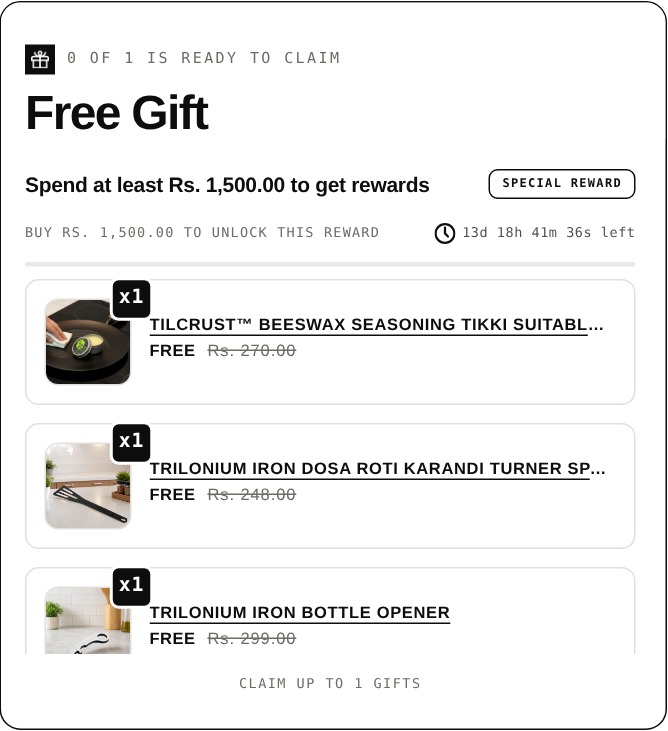
The cost of a gift is more than the unit price. Add the insert or pouch, the extra pick and pack time, and any added postage from extra weight. For the first rung in the example, a deluxe sample costs $1.40 for the item, $0.30 for packaging and an insert, and $0.35 for handling, which is $2.05 landed.
| Rung | Threshold | Gift | Landed cost | Cost as share of threshold | Cost as share of gross margin on the threshold order |
|---|---|---|---|---|---|
| 1 | $60 | Deluxe sample of a best-selling serum | $2.05 | 3.4% | 4.7% |
| 2 | $85 | Pick 1 of 3 travel-size items | $3.60 average (range $3.20 to $4.10) | 4.2% | 5.9% |
| 3 | $130 | Full-size item in a pouch, auto-added | $9.50 | 7.3% | 10.1% |
The third column of percentages divides the gift by the margin on the threshold order, for example $2.05 / (0.72 x $60 = $43.20) = 4.7 percent. Those ratios look small, but they hide the real question, which is how many of those orders would have reached the threshold without a gift.
Step 2: test each rung against cannibalization
A gift is paid for by every qualifying order. Some of those orders were pushed up by the gift (incremental) and some would have crossed the threshold anyway (cannibalized). The gift pays when the extra margin from the first group covers the cost of giving it to both.
For a shopper who stretches their order to reach the threshold, the extra margin is the margin on the stretch dollars, minus the gift. The share of qualifying orders you can afford to be cannibalized is: 1 – (gift cost / margin on the stretch).
| Rung | Typical order before | Stretch to threshold | Margin on the stretch (72%) | Gift cost | Net per converted order | Cannibalization you can tolerate |
|---|---|---|---|---|---|---|
| 1 ($60) | $48 | $12 | $8.64 | $2.05 | $6.59 | 76% |
| 2 ($85) | $70 | $15 | $10.80 | $3.60 | $7.20 | 67% |
| 3 ($130) | $105 | $25 | $18.00 | $9.50 | $8.50 | 47% |
Read the last column carefully. At the top rung, the gift pays only if fewer than about 47 percent of the qualifying orders would have reached $130 anyway. If your order data shows that half your $130-plus orders already happen without a gift, rung 3 loses margin on those orders even though it looks generous. Rung 1 is far more forgiving. This is the reason to push the expensive gift to a threshold that few shoppers reach today, and to keep the top-rung gift limited by stock or by loyalty status, as Charlotte Tilbury did.
The model ignores added postage and assumes the stretch dollars carry the full 72 percent margin, so treat it as a first screen. Add your own extra shipping cost to the gift cost if parcels get heavier.
Step 3: place the thresholds on your own order data
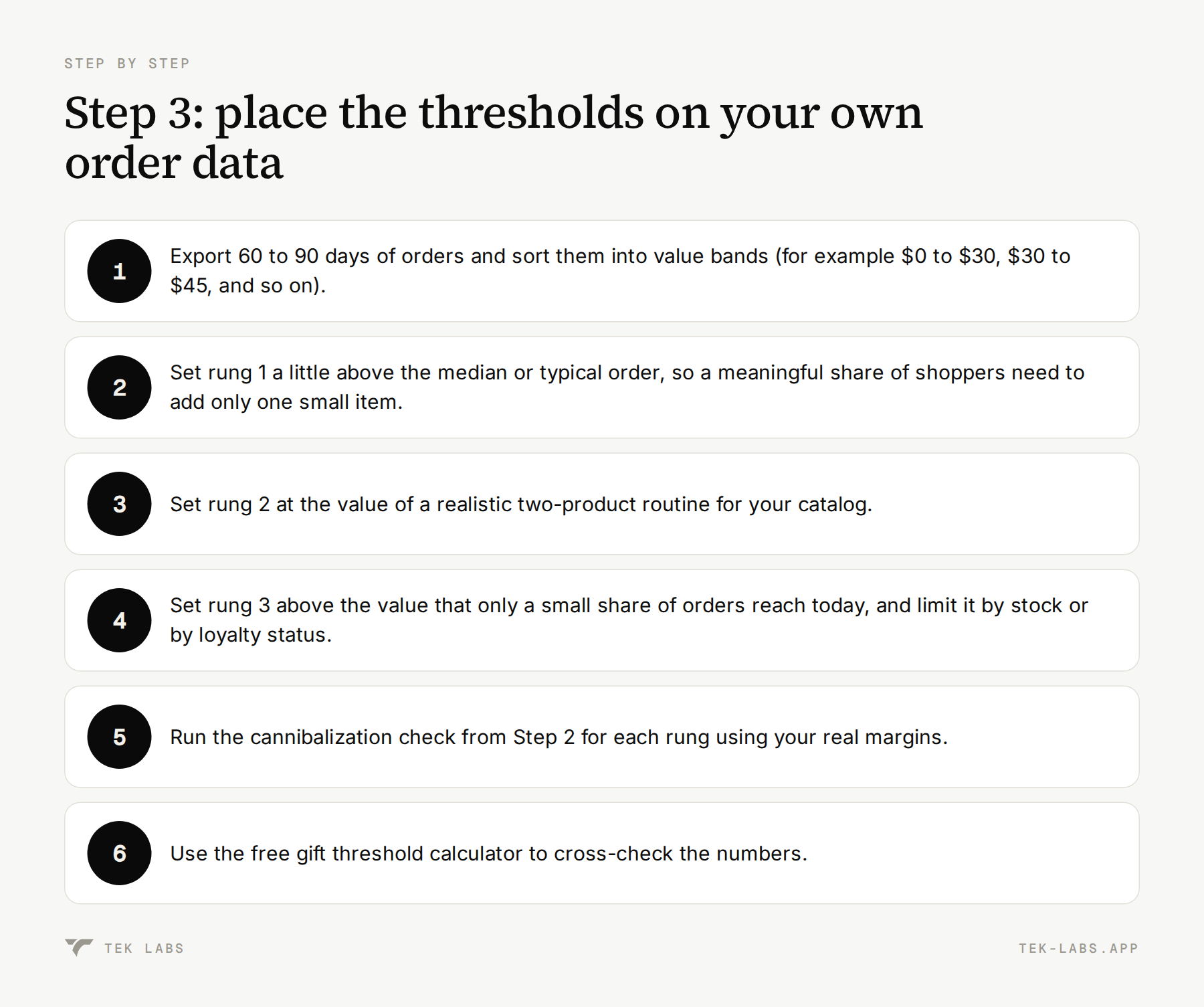
- Export 60 to 90 days of orders and sort them into value bands (for example $0 to $30, $30 to $45, and so on).
- Set rung 1 a little above the median or typical order, so a meaningful share of shoppers need to add only one small item.
- Set rung 2 at the value of a realistic two-product routine for your catalog.
- Set rung 3 above the value that only a small share of orders reach today, and limit it by stock or by loyalty status.
- Run the cannibalization check from Step 2 for each rung using your real margins.
- Use the free gift threshold calculator to cross-check the numbers.
One measurement note. Since 2023, Shopify defines AOV as gross sales minus discounts. If you also run discounts, your AOV baseline moves, so compare like with like when you judge the result.
The pick 1 of 3 gift format
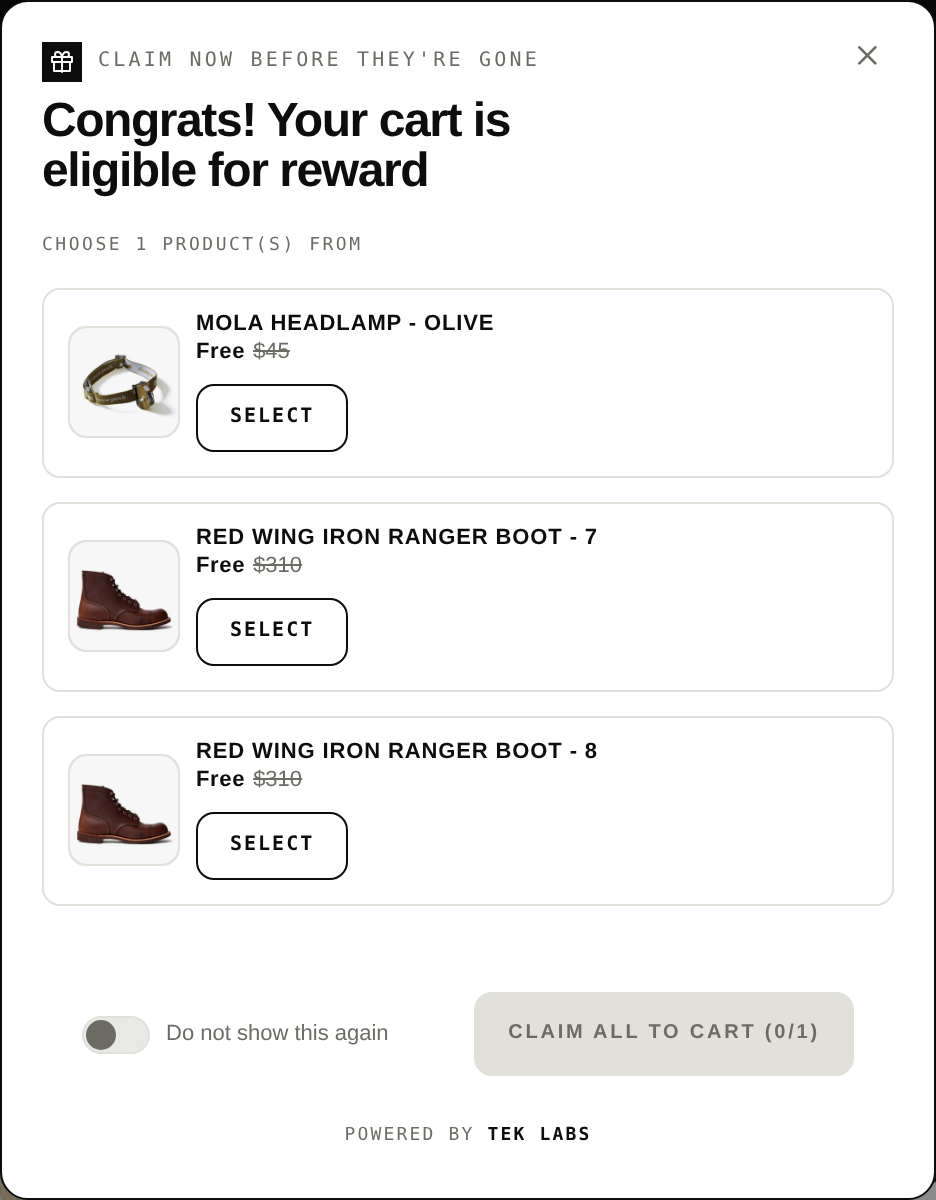
At the middle rung, letting shoppers choose from three gifts solves problems a single gift cannot. A gift in the wrong shade, scent or skin-type formula can end up unused, so offering a cleanser mini, a mask and a lip product lets a shopper take the one they will use. Clinique’s “choose 4 travel essentials” showed the same idea at larger scale.
Is three too many choices? The research suggests not. A meta-analysis of 63 conditions found the mean effect of choice overload to be virtually zero, and a later one found overload tied to complex choice sets, difficult tasks and high preference uncertainty. Picking one of three minis is a small, easy choice.
Design rules for the format:
- Keep the three gifts at nearly the same landed cost. In the example the range is $3.20 to $4.10. If one option costs twice as much, every shopper will take it and your real cost is the maximum, not the average.
- Choose gifts that map to different needs. One for cleansing, one for treatment, one for color, for instance, so the pick says something about the shopper.
- Watch which gift is claimed. Whatever tool you use, check whether you can see which gift each shopper chose. It tells you which minis to stock next and which products to feature, and it is a free preference survey if the data is available. Confirm that with your tool before you promise it internally.
- Plan a fallback. Clinique’s page said selection could vary and quantities were limited. Decide in advance what happens when one of the three runs out.
How Shopify delivers a gift with purchase
Shopify’s built-in Buy X Get Y discount can make a product free with a qualifying purchase, but its mechanics shape what you can promise. From Shopify’s help center on Buy X get Y discounts:
- Customers must add all items to their cart manually, and the free item is never added automatically.
- The minimum purchase amount counts product prices only. Shipping and taxes are never included.
- Products count toward the minimum at their full price, before other discounts. If another discount that can be combined has already been applied to an item, that item does not count toward the minimum at all.
- Buy X get Y discounts created in the Shopify admin do not apply to the post-purchase page.
Two practical consequences for beauty. First, if your promise is “a gift is added for you” (Charlotte Tilbury’s pattern) or “pick a gift in your cart” (Clinique’s pattern), native Buy X Get Y cannot do it alone, because the shopper has to add the gift manually. Second, beauty brands often stack sets, bundles and site-wide codes, and under the rule above an item with another combinable product discount may not count toward your gift threshold. Test those cases before launch. Our discount combinations test plan gives a pass and fail matrix, and the comparison of Shopify’s default Buy X Get Y and third-party providers covers where the native tool stops.
Decide your own counting rule and print it. Clinique measured after other discounts. Charlotte Tilbury excluded gift cards, shipping and gift wrap. Shopify’s native rule counts full prices before other discounts. Those are three different definitions, and the one you choose changes who qualifies.
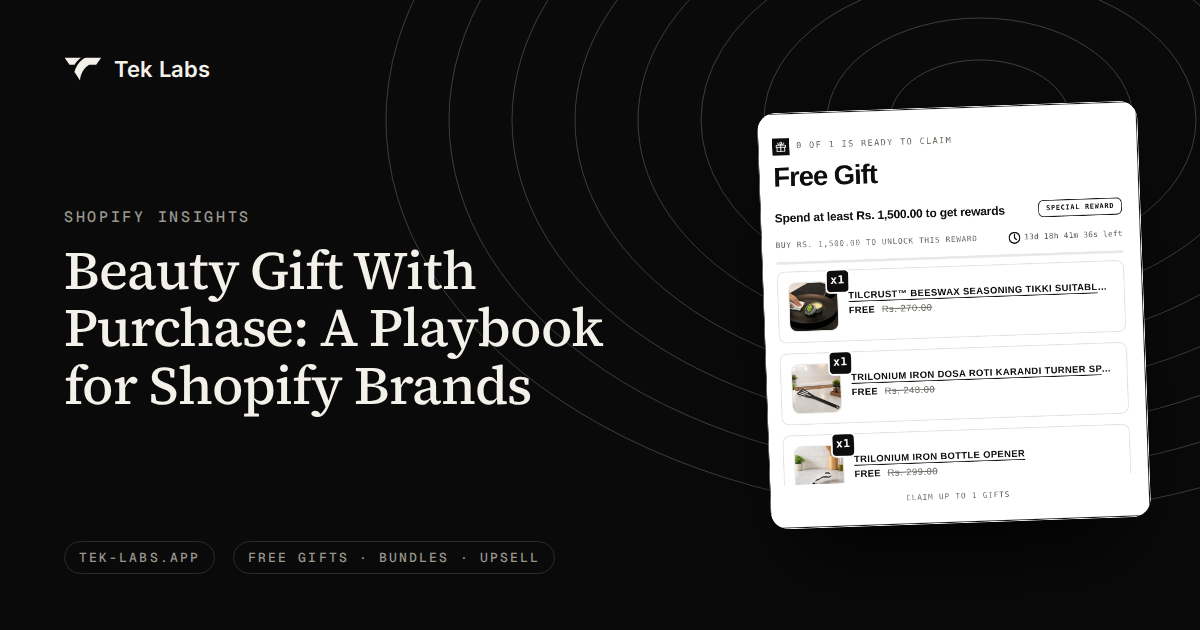
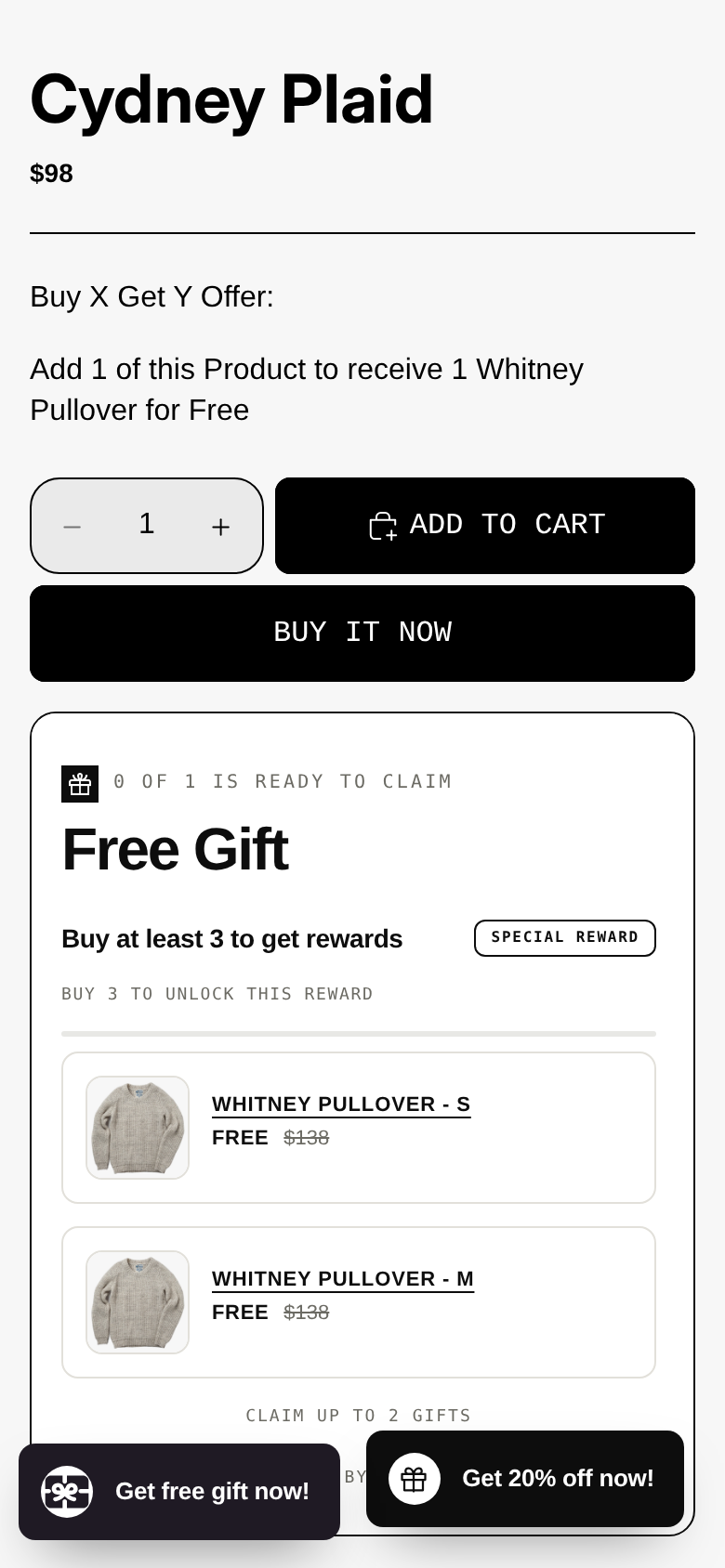
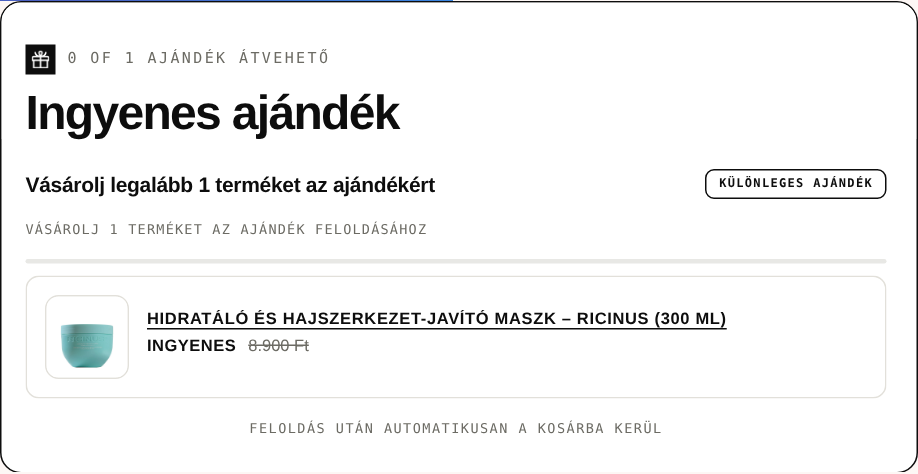
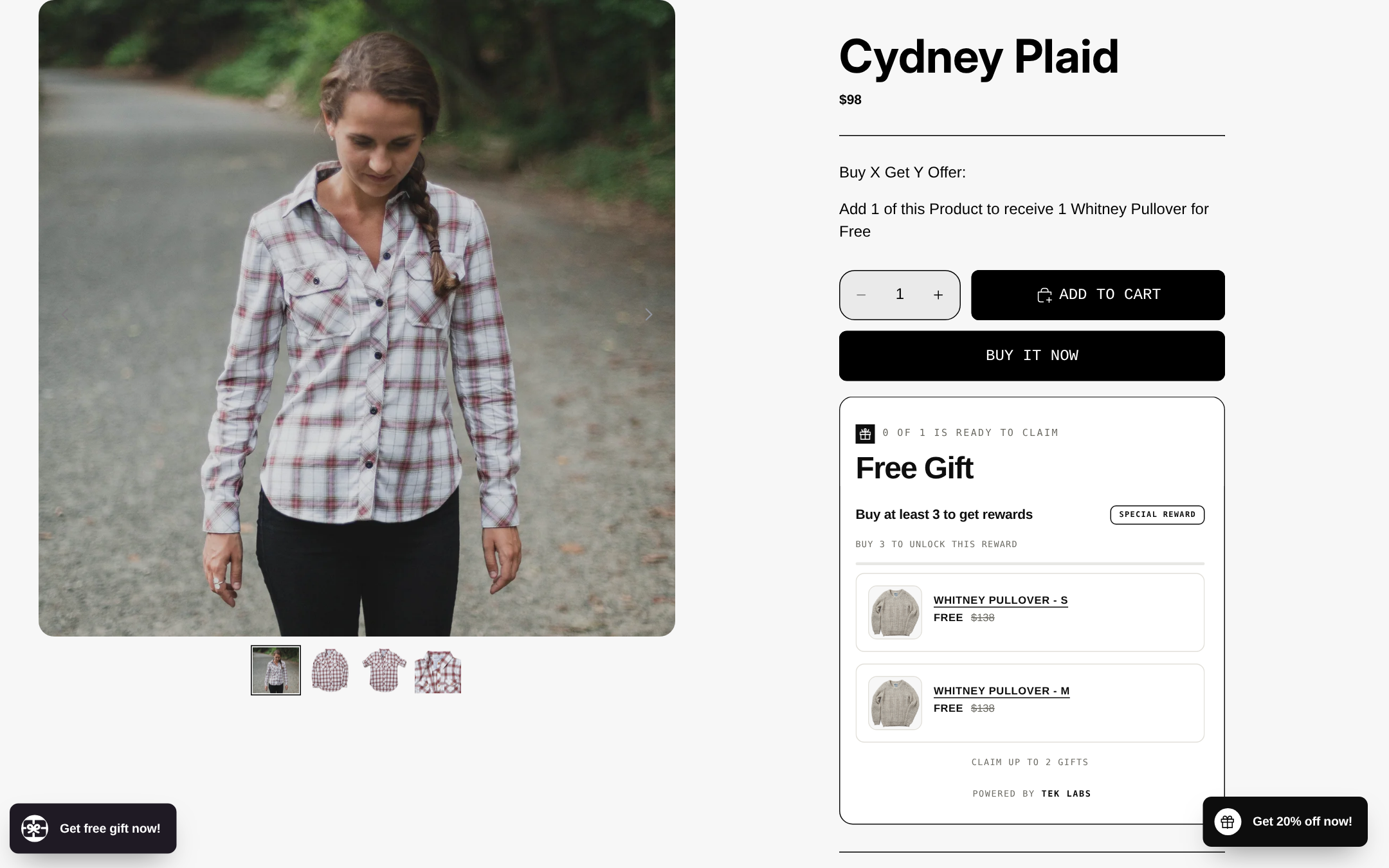
If you need an auto-added or customer-chosen gift, the Free Gifts BOGO & Upsell app from Tek Labs supports free gift with purchase, BOGO and Buy X Get Y offers, can add the gift to the cart automatically or let customers choose their own gift, and has a cart progress bar with multi-tier gift rewards. It is compatible with Shopify Checkout, Shopify POS, Shopify discounts and Upcart. You can try the widgets in the demo store at demo-salepify-app.myshopify.com (store password: 1).
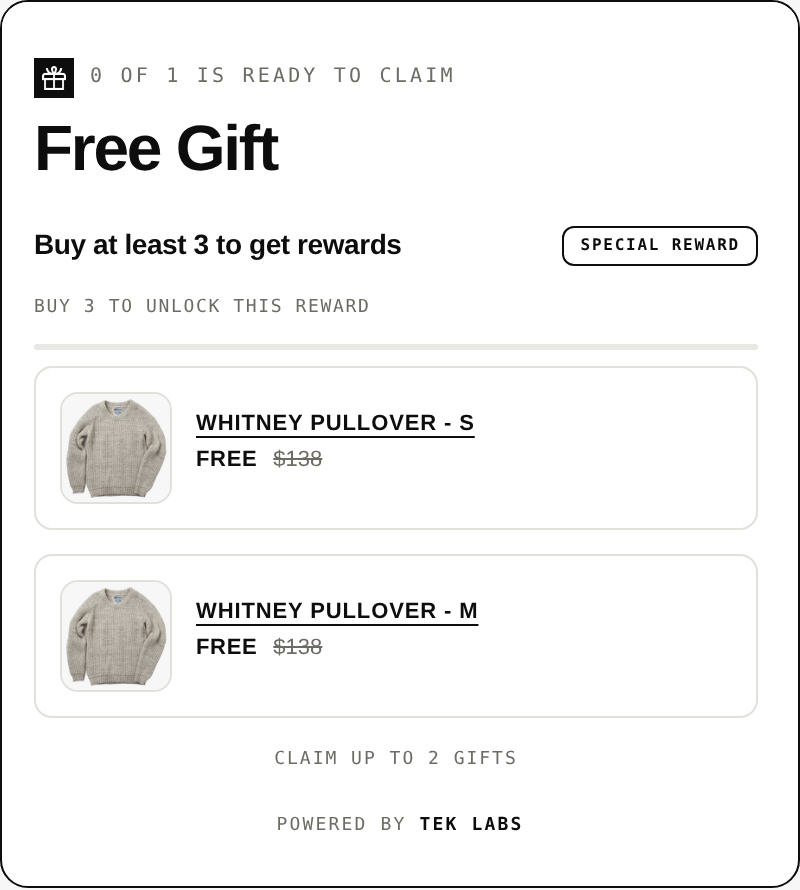
For mobile shoppers, show the offer on the product page, not only in the cart. Many shoppers browse on a phone, and a gift that appears only at checkout can arrive too late to change what goes into the bag.
Rules to check before you launch
Say “free” the way the FTC expects
The FTC’s guide on the use of the word “free” applies to gift-with-purchase promotions. Three points matter most for a beauty store. First, the guide says that when a purchaser is told an article is free if another is purchased, the purchaser is paying nothing for the free article and no more than the regular price for the other, so you should not raise the price of qualifying items to recover the gift. The guide defines the “regular” price as the price at which you openly and actively sold the product in the most recent and regular course of business for a reasonably substantial period, which it equates to a 30-day period. Second, all terms and conditions should be set out clearly and conspicuously at the outset of the offer, in close conjunction with it, and the guide says a footnote reached by an asterisk is not regarded as disclosure at the outset. Third, calling the item a “gift” or a “bonus” does not change this, because the guide says those words cannot be used to correct an offer that would be deceptive as “free”. I am not a lawyer, and this is a guide, so have your own counsel read your final copy.
Do not assume samples are exempt from labeling
The FDA’s cosmetics labeling page says the agency regulates cosmetic labeling under the Federal Food, Drug, and Cosmetic Act and the Fair Packaging and Labeling Act, that cosmetic labeling must be truthful and not misleading, and that products intended to affect the structure or function of the body, or for a therapeutic purpose, are regulated as drugs. I could not verify any labeling exemption for samples, minis or testers, so I am not claiming one. Before you buy 5,000 deluxe minis, ask whoever handles your regulatory work to confirm what the label on each gift item must carry. If a gift item makes claims that move it toward the drug category, such as sun protection or acne treatment, raise that question first.
Check shipping rules for the gift itself
Some beauty items are harder to ship than others. USPS publishes its rules for hazardous and restricted mail in Publication 52. Before you choose alcohol-based fragrance minis or nail polish as a gift, read it and check your carriers’ own rules. A gift that cannot ship with a standard parcel creates a fulfillment problem on your busiest days.
Common mistakes
- One big gift at one threshold. It is the version that looks generous and tolerates the least cannibalization. Use a ladder.
- A gift that costs more than the offer is worth. Compute landed cost, not unit cost, and test each rung with the table above.
- Hiding the terms. Put the threshold, the exclusions, the end date and the stock limit next to the offer, not behind a link.
- Running out of the gift. Size stock from your forecast. If you expect 2,000 orders in Cyber Week and 30 percent should reach the $85 rung, that is 600 gifts; with a 20 percent buffer you need 720, a commitment of 720 x $3.60 = $2,592 in landed cost (hypothetical). Set the offer to stop when stock runs out and say so in the terms.
- A threshold that silently excludes discounted items. Test sets, bundles and site-wide codes against your counting rule.
- Judging the promotion on conversion rate only. Track AOV, margin dollars per order, the share of qualifying orders, and gift take rate.
A launch timeline for Black Friday 2026
Publishing this on October 29 leaves 29 days before Black Friday on November 27. Work backward:
- By November 6, choose the ladder, the gifts and the thresholds, and order the gift stock.
- By November 13, build the offer and test every discount combination you plan to run.
- By November 20, place several test orders on desktop and mobile, including a case where a gift is out of stock.
- By November 25, publish the terms next to the offer and brief support on how thresholds are counted.
- After Cyber Monday on November 30, review take rate and margin per order before extending the offer into December.
Where to go next
If you want to try this on your store, the Free Gifts BOGO & Upsell app lets you set up a threshold gift, a customer-chosen gift and a multi-tier progress bar, and it has a free plan, so you can test one rung before you commit to the full ladder.
Frequently Asked Questions
What is a good threshold for a beauty gift with purchase?
Start a little above your typical order so shoppers only need to add one small item, then place higher rungs where few orders reach today. Use your own order data and the cannibalization check above, because the right number depends on your margin and your gift cost.
Should the gift be a sample or a full-size product?
Both can work at different rungs. A deluxe sample suits the first rung because its landed cost is small against the threshold, while a full-size item suits a top rung that you limit by stock or loyalty status. Check the cannibalization table before you commit to a full-size gift.
Can I use Shopify’s Buy X Get Y for a gift with purchase?
Yes for a basic offer, but Shopify says customers must add all items manually and the free item is never added automatically. If you want the gift added for the shopper or chosen in the cart, you need an app.
Do I have to put terms and conditions on a free gift offer?
The FTC’s guide on “free” offers says terms and conditions should be stated clearly and conspicuously at the outset, in close conjunction with the offer, and that a footnote reached by an asterisk is not regarded as disclosure at the outset. Put the threshold, exclusions, end date and stock limit next to the offer.
Do minis and samples need full cosmetic labeling?
I could not verify an exemption, so I make no claim either way. FDA regulates cosmetic labeling under the FD&C Act and the Fair Packaging and Labeling Act, and its page says labeling must be truthful and not misleading. Ask your regulatory advisor before you order gift items.