The best Cyber Monday promotion ideas for a Shopify store are offers that raise order value without a deeper percentage cut: a spend-threshold gift, a buy 2 get 1 on one collection, quantity breaks, free shipping at a set cart value and a one-click add-on after payment. Cyber Monday is November 30, 2026, and the strongest plans give each day of Cyber Week its own job, with a margin floor written down before any offer goes live.
Key takeaways
- Cyber Monday is not a repeat of Black Friday. In 2025, Adobe measured $14.25 billion of US online spend on Cyber Monday against $11.8 billion on Black Friday, and mobile carried 57.5% of the Monday total.
- Give each day a role: Thursday and Friday for acquisition, Saturday and Sunday for stock you want to move, Monday for a mobile-first, online-only offer with a clear end time.
- Write a margin floor before you build anything. A gift or tier that looks generous can lose money when many orders would have qualified anyway; the worked examples below show a threshold that loses $552.50 per 1,000 orders and a higher one that earns $638.
- Pick three offers, not ten. Shopify limits stacking, and every extra offer is one more combination to test.
- Test on a phone, with a wallet payment and with a discount code, before November 26. Then stop editing during the evening peak.
What the Cyber Week data says (and what it does not)
Cyber Monday ideas should start from where shoppers actually were last year. These numbers are from 2025, the latest full season at the time of writing (read 2026-10-04). They are not forecasts for 2026.
- Adobe reported that consumers spent $14.25 billion online on Cyber Monday 2025, up 7.1% year over year. Black Friday generated $11.8 billion (up 9.1%) and Thanksgiving Day $6.4 billion (up 5.3%).
- On Cyber Monday, 57.5% of online sales came through a mobile device, or $8.2 billion. Shopify’s own figure for the whole 2025 holiday season is a 56.4% mobile revenue share.
- The same Adobe release says consumers spent $16 million every minute between 8 pm and 10 pm, and that buy now pay later drove $1.03 billion on the day. Both facts affect how you schedule changes and what you test, covered below.
- Adobe’s deepest discounts were electronics at 31% off listed price, toys at 28% and apparel at 25%. If you sell in those categories, that is the reference point shoppers carry in their heads.
- Shopify merchants generated $14.6 billion in global sales during BFCM 2025, up 27% from 2024, and 16% of orders were cross-border.
On what shoppers want, Shopify cites Impact research in the same article: 44% of respondents prioritized free and reliable shipping, 38% preferred a percentage discount on a single item and 38% preferred BOGO or similar offers. Those are survey answers from one study, not a conversion benchmark for your store, but they back a simple conclusion: shipping and BOGO-style offers deserve a place next to the percentage banner.
Timing matters too. The NRF said in its 2025 holiday FAQs that roughly two out of every five holiday shoppers had started browsing and buying before November, and Shopify’s source reports that 61% of surveyed shoppers planned to start buying gifts before the end of October. By Cyber Monday, a large share of your audience has already bought something. That is why the Monday offer should speak to a second purchase, a gift for someone else, or a bigger basket, not only to first-time buyers. For the October build schedule, see our BFCM offer checklist.
What the data does not say: none of it tells you which offer will lift your conversion rate. Treat every idea below as a hypothesis, check it against your own margin, and compare against last year’s Cyber Monday report in your admin.
Margin guardrails before you pick any offer
A Cyber Monday offer fails in one of two ways: nobody takes it, or too many people take it who would have bought anyway. A guardrail is a number you decide in advance so the second failure cannot happen quietly.
- Define contribution margin per order. Revenue minus product cost, minus the cost of any free item (landed cost, not retail price), minus shipping you pay, minus payment fees, minus the discount. This is the number every offer must protect.
- Set a floor. Choose a minimum contribution per order, in dollars, not percent. If your usual order contributes $25, a floor of $15 on promotion days is a decision you can check line by line.
- Cap the free item’s cost against the stretch it buys. A practical rule: the landed cost of a gift should be no more than about half of the extra gross margin you expect from the customers it persuades to spend more. This is a rule of thumb, not a sourced standard.
- Count the free riders. Orders that would have crossed the threshold anyway get the gift at full cost and add nothing. Pull last November’s order-value distribution before setting a threshold.
- Decide stacking in writing. Which offers may combine, and which may not.
Shopify’s rules limit the stacking decision. A store can have at most 25 active automatic discounts, including app-based ones, and customers can use at most 5 product or order discount codes plus 1 shipping discount code per order. On plans other than Shopify Plus, products that are part of a Buy X get Y discount are ineligible for further product discounts. That means a “buy 2 get 1 free” collection cannot also carry a sitewide 20% code on those same products unless you are on Plus. Our discount combinations test plan walks through how to check this.
Worked example 1: a Cyber Monday gift threshold (hypothetical)
A hypothetical store sells 1,000 orders over Cyber Week at an average order value of $62 and a product gross margin of 55%. The gift costs $7 landed. Compare two thresholds. All inputs are assumed, for illustration only.
| Line | Threshold $85 | Threshold $95 |
|---|---|---|
| Orders already above the threshold (free riders) | 200 | 100 |
| Cost of gifts to free riders | 200 x $7 = $1,400 | 100 x $7 = $700 |
| Orders stretched up to the threshold | 150 | 120 |
| Average extra spend per stretched order | $23 | $33 |
| Extra gross margin (extra spend x 55%) | 150 x $23 x 0.55 = $1,897.50 | 120 x $33 x 0.55 = $2,178.00 |
| Cost of gifts to stretched orders | 150 x $7 = $1,050 | 120 x $7 = $840 |
| Net result | $1,897.50 – $1,050 – $1,400 = -$552.50 | $2,178 – $840 – $700 = $638.00 |
The lower threshold looks friendlier but loses money because too many orders qualify for free. The break-even check is simple: divide the free-rider cost by the margin each stretched order earns after the gift. At $85 each stretched order nets $12.65 – $7 = $5.65, so you would need about 248 stretched orders ($1,400 / $5.65) to break even, more than the 150 assumed. At $95 each nets $18.15 – $7 = $11.15, so about 63 stretched orders cover the $700. Your own free gift calculator runs the same arithmetic with your numbers, and the earlier threshold worked example goes deeper.
Worked example 2: percentage off against buy 2 get 1 (hypothetical)
A hypothetical item sells for $40 and costs $16 to buy and ship to the customer. A shopper takes three units.
| Offer | Units | Revenue | Cost | Gross margin | Margin % |
|---|---|---|---|---|---|
| Full price | 3 | $120 | $48 | $72 | 60.0% |
| 25% off | 3 | $90 | $48 | $42 | 46.7% |
| Buy 2 get 1 free | 3 | $80 | $48 | $32 | 40.0% |
| BOGO (buy 1 get 1 free) | 2 | $40 | $32 | $8 | 20.0% |
Buy 2 get 1 free is a 33.3% effective discount, so it costs more margin than 25% off on three units, while a plain BOGO is a 50% effective discount and leaves $8 of margin on two units. A BOGO can still be right for slow stock or a loss-leader to attract new customers, but it should be a deliberate choice, not the default. The BOGO versus percentage off margin math post covers the full comparison.
A day-by-day plan for Cyber Week 2026
Black Friday is November 27, 2026, and Cyber Monday is November 30. Thanksgiving is Thursday, November 26. That gives you five days, each with a different shopper mood. The table assigns one job per day and one guardrail.
| Day | Date | Job | Offer idea | Guardrail |
|---|---|---|---|---|
| Thursday (Thanksgiving) | Nov 26 | Early access for email and SMS subscribers | Gift discount code shown only to subscribers, or the first tier of a progress bar | Quiet day for staff: nothing here may need manual work |
| Friday (Black Friday) | Nov 27 | Acquisition | Spend-threshold gift, widest product range | Set the threshold above your usual order value |
| Saturday | Nov 28 | Move specific stock | Buy 2 get 1 on one collection | Limit to named collections so the free item is predictable |
| Sunday | Nov 29 | Basket building and gifts | Mix and match set, quantity breaks | Cap the discount at your floor |
| Monday (Cyber Monday) | Nov 30 | Online-only close | A different, time-limited offer plus free shipping tier, mobile-first | End time shown on the page; post-purchase add-on live |
Why vary the offer by day rather than run one site-wide discount for five days? Three reasons. First, a changing offer gives repeat visitors a reason to come back. Second, each offer has a different margin profile, so you can pair a generous Friday acquisition offer with a leaner Monday one. Third, it limits stacking: with only one or two offers live per day you test fewer combinations.
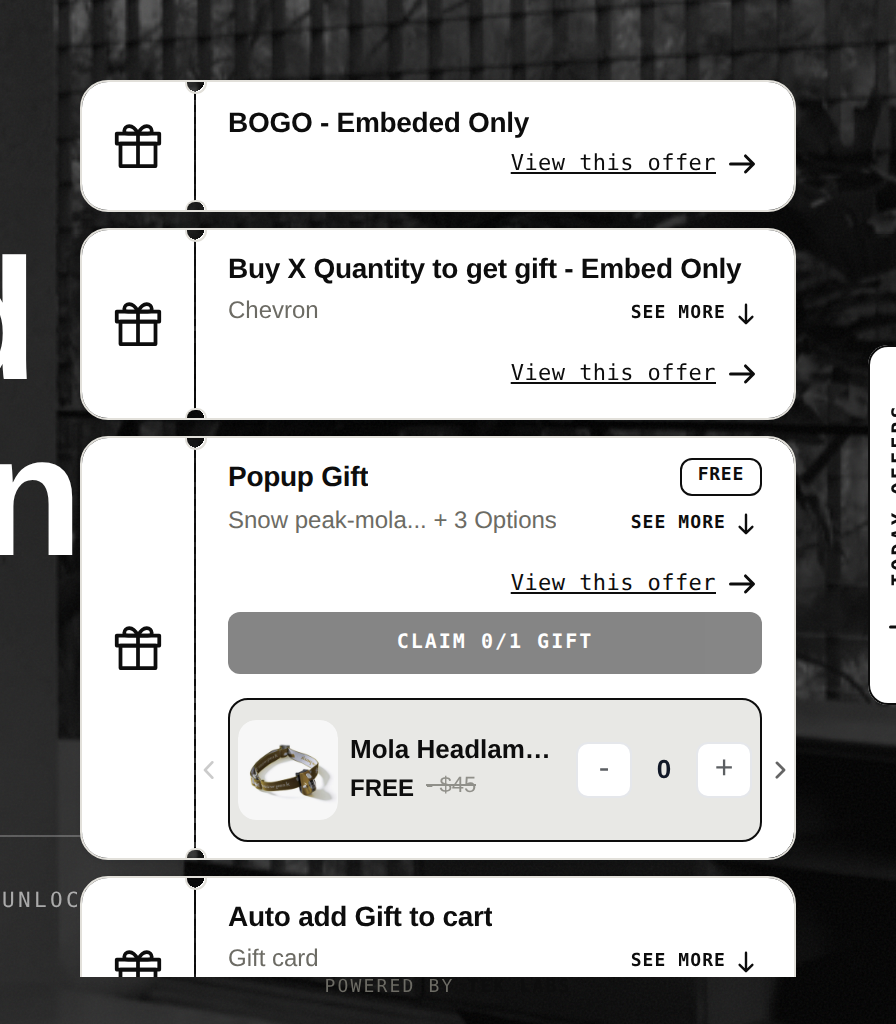
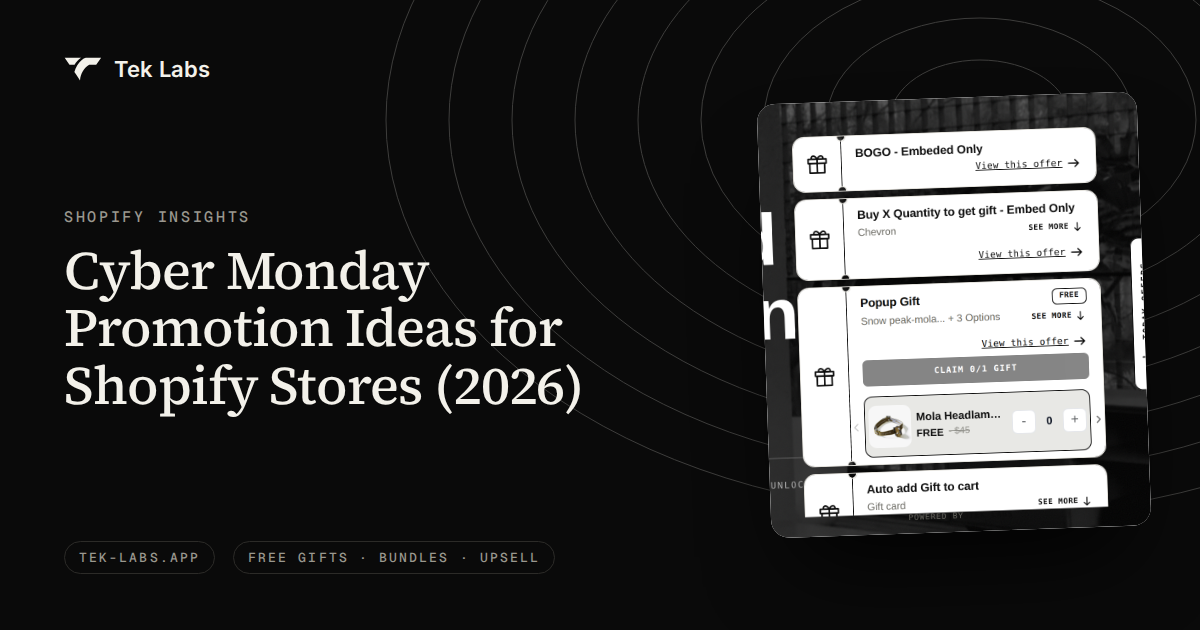
The drawer in the screenshot is a feature of the Free Gifts BOGO & Upsell app that shows the store’s live offers; for a multi-day event it saves you from stacking five banners on the homepage.
Cyber Monday offer ideas, with how to build each
Each idea names the feature that delivers it and the guardrail that protects margin. All of them can be set with start and end dates, which is how you keep a Cyber Monday offer from outliving Cyber Monday.
1. A spend-threshold gift that appears on the product page
This is the Black Friday workhorse and it works as a Monday offer too, if the gift is different. The Free Gifts BOGO & Upsell app lets you set a free gift with purchase condition by cart value or cart quantity, choose specific products, collections, variants or tags, and set start and optional end dates. The gift can be auto-added or chosen by the customer. The Posh Lana store shows a good structure: a widget that says to spend $500 to get rewards, with a choice among three scented candles. See the Posh Lana page for what the store runs.
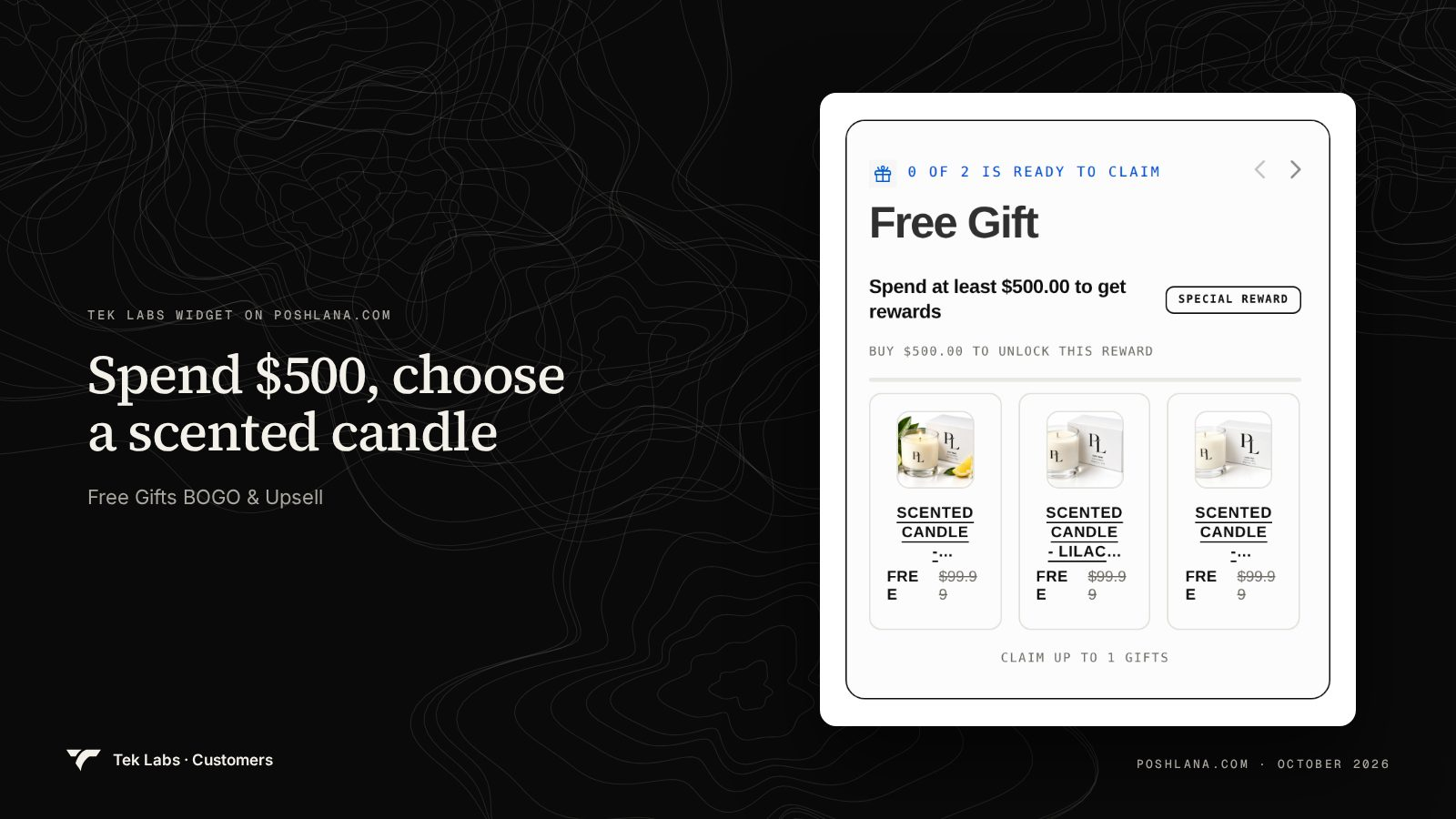
Guardrail: use the free-rider check from Worked example 1. Choice among three gifts also lets you steer shoppers to the gift with the best margin by listing it first, though the shopper decides.
2. Buy 2 get 1 free on one collection
This idea suits apparel and consumables where customers like several designs. Food Fight BJJ, a US jiu-jitsu apparel store, shows “Buy 2, get 1 free on rash guards, shorts and streetwear” in its announcement bar, alongside free US shipping on orders of $50 or more. The Food Fight BJJ customer page says the app restricts the free item to named collections and keeps the cheapest eligible item free, which keeps the margin predictable across different prints.

Build it with Buy X Get Y. Note what Shopify’s own Buy X get Y discount does not do: per the Shopify help center, customers must add all items to the cart manually, and the free item is never automatically added. If you want the free item to appear in the cart without the shopper adding it, you need an app that auto-adds. Our BOGO setup guide compares the options.
Guardrail: from Worked example 2, buy 2 get 1 free is a 33.3% effective discount. Make sure that is below your floor, and restrict it to one collection.
3. Quantity breaks, with a gift on the top tier
A “buy more, save more” table is easy to understand on a phone, and it raises units per order without a coupon code. The Tek Labs volume discount widget shows tiers on the product page, and a tier can carry a free gift.
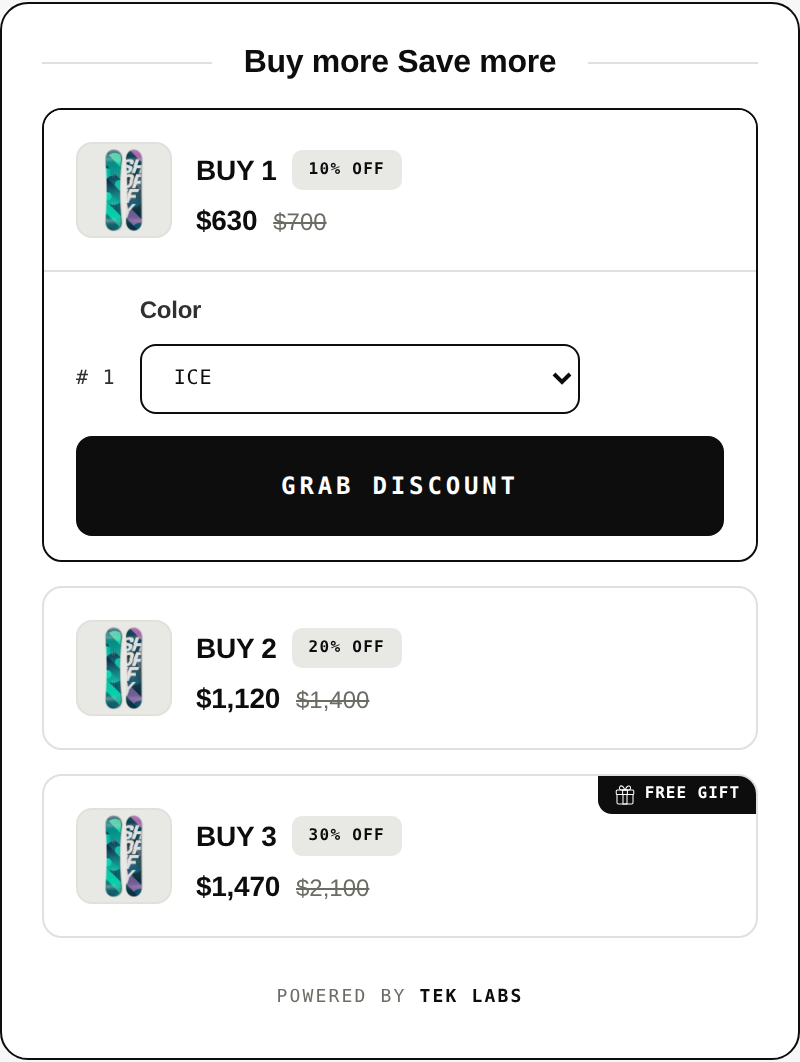
Hypothetical check: take the $40 item with a $16 cost again. A three-unit tier at 30% off is $84 in revenue against $48 in cost, so $36 of margin (42.9%), before adding a gift. A $7 gift takes it to $29. Decide whether the gift adds enough conversion to justify the extra cost, or make the third tier a plain discount.
4. A progress bar with free shipping first
Baymard’s list of checkout abandonment reasons puts extra costs such as shipping, tax and fees at 40%, the largest single reason, and shows 12% of shoppers could not see or calculate the total cost upfront. Free shipping above a threshold addresses both, and Shopify’s free shipping discount can be set to a minimum purchase amount that counts product prices only.
The milestone rewards bar in the Tek Labs app supports up to 6 milestones in a rule, where each reward can be a free gift, a cart discount or a shipping discount. A typical stepped plan for Monday: free shipping at the first tier, a 10% cart discount at the second, and a gift at the third. See the glossary entry on milestone rewards for the term.
Guardrail: set the free shipping tier above your average order value, not at it, or you give away shipping on orders that were already coming. Baymard’s 70.22% average abandonment rate also tells you why showing the total early matters.
5. A gift discount code popup for subscribers
For Thursday and Friday, a code revealed in a popup keeps a lean percentage offer away from the open web. The gift discount code feature shows a popup with a code and a sticky button.
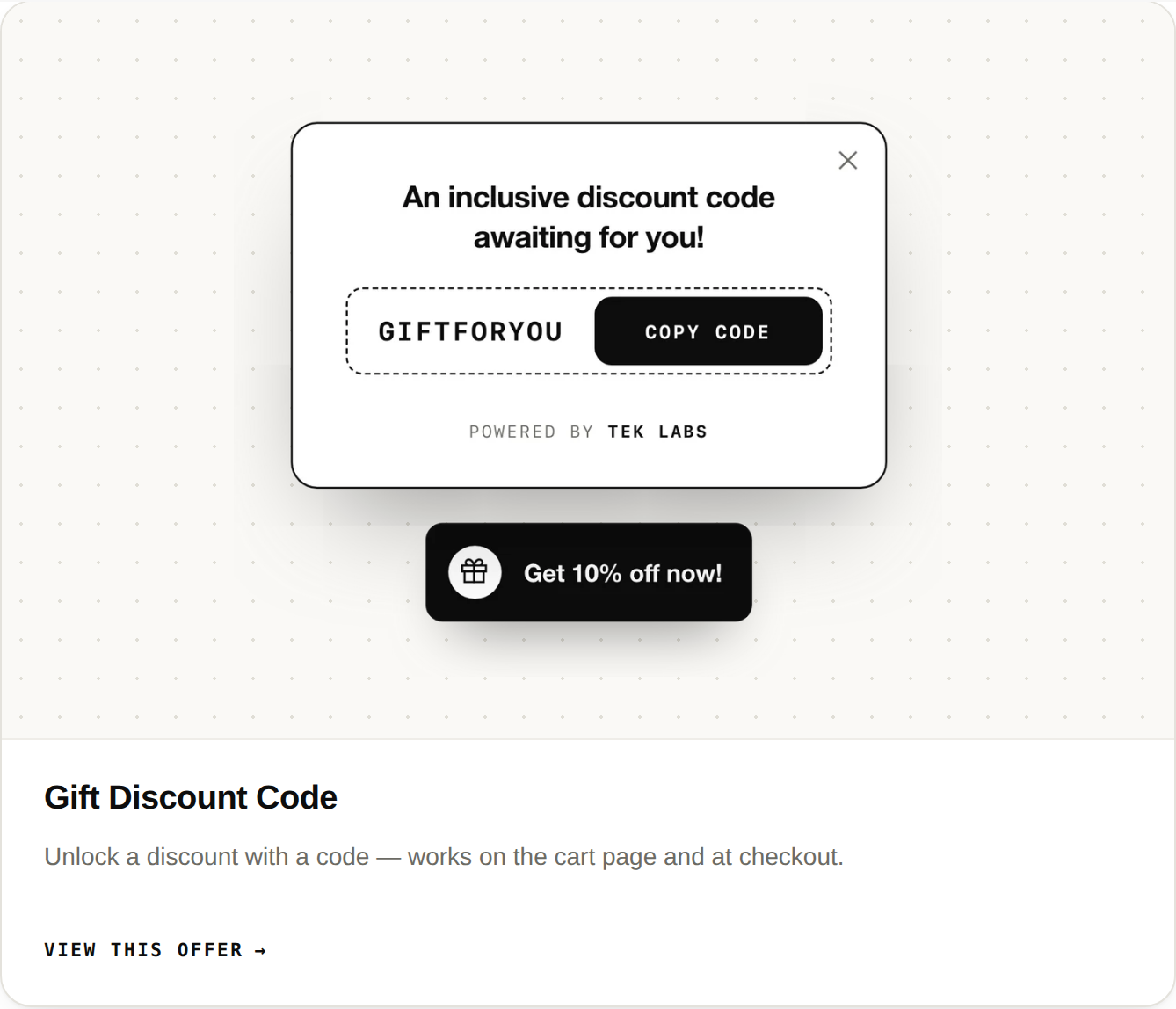
Guardrail: Shopify allows up to 5 product or order discount codes on one order, so decide whether this code may combine with an automatic gift, and test that on a real cart.
6. A one-click add-on after payment
Post-purchase offers are one of the few places a Cyber Monday order can grow after the shopper has committed. The Post Purchase Upsell app shows an offer right after payment, can use funnels for customer segments with up to two upsells and a downsell, and can show a countdown timer. Per the Shopify App Store listing, post-purchase and thank you page upsells do not need Shopify Plus, only the checkout editor does.
Two caveats from the feature page: Shopify’s limits mean the offer may not appear for orders paid with wallets or installment services, and Shopify’s Buy X get Y discounts created in the admin do not apply on the post-purchase page. That matters on Cyber Monday because Adobe measured $1.03 billion of buy now pay later spend on the day, so a share of your orders may skip the post-purchase screen. Put your most important offer before checkout, and treat the post-purchase add-on as a bonus.
Hypothetical math: a $15 add-on with a $6 product cost and $1.50 extra handling earns $7.50 per accepted offer. If 8% of 1,000 orders accept (an assumed rate, not a benchmark), that is 80 x $7.50 = $600 before payment fees.
7. A mix and match set for gift buyers
For a Sunday or Monday gift angle, Mix & Match Bundles lets shoppers build a set from groups you define, with a progress bar toward a higher discount. Keep the discount tiers within your floor and see our holiday gift bundles guide for pricing worked through.
Mobile considerations for Cyber Monday
With 57.5% of Cyber Monday sales on mobile in 2025, your offers must work on a small screen first. A checklist:
- Show the offer above the fold on the product page. The Tek Labs demo store’s mobile product header shows the offer text “Buy three, get two” and a “Today offers” tab before any product image.
- Keep sticky buttons from covering the add to cart button.
- Check that gift pickers and popups fit a 375-pixel-wide screen and can be dismissed.
- Test with a wallet payment such as Apple Pay or Shop Pay, which is how many mobile shoppers pay, and confirm your offer survives it.
- Keep the total visible. Baymard found that 12% of shoppers abandoned because they could not see or calculate the total cost upfront.
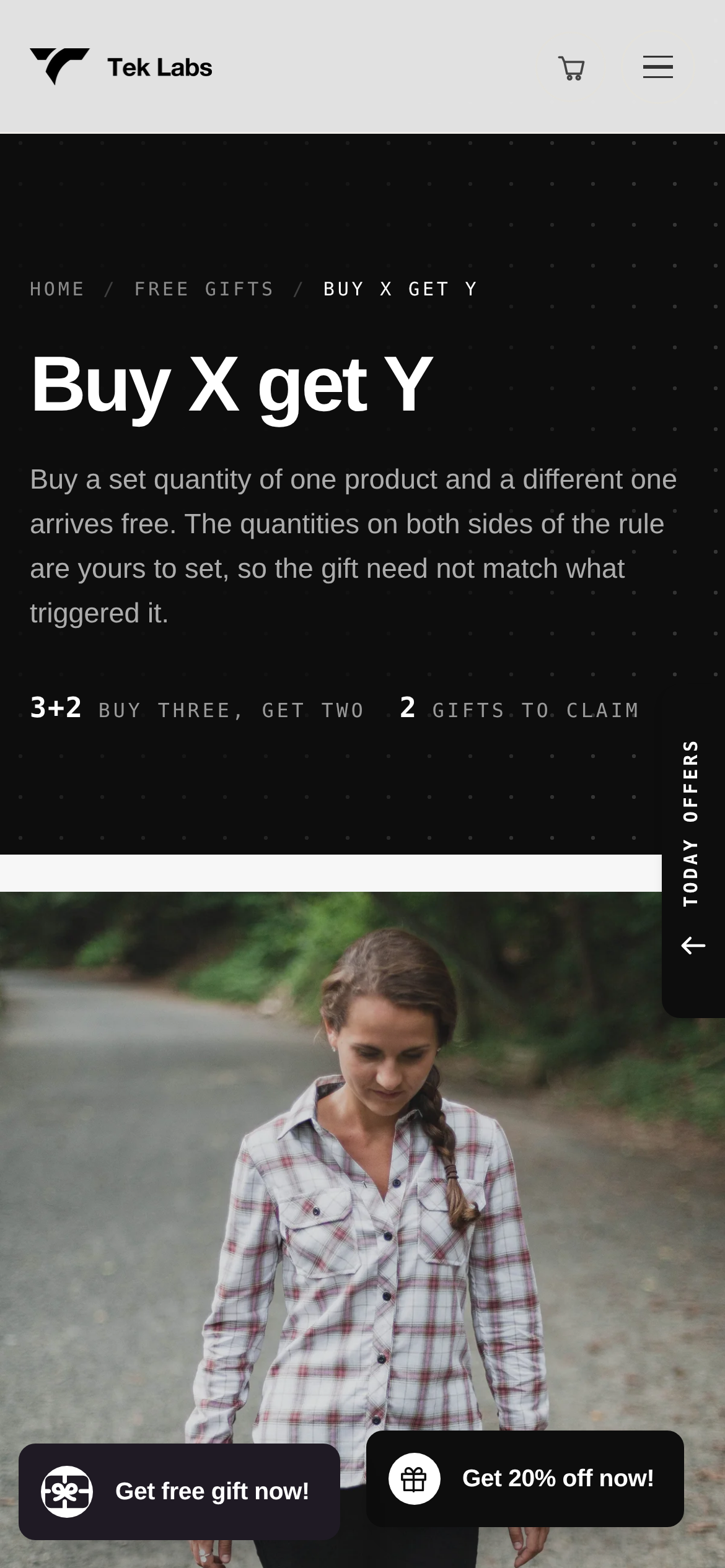
Two sticky buttons at the bottom, as in the screenshot, is a lot of competing prompts on a 375-pixel screen. If you run a gift and a discount code, pick one to be sticky.
Setting up your offers: a step-by-step plan
- Today to November 6: choose three offers. Use the day-by-day table, and make sure at least one is not a percentage discount.
- Run the math. Use worked examples 1 and 2 with your own numbers and your last Cyber Monday order-value distribution.
- Build each offer with start and end dates. In the Free Gifts BOGO & Upsell app, choose conditions, choose the reward, then preview and use Validate Offer, which checks the setup before you go live. Apply usage limits so an offer does not repeat per order unless you want it to.
- Set priority and stacking. Review offer priority and stacking and decide which offer wins when several qualify.
- Place a test order with Shopify’s Test payment gateway, per the Shopify help center. Note the caveat: customers cannot place live orders while payment providers are in test mode, so test off-peak and turn it off.
- Freeze changes by Tuesday, November 24. After that, only fix errors.
- Pre-schedule the Monday banner and email so no manual edit is needed at 8 pm, when Adobe measured the peak spend rate.
Cyber Monday QA checklist
| Check | How | Pass looks like |
|---|---|---|
| Offer start and end dates | Read the schedule in each offer | Each ends at the time shown on the page |
| Gift auto-add or choice | Qualify on desktop and phone | Gift appears once, price is free |
| Remove the qualifying item | Delete it from cart | Gift is removed, no free gift left behind |
| Discount code plus automatic offer | Apply the code on a qualifying cart | Result matches your stacking decision |
| Out of stock gift | Set gift stock to zero on a test product | Gift hidden or fallback shown |
| Wallet payment | Pay with a wallet on a phone | Order completes, offer applied |
| Post-purchase offer | Pay by card in test | Offer appears; skipped for wallets is expected |
| Free shipping tier | Cross the threshold | Rate shows as free for the right countries |
| Currency | Switch market on a test store | Thresholds convert as intended |
| Analytics | Place a test order | Order tagged or traceable to the offer |
The Free Gifts BOGO & Upsell app can hide out-of-stock gifts, auto-remove a gift when the condition is no longer met and lock the gift quantity in the cart, per its feature pages, so confirm those settings in the rows above.
Rules and wording that protect you
A “free” gift has to be described clearly. The FTC’s guide on “free” offers, 16 CFR 251.1, says all the terms, conditions and obligations should appear in close conjunction with the offer, and that consumers have a right to believe the merchant will not directly and immediately recover the cost of a free item by marking up the item they must buy. Put the minimum spend, the end date and any exclusions next to the offer, not in a footer.
On the psychology of free items, a Monash University study found that consumers’ willingness to pay after the promotion ended was higher when an item had been offered free than when it had been discounted, because a discounted price becomes an anchor. That is one reason a gift can protect your regular prices better than a deeper discount. One study is not a guarantee for your catalog.
Common mistakes
- Starting the Monday offer at the same threshold as Friday. Shoppers who saw Friday’s offer will compare.
- Setting a threshold at or below the average order value. Most orders qualify and you pay for every gift.
- Stacking by accident. A sitewide code plus a Buy X Get Y on the same product can behave differently on Plus and non-Plus plans.
- Editing during the evening peak. Adobe measured $16 million per minute between 8 pm and 10 pm on Cyber Monday 2025.
- Forgetting end times. An offer without an end date keeps running into December.
- No fallback gift. If the gift sells out, the offer should still make sense.
- Ignoring mobile. More than half of Cyber Monday revenue came from phones in 2025.
Putting it together
Choose three offers from the list, give each day one job, write down the margin floor and test on a phone. If a gift, tier or progress bar is part of your plan, Free Gifts BOGO & Upsell lets you build and schedule them in one app, and it has a free plan. For the wider season, our Black Friday free gift ideas cover the gifts themselves.
Frequently Asked Questions
When is Cyber Monday 2026?
Cyber Monday 2026 is Monday, November 30, three days after Black Friday on November 27 and four days after Thanksgiving on November 26. Many stores treat the whole span from Thanksgiving to Monday as Cyber Week.
What is the best Cyber Monday promotion for a small Shopify store?
For most small stores, a spend-threshold gift or a free shipping tier set above the average order value is safer than a deep sitewide percentage discount, because you pay for the gift only when the order grows. Run the free-rider check first, since orders that would qualify anyway add cost and no revenue.
Should Cyber Monday offers differ from Black Friday offers?
Yes, if you can afford the setup. A different offer gives returning visitors a new reason to buy, and Adobe’s 2025 data shows 57.5% of Cyber Monday sales came through mobile devices. Keep the Monday offer simple enough to read on a phone and give it a clear end time.
Can Shopify’s Buy X Get Y add the free item automatically?
No. Shopify’s help center states that customers must add all items to their cart manually and that the free or discounted item is never automatically added. An app that auto-adds the gift, such as the Free Gifts BOGO & Upsell app, handles that case.
How many offers should I run at once?
Two or three. Shopify allows up to 25 active automatic discounts and 5 product or order codes per order, but each combination needs a test. Fewer offers mean fewer ways for stacking to cut your margin below your floor.
Do post-purchase upsells work for every Cyber Monday order?
Not for all. Per the Post Purchase Upsell feature page, Shopify’s limits mean offers may not appear on orders paid with wallets or installment services. Place your key offer before checkout and use the post-purchase screen as an extra.